[This is an updated version of a post from 12/20/09: On How To Look For Medieval Pagans (Assuming You Actually Want To Find Them.)]
If we accept that there is room for doubt concerning the sincerity of Michael Psellos' claims to be a good Christian, then what? (If you have no idea what I am talking about, you might want to
look here.) Is there any way to resolve such doubts? And what about other possible cases of Byzantine crypto-Pagans, from Procopius (6th century) to Plethon (15th century)? And what of the even more tantalizing possibility of "dissident circles" of Byzantine Pagans (to borrow a phrase from Anthony Kaldellis, see below)?
 Richard Popkin
, in his seminal
The History of Scepticism, addresses similar questions concerning the religious allegiance of the so-called
libertins érudits. These were 17th century French intellectuals who are sometimes claimed to have been (or
accused of having been, depending on one's perspective) atheists. The intellectuals in question were all well known in their day, and they left behind voluminous writings. In addition to their own published writings we have impressions of them written by contemporaries and also private correspondences.
And yet despite such a great wealth of evidence, including the direct testimony of the individuals in question who all wrote a great deal on the subjects of philosophy and religion in particular, nevertheless, to this day there is reasonable doubt about the true religious feelings and allegiances of
les libertins érudits.
On the one hand, according to
Perez Zagorin, in his
Ways of Lying: Dissimulation, Persecution & Conformity in Early Modern Europe, "Nearly all modern writers have considered most of them [
les libertins érudits] to be unbelievers." [p. 325] This is generally assumed to be the most widely held opinion among those who care enough to have an opinion on the matter.
On the other hand, Richard Popkin (one of the leading modern scholars of scepticism), while acknowledging that his is a minority position, argues that "men like Naudé, La Mothe Le Vayer, and Gassendi [three prominent
libertins]
were sincere Christians (although, perhaps, not particularly fervent ones)." [p. 96 in
The History of Scepticism] Popkin argues, moreover, that the scepticism advocated by these men was not intended to undermine Christianity at all, but rather to defend, and even to define, a kind of liberal Catholicism against dogmatic Protestantism.

More important than Popkin's position on the religiosity of
les libertins, however, is the methodological approach that he not only employs, but that he very helpfully spells out for us:
I would certainly agree that the fear of persecution, as Leo Strauss has taught us, affects the way people write. The fear of prosecution would obviously lead people with critical views about established religion to be cautious in how they presented their beliefs and who they presented them to What had happened to Bruno and Vanini, both burned at the stake, would make a esprit fort think many times about what might happen if certain views were enunciated to the wrong parties. So it is easy to conceive that some people were leading double or triple if not quadruple lives and that these people would seek protection from the powerful figures of church and state. At the same time, these people would follow something like the steps presented in Strauss' book Persecution and the Art of Writing. They would write between the lines, they would make coded communications, or they would disguise their actual views while leaving people of similar attitude ways of finding their true meaning.
Considering the various disguises that people have, is it possible to really ascertain in any given case, what somebody actually believes? Besides the religious reasons people might have for disguising their true identities, we've learned over the last century from psychoanalysis and Freud that people are busy suppressing features of their real being. It may not really be possible to tell three hundred to four hundred years later what somebody believed if there is also a problem with knowing it right now. Nonetheless, we have to make judgements about this all the time in  determining who we can trust, who we can believe, who we want as our leaders in an election, and who want as mates, and so on. In all these cases, in spite of the most intense research, we could still be deceived. Scandals occur all the time about people who turn out to be different from what we thought. Religious figures turn out to be living nonreligious lives, political figures turn out to be other than how they have represented themselves. We are often disillusioned as further evidence emerges. Yet, unless we are going to live our lives in complete isolation from one another, we have no choice but to try and make good guesses about people's beliefs, real intentions, and real attitudes. In assessing people and their beliefs from the seventeenth century, we have less to go on, since we do not have eyewitness testimony that can be examined. We have documents, we have figures situated in a historical network, and we have a range of possible hypotheses as to how to evaluate the material. One has to examine what was said, to whom it was said, what contemporaries made of it, and what evidence has been uncovered since time passed.
I think the evidence concerning the libertins érudits is more compatible with some form of sincerity and some form of minimal Christian belief. The libertins érudits, who were very involved with the powers that were regulating expression in France at the time, never seemed to be worried, however, about the acceptability of their works. We have no evidence that the ecclesiastical or political powers were worried about their expressions. So I think it is hard to interpret their public statements as duplicitous without further evidence of their real intent. Nonetheless, we know, at least in Gassendi's case, that the author did no publish some of his works because he knew that some similar ones had been censored or forbidden.
[pp. 88-89]
At this point, Popkin shifts his focus to individual
libertins and also to issues specific to purported atheists in 17th century France. A little later on, he returns to a more general discussion of how to discern the truth in the face of possible dissembling:
The long tradition of assuming that there must have been duplicity in the writings of the libertins érudits depends, it seems to me, on the supposition that no other explanation of their views can be offered. But, as I have tried to indicate, another possibility exists, namely that men like Naude, La Mothe Le Vaye, and Gassendi were sincere Christians (although, perhaps, not particularly fervent ones). In the absence of completely decisive evidence as to the real intentions of these men, why should assume the worst (or the best?), that they were engaged in a conspiracy against Christendom? The overwhelming number of their contemporaries found no signs of insincerity. And one of the basic sources of the suspicion of libertinage in each case has been the friendship with the others; Naude was a friend of La Mothe Le Vayer and Gassendi; Gassendi was a friend of Naude and La Mothe La Vayer; and so on. If we knew definitely (1) that at least one of these men was a genuine libertin trying to undermine Christendom, and (2) that the others accepted his friendship because of (1), then the argument of guilt by association might be significant. But since it is possible that each of the men in question were a sincere fideist, and quite probably that Gassendi was, then nothing is indicated by the fact that these men, all to some extent involved in the affairs of the Church or the Christian state, with similar avowed sceptical views and fideistic theologies, were close friends. (One might mention that they were all, apparently, intimates of Father Mersenne, who has not, to my knowledge, ever been accused libertinage.) If one considers the libertins érudits without any preconceptions as to their intent, can we decide positively either from their views, or their careers, or the circle of religious and irreligious figures within which they moved, whether they were the center of a campaign against Christianity or part of a sincere movement with the Counter-Reformation aimed at undermining Protestantism through the advocay of fideism?
[pp. 95-96]
Popkin has proposed no less than nine different criteria to be applied in cases of persons suspected of secretly holding beliefs at variance with what they have stated publicly. Four of these are very general, and he groups them together neatly (on p. 89) in a single sentence:
"One has to examine what was said, to whom it was said, what contemporaries made of it, and what evidence has been uncovered since time passed."
(1) "what was said"
(2) "to whom it was said"
(3) "what contemporaries made of it"
(4) "what evidence has been uncovered since time passed"
The other five criteria ask more specific questions, and these are presented by Popkin less systematically, but in the course of the same argument:
(5) Alternative explanations that are consistent with an individual's public statements must be given sufficient consideration. Such explanations are to be preferred unless there is strong evidence for dissembling. Such strong evidence would be positive answers to one or (preferably) more of the following questions. [p. 96]
(6) Did those in question "make coded communications, or ... disguise their actual views while leaving people of similar attitude ways of finding their true message"? [p. 88]
(7) Do we know "definitely that at least one of these men was a genuine libertin trying to undermine Christendom"? [p. 96](8) In the case of such a person who can be clearly identified as a "genuine
libertin" were there others who "accepted his friendship because of" this genuine
libertinage? [p. 96]
(9) Is there "evidence that the ecclesiastical or political powers were worried about their [
les libertins érudits'] expressions"? [p. 89] That is, is there actual evidence that those who are today suspected of dissembling were seriously suspected of it by those who knew them first-hand?
Although Popkin is focusing on a specific group of suspected atheists during the 17th century in France, the approach he describes appears, to me, to be directly applicable to the question of Michael Psellos' religious identity, and that of suspected crypto-Pagans generally. Three things strike me as especially appealing about applying Popkin's criteria to suspected Byzantine crypto-Pagans:
(i) Popkin proposes these criteria in the course of
arguing against the claim of that the
libertins had engaged in dissimulation. If these criteria can be applied to motivate the opposite conclusion with respect to suspected Byzantine crypto-Pagans, the case is that much more convincing. That is to say, these are definitely not faux criteria cooked-up expressly to support claims about dissembling.
(ii) Popkin is addressing a different (but not altogether unrelated) issue of crypto-religiosity, therefore to the extent that it can be shown that these same criteria, originally intended to be applied to 17th century France, are applicable to cases of crypto-Paganism in Byzantium over a period stretching from the 6th to the 15th centuries, then a significant contribution has been made to the
general problem of religious dissembling and crypto-religiosity.
(iii) Popkin's criteria are consciously geared toward not just the question of
individuals engaged in dissembling, but of a purported
intellectual movement engaged in a collective, conscious and coordinated exercise in dissimulation.
In the (not too distant??)future I hope (!) to systematically apply these nine criteria to the cases of three different (but perhaps not unconnected?) "dissident circles" of putative Byzantine crypto-Pagans:
5th and 6th centuries, including:
John Lydus (490 - c. 570)
Procopius (c. 500 - c. 565)
11th and 12th centuries, including
Michael Psellos (c. 1017 - c. 1080)
John Italos (younger contemporary of Psellos)
14th and 15th centuries, including
George Gemistos Plethon (c. 1355 - c. 1453)
Juvenal (executed c. 1450) and the "Pagan underground" in Mistra
Before ending this post I will, as promised, briefly mention Anthony Kaldellis' work on anti-Christian (or at least "non-Christian") "dissident circles" in the first of the three periods listed above. The phrase itself comes from a 2004 paper of Kaldellis' published in
Florilegium: "Identifying dissident circles in sixth-century Byzantium: the friendship of Prokopios and Ioannes Lydos". (That article can be downloaded in pdf format from
here.) Therein, Kaldellis inquires into the identity of the intended "audience" of Prokopios' "Secret History", for, as Kalldellis puts it, "obviously someone must have read the work, or at least owned and copied it, between 551 [when it was written] and the tenth century [when it is mentioned in the
Souda]. More specifically, Prokopios must have had some readers in mind when he wrote it, men who he knew were as hostile to the regime as he was himself. It would not have been difficult to find them. Justinian was one of the most hated rulers in history ...."
A little later on, Kaldellis posits two likely suspects: the diehard Pagan Platonist philosopher Simplicius and Ioannes Lydos, who publicly professed to be a Christian. The article in question focuses on Lydos, while Kaldellis discusses the case of Simplicius in his subsequently published book-length study
Procopius of Caesarea: tyranny, history, and philosophy at the end of antiquity. I hope to return to this fascinating topic of who Prokopios' possible audience/co-conspirators might have been, but for now I will quote from Kaldellis' conclusion: "The
Secret History offers us the opportunity to link the chief writers of the age, to uncover the loose and fragile web of dissidence that bound historians, lawyers and jurists, professors and bureaucrats, to the last philosophers of antiquity."
Kaldellis also has another highly relevant paper with the self-explanatory title "The Religion of Ioannes Lydos," published in 2003 (also available in pdf format at
the page linked to above). A quote from that paper provides a fitting conclusion to this post:
In the eastern empire philosophical alternatives to Christianity continued to flourish well into the sixth century. Proklos and his students defined the shape of the Platonic tradition for the next 1300 years, through Psellos, Plethon, Bessarion, and Ficino. In the earlier part of his life, at least, Lydos could have found an extensive circle of men who remained loyal to the older tradition, including Agapios, Zosimos, Damakios and his students, and the prefect Phokas. There were no doubt others unknown to us, the targets of Justinian's laws against feigned Christianity. The most cultured men of the age, including the jurist Tribonianos and the historian Prokopios, have been suspected of belonging to this group and and should now be classified as non-Christians. So too were the historians Agathias of Myrina and Hesychios of Miletos, born in the 520s and 530s. There was a pagan intelligentsia in the sixth-century empire and much of it originated or carried on in the tradition of the centers of Greek philosophy, Athens and the western coast of Asia Minor.


 An ancient tale tells the story of a foolish young man whose blind lust for magical power leads him to accidentally turn himself into a donkey (instead of a bird, which had been his goal).
 But soon after dark, he awakes suddenly, and, lifting up his head (still that of an ass), he sees the full moon rising above the sea. Now Lucius had never been a really wicked person. Certainly he was self-centered, short sighted, and morally lax. Nevertheless, he was still, at least in a very limited way, something like a good Pagan in the widest and most generous sense, and also, way down deep inside, a decent human being in spite of his many faults (think Titus Pullo in HBO's Rome).
"Blessed Queen of Heaven, whether you are pleased to be known as Ceres, the original harvest mother who in joy at the finding of your lost daughter Proserpine abolished the rude acorn diet of our forefathers and gave them bread raised from the fertile soil of Eleusis; or whether as celestial Venus, now adored at sea-girt Paphos, who at the time of the first Creation coupled the sexes in mutual love and so contrived that man should continue to propagate his kind for ever; or whether as Artemis, the physician sister of Phoebus Apollo, reliever of the birth pangs of women, and now adored in the ancient shrine at Ephesus; or whether as dread Proserpine to whom the owl cries at night, whose triple face is potent against the malice of ghosts, keeping them imprisoned below earth; you who wander through many sacred groves and are propitiated with many different rites—you whose womanly light illumines the walls of every city, whose misty radiance nurses the happy seeds under the soil, you who control the wandering course of the sun and the very power of his rays—I beseech you, by whatever name, in whatever aspect, with whatever ceremonies you deign to be invoked, have mercy on me in my extreme distress, restore my shattered fortune, grant me repose and peace after this long sequence of miseries. End my sufferings and perils, rid me of this hateful four-footed disguise, return me to my family, make me Lucius once more. But if I have offended some god of unappeasable cruelty who is bent on making life impossible for me, at least grant me one sure gift, the gift of death.”
 After having poured his heart out to the Goddess in this way, Lucius lay back down again and slept. And dreamed:
the boss of a shield; but part of it hung in innumerable folds, the tasseled fringe quivering. It was embroidered with glittering stars on the hem and everywhere else, and in the middle beamed a full and fiery moon.
Some know me as Juno, some as Bellona of the Battles; others as Hecate, others again as Rhamnubia, but both races of Ethiopians, whose lands the morning sun first shines upon, and the Egyptians who excel in ancient learning and worship me with ceremonies proper to my godhead, call me by my true name, namely, Queen Isis. I have come in pity of your plight. I have come to favor and aid you. Weep no more, lament no longer; the hour of deliverance, shone over by my watchful light, is at hand! ..."
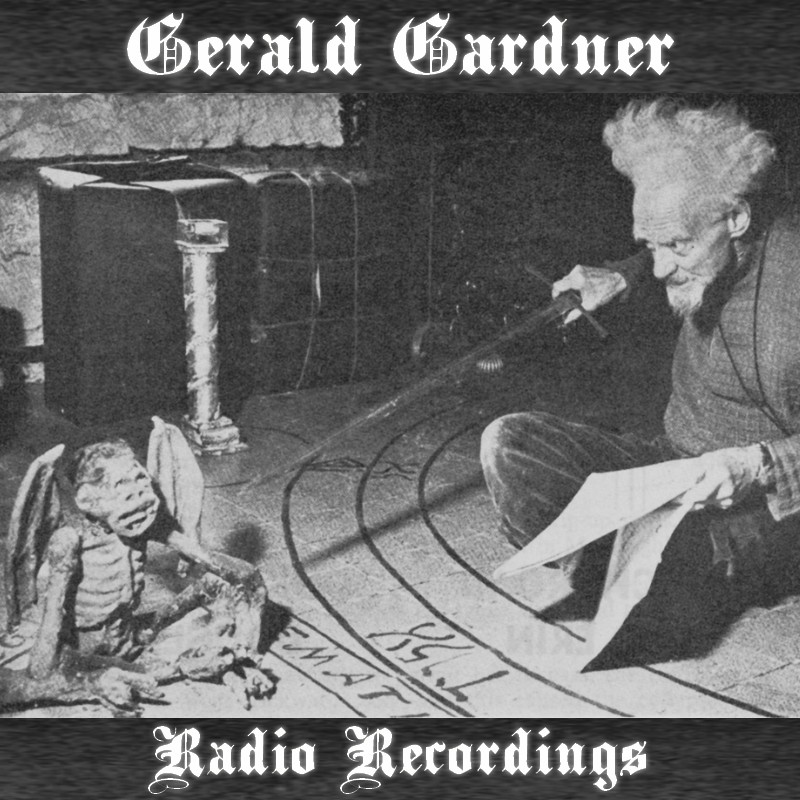 The story of Lucius was immortalized by the writer Apuleius in his Latin novel The Metamorphoses (aka "The Golden Ass"). Eighteen centuries later, Gerald Gardner's Witchcraft Today (the pdf of the complete book can be viewed here, and if for any reason that link doesn't work, just do a google search on something like "gardner witchcraft today pdf") was published, announcing to the world that the ancient worship of the Goddess was still alive. Therein Gardner explains that he is oathbound not to "detail the rites and prayers" of the Wiccan religion. But he can tell us that when an initiation rite is about to start there is first read "a charge", beginning as follows:
  Gardner then states that these words show the influence of "a similar charge" that came from "the Romans" and/or "the ancient mysteries". The cult of Isis was, of course, an ancient mystery religion especially popular among Romans. Apuleius was a prominent Roman citizen, and archaeologists have discovered the remains of Roman era cultic sites dedicated to the Goddess Isis in Britain. Gardner even explicitly mentions Apuleius' Metamorphoses in the Forward to Witchcraft Today.
Yet like Cain's daughter thou shalt never be,
"For the true God the Father is not yours;


 That "no less than four different cultural streams" provide a continuous connection between ancient and modern Paganism: (a) practitioners of ritual (learned) magic, (b) practitioners of popular magical traditions ("cunning folk"), (c) those who participate in "folk rites", and (d) lovers of Pagan art, literature, and philosophy.
 (i) That all of those who were part of the "four streams" mentioned above were purely and only Christian, and cannot in any way be considered to have been "Pagan". This includes, most emphatically, all of the victims of the Burning Times.
 Do Buddhists believe in God? (5/24/09)

 R. Joseph Hoffmann's sister died recently. He has written a moving tribute to her at his blog. I think this eulogy is well worth reading not only to learn about the remarkable woman described therein by her little brother, but also because it provides a profoundly humane and skillful example of that most important and difficult of philosophical exercises: meditation on death.
 0. Caveat meditator.
 The Buddha showed genuine respect for the ancient spiritual traditions of his native land. He spent many years studying under the two most famous meditation masters alive at the time. He was deeply appreciative of what he learned from these teachers, and made extensive use of what he had been taught, even though he eventually decided that he needed to continue his search on his own. Years later, when he was nearing the culmination of his spiritual quest, Mara, the God of Deception, made one last attempt to prevent the Buddha from attaining final and complete Enlightenment. In response, the Buddha turned to the traditional Vedic Earth Goddess, Prthivi, who answered the Buddha's prayer by rising up from the depths of the ocean and wringing the water out her hair. With this simple gesture, Prthivi caused a great flood that swept away Mara and all of his demonic hordes. This is why the Buddha is often depicted reaching down and touching the earth, showing how he called upon the Earth Goddess at this most crucial moment.
 Compassion, Kuan Yin, is one of the most ubiquitous features of Buddhism throughout east Asia, including China, Korea, Japan and Vietnam. The Goddess Tara is, if anything, even more prominent in the Tantric Buddhism of Tibet, Mongolia, and other parts of central Asia. Tara is revered as the mother of all Buddhas (and also of all other beings, who are all potential Buddhas), the embodiment of pure awareness, and even as Ultimate Reality itself.
 Unlike Christianity, but like many forms of ancient and modern Paganism, Buddhism views the physical universe as eternal, uncreated, alive and conscious. As it spread peacefully throughout all of Asia, Buddhism never displaced the more ancient forms of religion it encountered, and these inevitably included the worship of spirits and Gods associated with Nature. In Korea, Buddhist temples always include statues, shrines, or other specific places dedicated to the reverence for the ancient Mountain God, Sahn Shin. In Japan, Buddhism and the ancient nature religion of Shinto exist in a truly symbiotic relationship. Religion scholars who specialize in China have given up trying to clearly demarcate Buddhism from ancient forms of "animism" and ancestor worship. Throughout Central Asia (Tibet, Mongolia, etc), the lines separating Buddhism from Shamanism are all but nonexistent. Throughout Southeast Asia, most Theravadin Buddhists also believe in and practice various forms of "spirit religion" alongside the Buddhadharma. Sometimes one finds purists who would like to purge Buddhism of the influence of Gods, spirits, "demons", "magic" and so forth, but such efforts never succeed, and in both the attempt and the failure they only serve to accentuate the luxuriant diversity and tolerance of Buddhism.
 Although Socrates would not approve, instead of attempting to actually define magic, I will simply list eight things that are widely accepted as being magical, and briefly give an example of each of these magical practices in Buddhism.
 Jeffrey Hopkins is a Buddhist scholar of some note. Among other things he served as His Holiness the Dalai Lama's chief English interpreter for a decade (from 1979 to 1989). Among his numerous publications is a book with the self-explanatory title Sex, Orgasm and the Mind of Clear Light: The Sixty-Four Acts of Gay Male Love. One of the latter chapters in that book is titled, "Why Tibetan Buddhism Is Sex-Friendly," on which subject, Hopkins has this to say:
  Until very recently (in historical terms) it was not possible for people living in the West to freely explore non-Christian religious traditions. As this freedom was slowly recovered, there were two natural inclinations among those who were adventurous enough to take advantage of it: (1) to explore "our own" pre-Christian religious traditions (Paganism), and (2) to explore religions found in other parts of the world that have not been Christianized (especially Buddhism and Hinduism). As a result, the recent histories of western Buddhism and modern Paganism are inextricably entwined with one another. In particular, the pioneers of Buddhism in the West often turn out to be important figures in the foundations of modern Paganism as well. It is in the nature of pioneers to cross boundaries, and so figures like Alan Bennett (who taught Qabalah to Aleister Crowley and became one of the first Europeans to ever ordain as a Buddhist monk), and Henry Steel Olcott (a military officer, journalist, lawyer, occultist and Theosophist from New Jersey, who is honored with his own holiday in the Buddhist nation of of Sri Lanka) defy any simplistic categorization. Rick Fields devotes a chapter to some of these genre-bending Occultist/Buddhist pioneers, whom he calls "White Buddhists", in his now classic study of the history of Buddhism in America, How the Swans Came to the Lake.
 10. Buddhism and Hinduism have been far more successful than other religions in resisting the spiritual aggression of Christianity and Islam.

 Richard Popkin, in his seminal The History of Scepticism, addresses similar questions concerning the religious allegiance of the so-called libertins érudits. These were 17th century French intellectuals who are sometimes claimed to have been (or accused of having been, depending on one's perspective) atheists. The intellectuals in question were all well known in their day, and they left behind voluminous writings. In addition to their own published writings we have impressions of them written by contemporaries and also private correspondences.
 More important than Popkin's position on the religiosity of les libertins, however, is the methodological approach that he not only employs, but that he very helpfully spells out for us:


