When polled, how many Muslims freely acknowledge that they approve of Isis?
4% of Indonesians have a favorable opinion of Isis. That's 250M x 0.04 = 10 million Isis supporters.
8% of Turks have a favorable opinion of Isis. That's 75M x 0.08 = 6 million Isis supporters.
11% of Malaysians have a favorable opinion of Isis. That's 30M x 0.11 = 3 million Isis supporters.
9% of Pakistanis have a favorable opinion of Isis. That's 182M x 0.09 = 16 million Isis supporters.
So, the "good news" is that in just four Muslim majority countries there are 35 million supporters of Isis.
Source (link to to Pew Research website):
In nations with significant Muslim populations, much disdain for ISIS

Showing posts with label islam. Show all posts
Showing posts with label islam. Show all posts
Wednesday, November 18, 2015


Sunday, October 5, 2014
Fact Checking Reza Haslan on Human Rights in Muslim Majority Countries (Other Than Iran and Saudi Arabia)

Go here to see what Aslan says in his own words (that link has both the original unedited video and the full transcript). Aslan was responding to what Bill Maher had said in an earlier interview, and that interview (again, the full undedited video along with full transcript) is here. The money-quote from Bill Maher is, "[Islam is] the only religion that acts like the Mafia that will fucking kill you if you say the wrong thing, draw the wrong picture, or write the wrong book."
Aslan claims that the "bigoted" negative view of Islam voiced by Bill Maher is dramatically disproven by the specific cases of Indonesia, Malaysia, Bangladesh and Turkey. One has to wonder what the fuck Aslan was smoking when he said this. Indonesia is a country where over 70% of the population is in favor of Sharia law, Malaysia is the country that kidnapped Hamza Kashgari and extradited him back to Saudi Arabia, Bangladesh has a sinister history of murderous violence against it's Hindu and Buddhist minorities, and Turkey, while once something of a paragon of genuine "moderate" Islam, is now home to one of the most popular and politically powerful fundamentalist mass movements in the contemporary Islamic world.
Indonesia:
- Rights Rollback for Religious Minorities, Women: Leadership Fuels Intolerance, Emboldens Abusers
- New Islamic Laws Violate Rights: Same-Sex Relations Banned; Whipping Imposed as Punishment
- Seven in 10 Indonesian Muslims want sharia law
- No need for women’s rights movement in Malaysia, says Prime Minister
- BN politics the bane of women’s rights
- Malaysian Lesbians Arrested Under Sharia
- Bangladesh tumbled backwards on human rights in 2013
- Bangladesh minorities 'terrorised' after mob violence
- Bangladesh: Wave of violent attacks against Hindu minority
- Turkey accused of gross human rights violations in Gezi Park protests
- Turkey’s Human Rights Rollback
- Turkey: YouTube Block Violates Free Expression
.

Wednesday, April 24, 2013
"Secrets of Britain's Sharia Councils"
This is a very educational documentary. It turns out that if a woman is beaten by her her husband, this might simply be his way of telling her that she needs to improve her cooking skills. And so forth.
Friday, August 31, 2012
The "Religion of Peace" Naked At Last?
 Best selling author Tom Holland has written a book about the early history of Islam. Barnaby Rogerson, writing for the Independent, nicely summarizes the gist of what Holland is up to:
 This is a history of the history as it were, telling how the warrior-dominated Empires of Antiquity were transformed into the first monotheistic states; how the old inclusive conquest states, with their comparatively simple desire for submission and tribute were replaced by states which imposed systems of total belief and demanded exclusive loyalty.Rogerson begins his review by saying "This is a book of extraordinary richness. I found myself amused, diverted and enchanted by turn," and ends it with "Even with these slight flaws In the Shadow of the Sword remains a spell-bindingly brilliant multiple portrait of the triumph of monotheism in the ancient world." So it appears that he rather liked it.
(link to full review dated March 30)
Anthony Sattin, writing for the Guardian, was also very positive about Holland's book, which he characterized as "brilliantly provocative".
Here is the concluding paragraph of Sattin's review:
The Qur'an anticipated the day of Holland's coming (or someone very like him). Sura 25 instructs Muslims to counter the claim that "these are fables of the ancients which he has got someone to write down for him" with the insistence that it was "revealed by Him Who knows every secret". For believers, these words are proof enough of the veracity of the Qur'an. Some have gone further and used them as justification for intellectual, legal and physical attacks on people who claim otherwise. The lives of some people who have dared to question the historicity of the prophet Muhammad and the Qur'an have been ruined, even ended. We must hope that Holland is spared their wrath and that his excellent book will be lauded, as it should be, for doing what the best sort of books can do – examining holy cows.Ziauddin Sardar, writing for the New Statesman, spews forth a predictable apolgetic hit-job in his "review" of Holland's book. Sardar frames his attack in terms of what Holland is "ostensibly ... concerned with", as opposed to what Holland's "real aim" is. Further, Sardar attacks Holland's sources, Holland's colleages, anyone who agrees with Holland, and the horse he rode in on. In all, it is exactly the kind of obscurantist tripe that one expects from a Left-Islamic cultural warrior like Sardar. Here is a link to Sardar's full review, dated April 25.
(link to full review, dated April 5)
Not wanting to be outdone in the political-correctness department by the good Fabians over at the New Statesman, the Guardian decided to publish another review. This time it was the turn of G.W. Bowersock, one of the world's premier historians of late antiquity, who wrote sneeringly that:
Holland came to his work on Islam unencumbered by any prior acquaintance with its fundamental texts or the scholarly literature. He modestly compares himself to Edward Gibbon, whom he can call without the slightest fear of contradiction 'an infinitely greater historian than myself'.Bowersock ends his review by openly questioning Holland's motives and personal character. This kind of unhinged attack is nothing new for Bowersock, as those familiar with his obsessive hatred for the Emperor Julian are already aware. While generally a staid and reliable scholar, Bowersock reacts to certain subjects the way Rigby Reardon (in Dead Men Don't Wear Plaid) reacts to any mention of "the cleaning woman".
(link to full review dated May 4)
Fortunately, Tom Holland was given the opportunity to respond to Bowersock's screed. This excerpt gives a taste of Holland's highly effective and dignified rejoinder:
If I did not cite a manuscript in the Bibliothèque Nationale dated by the French scholar François Déroche to the third quarter of the seventh century, it was not – as Bowersock charges – because I had "missed" it, but because the dating of early Qur'an manuscripts is notoriously a work in progress. Déroche himself, for instance, originally placed the origins of the Bibliothèque Nationale manuscript in the early eighth century – and there are other scholars who still do. Nor, unfortunately, does carbon dating offer any greater certainty. At a conference in 2010, the same Christian Robin cited by Bowersock in his review revealed that a preliminary carbon dating of some pages from one of the Sana'a palimpsests had given dates in the late 500s – a most awkward misfire. I hope, then, that it will be understandable why, in a book aimed at a general readership, I opted not to venture into such a quagmire.
(link to full response, dated May 7)
David Frum very much liked Holland's book. Frum is an interesting guy who went from being a celebrated right-wing pundit to, well, the kind of guy who resigns/gets fired from the American Enterprise Institute because he was sick and tired of the Republican obstructionism in Washington, especially with respect to President Obama's Affordable Care Act. This is important to note because it means that Frum is definitely not a knee-jerk reactionary who simply spouts well-rehearsed xenophobic talking points any time the subject of Islam is mentioned.
The beginning of Frum's review (written for the Daily Beast) is worth quoting at length:
"Over the past century, modern scholarship has pretty thoroughly debunked the standard story of the birth of Islam.
The Quran was assembled over a century or more, not revealed in one go.
The religion we call Islam coalesced after the Arab Conquest of what is now Syria and Iraq, not before.
We have no reliable biographical details at all of the life of the prophet now known as Muhammad, but if he existed at all, he was likely a native of someplace in what is now Jordan, not the Hijaz, much less Mecca.
I could go on, but you get the idea.
Until now, however, if you wanted more than just an "idea," you faced a challenging time. The revisionist scholars of Islam wrote in a style that was at best highly technical and at worst deliberately obscure. Unlike the gleeful debunkers of the self-told histories of Christianity and Judaism, revisionists such as John Wansborough and Patricia Crone have taken enormous pains to tread delicately.
The scrupulosity of these scholars however has left the largest part of the reading public to popularizers like Karen Armstrong, who continue to spread long-exploded versions of Islamic history as if the explosions had never been detonated. Those unwilling to struggle through academic texts have long needed a guide to the story of Islam as it's understood by those with the fullest access to the latest linguistic and archaeological evidence. Now at last in Tom Holland's In the Shadow of the Sword, they finally have it."
(link to full review, dated June 4)
Other reviews:
- Review by Michael Scott writing for the Telegraph, April 3
- Review by Dan Jones writing for the Telegraph, April 5
- Review by Richard Miles writing for the Financial Times, April 7
- Review by Malise Ruthven writing for the Wall Street Journal, May 11
- Coverage by NPR staff, June 3
Finally, Tom Holland's own website has a collection of blurbs from various reviews, some of which are not included in this post.
Tuesday, July 24, 2012
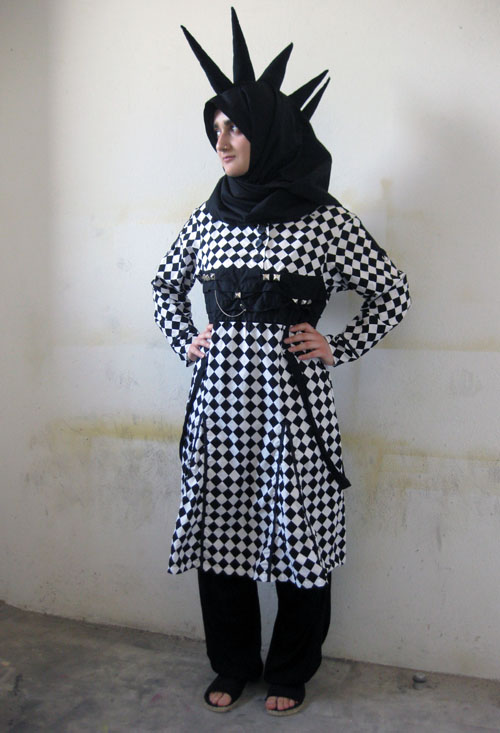
Covered In .... Spikes?!?!
.
Submitted for your approval:


many of these images were found at the website of Kristina Ask, who has collaborated with Tesnim Sayar and appears in many of the photos with her:
http://www.kristinask.net/ASK_TESNIM/TAQWACORE.html
images also found here:
http://mydisguises.com/2011/08/25/muslim-punk-fashion/
and here:
http://www.google.com/search?&q=tesnim%20sayar
And here is a portrait of Tesnim Sayar by Nadia Karroue:

And here is an article about Tesnim Sayar written by a "Buddhist Geeky Feminist":
http://postmodernismruinedme.tumblr.com/post/22164193206/taqwaacore-tesnim-sayar-is-a-muslim-punk-she
Excerpt from the above:
Flag design by Kristina Ask:

Submitted for your approval:




many of these images were found at the website of Kristina Ask, who has collaborated with Tesnim Sayar and appears in many of the photos with her:
http://www.kristinask.net/ASK_TESNIM/TAQWACORE.html
images also found here:
http://mydisguises.com/2011/08/25/muslim-punk-fashion/
and here:
http://www.google.com/search?&q=tesnim%20sayar
And here is a portrait of Tesnim Sayar by Nadia Karroue:

And here is an article about Tesnim Sayar written by a "Buddhist Geeky Feminist":
http://postmodernismruinedme.tumblr.com/post/22164193206/taqwaacore-tesnim-sayar-is-a-muslim-punk-she
Excerpt from the above:
“I go with it, because I think it’s cool and fits me. I have not designed it to provoke. But my message is also that one should refrain from thinking that Muslim girls are sitting at home and are boring,” says Tesnim in the Youth House on Dortheavej in Copenhagen.
Flag design by Kristina Ask:

Wednesday, July 18, 2012
Keeping The Meat Safe: My response to "Covered In Light"
[I am reposting this, from April of last year (link to original), in response to ridiculous attempts being made now by some Pagans to legitimize one of the most obvious and deservedly hated symbols of oppression in the modern world: the "veil". If you have no idea what I am talking about, count yourself very fortunate.]
 The following article by Taslima Nasreen was first published on January 22, 2007 by OutlookIndia.Com. You can download it from her website here (clicking that link will go directly to the pdf).
In February of 2010 a newspaper in the state of Karnataka, India, published a translation of the article in the Kannada language (the article was originally written in English). This was done without Nasreen's participation or even her knowledge.
The publication of the unauthorized translation of the article led to several days of bloody rioting by Muslims in the districts of Shimoga and Hassan. At least two people died in these riots and many more were injured. Rioters also burned vehicles and threw stones at buses and shops (source).

I shall unloose --
From the small jeweled
Doll he guards like a heart --
The lioness,
The shriek in the bath,
The cloak of holes.
[Purdah, by Sylvia Plath]
From the small jeweled
Doll he guards like a heart --
The lioness,
The shriek in the bath,
The cloak of holes.
[Purdah, by Sylvia Plath]
 The following article by Taslima Nasreen was first published on January 22, 2007 by OutlookIndia.Com. You can download it from her website here (clicking that link will go directly to the pdf).
In February of 2010 a newspaper in the state of Karnataka, India, published a translation of the article in the Kannada language (the article was originally written in English). This was done without Nasreen's participation or even her knowledge.
The publication of the unauthorized translation of the article led to several days of bloody rioting by Muslims in the districts of Shimoga and Hassan. At least two people died in these riots and many more were injured. Rioters also burned vehicles and threw stones at buses and shops (source).
Let's Think Again About The Burqa
The Quran does prescribe purdah. That doesn't mean women should obey it.
TASLIMA NASREENMy mother used purdah. She wore a burqa with a net cover in front of the face. It reminded me of the meatsafes in my grandmother's house. One had a net door made of cloth, the other of metal. But the objective was the same: keeping the meat safe. My mother was put under a burqa by her conservative family. They told her that wearing a burqa would mean obeying Allah.
Women too have sexual urges. So why didn't Allah start the purdah for men? Clearly, He treated them on unequal terms.
And if you obey Allah, He would be happy with you and not let you burn in hellfire. My mother was afraid of Allah and also of her own father. He would threaten her with grave consequences if she didn't wear the burqa. She was also afraid of the men in the neighbourhood, who could have shamed her. Even her husband was a source of fear, for he could do anything to her if she disobeyed him.As a young girl, I used to nag her: Ma, don't you suffocate in this veil? Don't you feel all dark inside? Don't you feel breathless? Don't you feel angry? Don't you ever feel like throwing it off? My mother kept mum. She couldn't do anything about it. But I did. When I was sixteen, I was presented a burqa by one of my relatives. I threw it away.
The custom of purdah is not new. It dates back to 300 BC. The women of aristocratic Assyrian families used purdah. Ordinary women and prostitutes were not allowed purdah. In the middle ages, even Anglo-Saxon women used to cover their hair and chin and hide their faces behind a cloth or similar object. This purdah system was obviously not religious. The religious purdah is used by Catholic nuns and Mormons, though for the latter only during religious ceremonies and rituals. For Muslim women, however, such religious purdah is not limited to specific rituals but mandatory for their daily life outside the purview of religion.A couple of months ago, at the height of the purdah controversy, Shabana Azmi asserted that the Quran doesn't say anything about wearing the burqa. She's mistaken. This is what the Quran says:
"Tell the faithful women that they must keep their gaze focused below/on the ground and cover their sexual organs. They must not put their beauty and their jewellery on display. They must hide their breasts behind a purdah. They must not exhibit their beauty to anybody except their husbands, brothers, nephews, womenfolk, servants, eunuch employees and children. They must not move their legs briskly while walking because then much of their bodies can get exposed." (Sura Al Noor 24:31)
"Oh nabi, please tell your wives and daughters and faithful women to wear a covering dress on their bodies. That would be good. Then nobody can recognise them and harrass them. Allah is merciful and kind." (Sura Al Hijaab 33: 59)Even the Hadis --a collection of the words of Prophet Mohammed, his opinion on various subjects and also about his work, written by those close to him-- talks extensively of the purdah for women. Women must cover their whole body before going out, they should not go before unknown men, they should not go to the mosque to read the namaaz, they should not go for any funeral.
There are many views on why and how the Islamic purdah started. One view has it that Prophet Mohammed became very poor after spending all the wealth of his first wife. At that time, in Arabia, the poor had to go to the open desert and plains for relieving themselves and even their sexual needs. The Prophet's wives too had to do the same. He had told his wives that "I give you permission to go out and carry outyour natural work". (Bukhari Hadis first volume book 4 No. 149). And this is what his wives started doing accordingly. One day, Prophet Mohammed's disciple Uman complained to him that these women were very uncomfortable because they were instantly recognisable while relieving themselves. Umar proposed a cover but Prophet Mohammed ignored it. Then the Prophet asked Allah for advice and he laid down the Ayat (33:59) (Bukhari Hadis Book 026 No. 5397).
This is the history of the purdah, according to the Hadis. But the question is: since Arab men too relieved themselves in the open, why didn't Allah start the purdah for men? Clearly, Allah doesn't treat men and women as equals, else there would be purdah for both! Men are higher than women. So women have to be made walking prisons and men can remain free birds.Another view is that the purdah was introduced to separate women from servants. This originates from stories in the Hadis. One story in the Bukhari Hadis goes thus: After winning the Khyber War, Prophet Mohammed took over all the properties of the enemy, including their women. One of these women was called Safia. One of the Prophet's disciples sought to know her status. He replied: "If tomorrow you see that Safia is going around covered, under purdah, then she is going to be a wife. If you see her uncovered, that means I've decided to make her my servant."
The third view comes from this story. Prophet Mohammed's wife Ayesha was very beautiful. His friends were often found staring at her with fascination. This clearly upset the Prophet. So the Quran has an Ayat that says, "Oh friends of the prophet or holy men, never go to your friend's house without an invitation. And if you do go, don't go and ask anything of their wives". It is to resist the greedy eyes of friends, disciples or male guests that the purdah system came into being. First it was applicable to only the wives of the holy men, and later it was extended to all Muslim women. Purdah means covering the entire body except for the eyes, wrist and feet. Nowadays, some women practise the purdah by only covering their hair. That is not what is written in the Hadis Quran. Frankly, covering just the hair is not Islamic purdah in the strict sense.In the early Islamic period, Prophet Mohammed started the practice of covering the feet of women. Within 100 years of his death, purdah spread across the entire Middle East. Women were covered by an extra layer of clothing. They were forbidden to go out of the house, or in front of unknown men. Their lives were hemmed into a tight regime: stay at home, cook, clean the house, bear children and bring them up. In this way, one section of the people was separated by purdah, quarantined and covered.
Why are women covered? Because they are sex objects. Because when men see them, they are roused. Why should women have to be penalised for men's sexual problems? Even women have sexual urges. But men are not covered forthat. In no religion formulated by men are women considered to have a separate existence, or as human beings having desires and opinions separate from men's. The purdah rules humiliate not only women but men too. If women walk about without purdah, it's as if men will look at them with lustful eyes, or pounce on them, or rape them. Do they lose all their senses when they see any woman without burqa?
My question to Shabana and her supporters, who argue that the Quran says nothing about purdah is: If the Quran advises women to use purdah, should they do so? My answer is, No. Irrespective of which book says it, which person advises, whoever commands, women should not have purdah. No veil, no chador, no hijab, no burqa, no headscarf. Women should not use any of these things because all these are instruments of disrespect. These are symbols of women's oppression. Through them, women are told that they are but the property of men, objects for their use. These coverings are used to keep women passive and submissive. Women are told to wear them so that they cannot exist with their self-respect, honour, confidence, separate identity, own opinion and ideals intact. So that they cannot stand on their own two feet and live with their head held high and their spine strong and erect.Some 1,500 years ago, it was decided for an individual's personal reasons that women should have purdah and since then millions of Muslim women all over the world have had to suffer it. So many old customs have died a natural death, but not purdah. Instead, of late, there has been a mad craze to revive it. Covering a woman's head means covering her brain and ensuring that it doesn't work. If women's brains worked properly, they'd have long ago thrown off these veils and burqas imposed on them by a religious and patriarchal regime.
What should women do? They should protest against this discrimination. They should proclaim a war against the wrongs and ill-treatment meted out to them for hundreds of years. They should snatch from the men their freedom and their rights. They should throw away this apparel of discrimination and burn their burqas.


Wednesday, March 7, 2012
Hamza Kashgari To Be Released??
 The blog Saudi Jeans has reported that Hamza Kashgari "will be freed in the next few weeks": Hamza Kashgari To Be Released. (If for some reason you don't know who Hamza Kashgari is and what this is all about, look here, and here, and here, and here ....)
Certainly it will be welcome news, if it turns out to be true, when and if Hamza Kashgari is released, unharmed, from prison. But there are several troubling things about the story, as reported by Saudi Jeans.
First of all, and most disturbing of all, there is the the fact that he will apparently continue to be incarcerated for a "few weeks".
Second of all, the release, if it takes place, has been granted only on the condition of Hamza Kashgari's "repentance". According to Saudi Jeans, "a Sharia court in the capital has ratified his repentance in the presence of his family, and that he showed his regret over what he has written about the Prophet." In other words, it's starting to sound like "Hamza Kashgari" could end up being Arabic for "Winston Smith".
The third troubling aspect of all this is that Saudi Jeans also reports that he has been unable to reach Hamza Kashgari's lawyer directly. One would think that the lawyer of a man about to freed from prison would be eager to publicly confirm such good news.
At the very least all of this suggests that Kashgari's family, friends and associates are under a great deal of pressure to keep a low profile. But far worse things are distinctly possible. Has Kashgari been tortured or otherwise abused by the Saudis, or is he being threatened with torture and/or prolonged imprisonment if he and his family and friends and associates don't cooperate and act sufficiently "repentant"?

Thursday, March 1, 2012
Hamza Kashgari: Malaysia Govt Minister Doubles Down on Extradition, & Other News of Note
 Before getting to the main focus of this post (referred to in the title) I want to mention five other interesting news items related to the case of Hamza Kashgari. First off, March 14 has been declared International Day of Action to Defend Blasphemers and Apostates. For more information see this facebook page and also this blog post by Iranian-British human rights activist Maryam Namazie. Second of all there is an analysis piece on the current political and economic situation in Saudi Arabia in the latest issue of The Economist, and mention is made therein of the cynical way in which Hamza Kashgari's case is being exploited by the Saudi government: Out of the comfort zone: Growing unemployment and political tensions are buffeting the kingdom. The Third story is a report that the United Nations High Commission for Refugees (UNHCR) had formally requested access to Hamza Kashgari while he was still being held in Malaysia before being extradited to Saudi Arabia, but this request was denied: UNHCR says not given access to blogger (this is not a new story, it's from mid-February, but somehow I missed it at the time). The Fourth story is a piece that appeared a couple days ago in the New Yorker: Rick Santorum, Meet Hamza Kashgari. Fifth up is the story of Erykha Badu's banning from Malaysia, which I think provides some valuable insight into this "moderate" Muslim nation: Badu victim of Malaysian politics.
Now on to the main story for this post!
Nazri Aziz is the Minister for the Department of Parliamentary Affairs in the Malaysian government, and he is also the former Minister of Legal Affairs and Judicial Reforms. He is sometimes referred to as "the de facto Law Minister". Here is an unflattering profile of him from last September from FreeMalaysiaToday.Com: The Defective Law Minister.
Aziz has now waded into the continuing scandal over the illegal (under both international law and the Malaysian Constitution) extradition of Hamza Kashgari to Saudi Arabia on February 12. The outrageous nature of this act is compounded by the fact that not only was the UNHCR seeking access to Kashgari, a Malaysian court actually ruled in favor of Kashgari and granted an injunction against his extradition! But Malaysian government officials had secretly rushed with the extradition so they could spirit the 23-year old Saudi writer out of Malaysia before the UNHCR could see him and just hours before the injunction was handed down (see timeline here).
So what does the "Defective/De Facto Law Minister" Nazri Aziz have to say about all this? "If we did not send him back, it will then be inconsistent with what we do over here. The government does not want to be seen as hypocrites. And thus, the deportation." Aziz further clarified these remarks by insisting that Hamza Kashgari's now famous tweets were in his opinion "seditious" and what Kashgari did would also be considered a serious crime in Malaysia. "It is seditious. What he did could incite anger and hatred, and is racially sensitive. We could try him in our own court." He also stated that no extradition treaty is needed between Malaysia and Saudi Arabia because the two nations are "Brotherly Muslim countries".
Sources:
"We're justified in deporting Saudi writer" Malay Mail
"We don’t need an extradition agreement" FreeMalaysiaToday.Com

Thursday, February 23, 2012
Hamza Kashgari Case Not Going Away
 Although the western mainstream media is doing its best to downplay or even completely ignore the case of the imprisoned 23 year old Saudi writer Hamza Kashgari, the world-wide campaign on his behalf is gathering momentum and shows no sign of losing steam.
The London based human rights group Article 19 has released a statement and put together a helpful timeline of events:
Saudi Arabia and Malaysia violate rights of Saudi tweeter
The group Anonymous may or may not be behind the flooding of the Chicago Tribune's Facebook page with messages in support of Hamza Kashgari (link). And Anonymous also may or may not be behind this youtube video in support of Kashgari.
Gulf News has reported another twitter related religious controversy in Saudi Arabia: a Saudi national named Hamoud Saleh Al Amri, who lives in Mecca, has reportedly posted tweets about his conversion to Christianity, leading to calls for his arrest, trial and execution:
Another Saudi wades into controversy for insulting tweets
This appears to be the same Hamoud Saleh Al Amri who has been arrested previously for similar reasons in 2004, 2008, and 2009, according to a 2009 story from the fundamentalist Christian missionary group Compass Direct:
Authorities Release Christian Blogger
I am not a big fan of Richard Cohen, but his column two days ago in the Washington Post on Hamza Kashgari is getting a lot of attention, and that is a good thing:
The plight of Hamza Kashgari
And there continues to be outrage in Malaysia in response to the dastardly (that's right: dastardly) role of the Malaysian government in delivering Kashgari over to the Saudis, including ongoing legal efforts to expose the literally criminal behavior of the Malaysian officials involved in violation of international law and the Malaysian Constitution:
Kashgari's habeas corpus application struck out (New Straights Times, Singapore)
Meanwhile, Islamic scholar Dr. Wael Shihab (writing for OnIslam.Net) is trying to have it both ways in his little essay Tweets on the Prophet: Islamic Thoughts. On the one hand, Dr. Shihab comes out against any punishment for Kashgari, saying that "misunderstanding isn't apostasy". But the clear implication is that actual apostasy should still be treated as criminal activity! Also, Dr. Shihab insists that Twitter, Facebook, etc, need to adopt a "Code of Ethics" that will protect only "responsible freedom of expression", while systematically censoring anything "attacking people’s beliefs, honor, or values"!
Lastly, the Middle East Media Research Institute ran a piece yesterday that is notable for documenting a broad spectrum of responses to Kashgari's case both inside Saudi Arabia itself and elsewhere in the Arab world:
Controversy in Saudi Arabia Over Journalist's Tweets about the Prophet Muhammad

Wednesday, February 22, 2012
Al Jazeera's "The Stream" on Hamza Kashgari
Al Jazeera's "The Stream" has a good collection of up-to-date information related to the Hamza Kashgari case:
http://stream.aljazeera.com/story/saudi-journalist-faces-trial-over-tweets-0022055
 A significant highlight of what you'll find there includes an English language translation of the full text of a long poem written by Kashgari last year titled "Out of Time: A dialogue with the Prophet". The three tweets posted by Kashgari that resulted in the accusations against him were excerpts from this longer poem.
They also have a video of a senior Saudi cleric calling for Kashgari's execution, and another video from 2009 of another Saudi cleric explaining why Islam is incompatible with freedom of thought and expression.
Al Jazeera has also found what they claim to be the "only known legal precedent" for Kashgari's case: a Saudi who was imprisoned for almost 20 years for the crime of "jokingly insulting" Muhammad. Ironically, this man, Hadi Al Mutif, was only released from prison earlier this year!
Al Jazeera has also collected snapshots of an Arabic language Facebook group calling for Kashgari's execution, news about protests in support of Kashgari around the world, and more. Check it out.
It is worth noting that Al Jazeera has actually done a better job of reporting on this case than the western mainstream media!
http://stream.aljazeera.com/story/saudi-journalist-faces-trial-over-tweets-0022055
 A significant highlight of what you'll find there includes an English language translation of the full text of a long poem written by Kashgari last year titled "Out of Time: A dialogue with the Prophet". The three tweets posted by Kashgari that resulted in the accusations against him were excerpts from this longer poem.
They also have a video of a senior Saudi cleric calling for Kashgari's execution, and another video from 2009 of another Saudi cleric explaining why Islam is incompatible with freedom of thought and expression.
Al Jazeera has also found what they claim to be the "only known legal precedent" for Kashgari's case: a Saudi who was imprisoned for almost 20 years for the crime of "jokingly insulting" Muhammad. Ironically, this man, Hadi Al Mutif, was only released from prison earlier this year!
Al Jazeera has also collected snapshots of an Arabic language Facebook group calling for Kashgari's execution, news about protests in support of Kashgari around the world, and more. Check it out.
It is worth noting that Al Jazeera has actually done a better job of reporting on this case than the western mainstream media!
Sunday, February 19, 2012
Update on Hamza Kashgari
Here is a very informative update on Hamza Kashgari from the blog "Saudi Jeans", which I just added to my own blogroll (this is a blog by Ahmed Alomran, a Saudi national who currently works for NPR):
Just a quick update on the Hamza Kashgari case since many people have been asking: The young man is now in detention, his family visited him and he is reportedly in high spirits and being treated respectfully. Several sites and petitions have been set up to support him and call for his release.
Prominent human rights lawyer Abdul-Rahman al-Lahem has announced that he will defend Kashgari, arguing that he will push for this case to be handled by a committee in the information ministry instead of a Sharia court.
Meanwhile, several people on the right are claiming that Hamza is a member what they believe is a “sleeping cell” to spread atheism among Saudi youth. Al-Hayat has a thinly sourced story saying public prosecutors are likely to summon people that supported or agreed with Kashgari, which opened the door widely for something like a witch hunt.
حمزة كاشغري واحد من العشرات من (ضحايا) عبدالله حميد الدين. فهل ستتم محاكمة حميد الدين مع حمزة كاشغري ؟
People like Mohammed al-Hodaif are accusing Abdullah Hamidaddin of being the cell leader but so far they have failed to provide a strong evidence to support their claims.The two men faced off on TV today where al-Hodaif threatened Hamidaddin, who is currently traveling to the US, to return to the Kingdom for a trial in a Saudi court.


Saturday, February 18, 2012
British Muslim cleric publicly states that apostates should be killed.
 The website "Islam in Europe" has just posted the following report (link):
British Muslim cleric Haitham al-Haddad participated in a debate in Amsterdam this past Friday. Asked by a member of the audience who left Islam what the cleric thought of him, al-Haddad told him apostates should be killed in an Islamic country.It's all on youtube: here is a direct link to the exchange in question (at 39m4s).
An Iranian man who had left Islam asked the cleric, "My question is very simple: what do you think about me?"
The cleric replied: "Apostasy deserves, once the requirements are met, capital punishment in an Islamic state. And I can state this openly, I am not trying to hide it."
Below is a brief description of Haitham al-Haddad from his web page at the Islamic Research Foundation (link), an organization devoted to "the proper presentation, understanding and appreciation of Islam, as well as removing misconceptions about Islam - amongst less aware Muslims and non-Muslims."
Haitham al-Haddad is a London-based Islamic Scholar and a prominent Muslim community leader. He was born and raised in Saudi Arabia and is of Palestinian origin.Here is the whole debate (over 1 hour and 15 minutes worth):
Shaykh Haitham sits on the board of advisors for a number of key Islamic organisations in the United Kingdom, including the Islamic Sharia Council. He currently holds the position of chair person and operations advisor for the Muslim Research and Development Foundation– a think tank aiming to find solutions based on the original teaching of Islam, for Muslims living in the west (website: www.islam21c.com).
He has studied for a number of decades and gained proficiency in many Islamic sciences under the tutelage of world-renowned scholars.
Shaykh Haitham holds a B Sc (Honours) in Law and Sharia from Omdurman University in Khartoum, Sudan. He also holds a B Sc in Computer Science from the King Fahd University of Petroleum and Minerals, Saudi Arabia. He is currently pursuing his P hD in Islamic Law at SOAS in London.
Shaykh Haitham is qualified to deliver religious verdicts with a specialization in Islamic Jurisprudence and its principles, Islamic Law and Islamic Finance. He had edited a number of Islamic books in Arabic and is in the process of completing four more books in English (to be published soon).
Friday, February 17, 2012
Muslim Voices In Defense Of Hamza Kashgari
There actually are some voices being raised among Muslims condemning the persecution of Hamza Kashgari. This is certainly worth taking note of, at least for the sake of giving credit where credit is due.
by Tehmina Kazi
by Myriam Francois-Cerrah, a British Muslim and Oxford PhD student
 by Jalees Rehman
by Shalah Khan Salter, Muslims for Progressive Values (Canada)
press statement by Malaysian Muslim women's group
statement by the Center for Policy Initiatives, Malaysia
by the Islamic Renaissance Front
by Tehmina Kazi
[excerpt:]
As of 6pm (UK time) today, 7,894 people had signed a petition urging the Saudi government to drop all charges of blasphemy against Hamza Kashgari, a columnist for the Jeddah-based daily Al-Bilad. Kashgari, 23, had sparked outrage for detailing an imaginary conversation with the prophet Muhammad on his Twitter account, in which he addressed him as an equal: "I will say that I have loved aspects of you, hated others, and could not understand many more."
After generating over 30,000 fevered responses (including a number of death threats), Kashgari deleted the post and issued a formal apology. However, this did not stop the juggernaut. As of 6pm (UK time) today, A Facebook page entitled "The Saudi people want the execution of Hamza Kashgari" had 26,632 members – a figure that sadly dwarfs the number who had signed the petition to save him.

by Myriam Francois-Cerrah, a British Muslim and Oxford PhD student
[excerpt:]The case of Hamza Kashgari has entered a new and deeply worrying phase as Malaysian authorities have deported the 23-year-old journalist back to Saudi Arabia, where he currently risks execution. There has been widespread and rightful opprobrium of the Saudi government’s response but few seem to question the official Saudi line that their indignation at alleged blasphemy is behind the call for the death penalty. Specifically, the government claims Hamza’s tweets, in which he appeared to express irreverence for the Prophet, is the source of its vendetta.

 by Jalees Rehman
[excerpt:]
Last week, the Saudi writer and blogger Hamza Kashgari tweeted about Prophet Muhammad and his tweets caused an unanticipated fire-storm of outrage among many Saudis. They formed an "electronic lynch mob" and responded with hate-filled tweets, Face-book posts, comments, threats and YouTube videos, calling for the arrest and punishment of Kashgari.
by Shalah Khan Salter, Muslims for Progressive Values (Canada)
[excerpt:]
When I was 23 years old, I drew a hooded white figure on posters that advertised a special lecture at my university. It was to be delivered by an up and coming leader, starting a new federal political party. I had read the leader had ties to racist groups in Alberta.
I defaced the posters wherever I found them on campus.
If I had been caught, would I have been beheaded?
Such may be the fate of 23-year-old Hamza Kashgari, a Saudi writer who messaged via Twitter an imaginary conversation with the Prophet Muhammad a week ago, around the time of Prophet Muhammad's birthday.

press statement by Malaysian Muslim women's group
[excerpt:]
Sisters in Islam (SIS) is deeply disappointed that the Malaysian government has deported the Saudi blogger Hamza Kashgari without due process. This deportation was carried out despite the absence of an extradition treaty between the two countries and the probability that Hamza might face the death penalty in Saudi Arabia for alleged blasphemy.
Home Minister Dato Seri Hishammudin Hussein’s statement that we have an agreement with other countries to always return their citizens should they ask for them is therefore questionable. In the absence of an extradition treaty with Saudi Arabia, under what legal provision did Hishammudin act in deporting Hamza Kashgari?

statement by the Center for Policy Initiatives, Malaysia
[excerpt:]
The BBC, reporting on Hamza Kashgari’s deportation from Kuala Lumpur back to his native Saudi Arabia, said the charge hanging over the young man’s head of insulting the Prophet Muhammad is considered blasphemous in Islam and punishable by death.
Kashgari, 23, fled his country was detained upon his arrival here on Thursday en route to New Zealand where he was planning to seek political asylum. A journalist, Kashgari was recently sacked by Saudi daily al-Bilad where he had a column.
Three allegedly blasphemous tweets were made about Muhammad on the prophet’s birthday (Maulidur Rasul) last week and sparked vociferous calls for the death penalty to be imposed on him.
The climate of fear and caution has been such that – even merely for the purpose of reference – it’s difficult to find Kashgari’s tweets reproduced in reputable websites (although some independent blogs have carried them). One website which initially reproduced them has withdrawn the tweets.
by the Islamic Renaissance Front
[excerpt:]
The Islamic Renaissance Front strongly condemns the deportation of Hamza Kashgari over his allegedly offensive tweets.
Due to the irresponsible and cowardly actions of the Malaysian government in enabling the deportation, Mr Kashragi now faces the possibility of the death penalty in his home country of Saudi Arabia for the simple act of demanding his right to practice the most basic human rights – freedom of expression and thought.

"Why you won’t see Muslims adopting the ‘right’ to insult Prophets"
Hamza Kashgari and the Divide Over Free Speech
Dr. Abdul Wahid, writing for the NewCivilization.Com website
 The case of Hamza Kashgari is one that I think most people in the West simply don’t understand.
Dr. Abdul Wahid, writing for the NewCivilization.Com website
 The case of Hamza Kashgari is one that I think most people in the West simply don’t understand.
 Even those who are not hostile to Islam find it hard to reconcile European notions of free speech – established after many battles with the religious establishment – with cases like this one, where a Saudi writer and poet has been extradited from Malaysia at the request of the Saudi regime after being accused of insulting the Blessed Prophet Muhammad, peace and blessings be upon him.
Kashgari appears to have posted the disparaging and offensive remarks on Twitter in a month when Muslims around the world remember his birth.
Thankfully, it’s been reported that Kashgari has retracted them, removed them from the web and apologized for making them, all of which ought mark the end of the matter.
Yet there has been much focus on the remarks of the Saudi ‘king’ calling for his arrest and that he was even extradited by Malaysia to face a possible death sentence. It’s been said that Abdullah al Saud has simply used this case for political reasons, and the outrage he has expressed is little more than hypocrisy by the regime.
It’s a pretty safe allegation to make, given that hypocrisy in this regime is more abundant than oil and sunlight in the ‘kingdom’ they dominate. Other than the fact that the regime doesn’t govern, run its economy or foreign relations according to the standards of God and His Messenger, it is infamous for its ill treatment of pilgrims who spend their life’s savings to visit the Prophet’s mosque out of heartfelt love. The accusation of playing politics may also be true, since the regime has been very concerned about growing disquiet, both from a younger generation and from its Shia community. It’s argued that by arresting Kashgari, Abdullah ibn Saud can send a strong signal to dissident voices.
Yet, this affair does draw a sharp distinction between Islamic standards and secular liberal standards – and it is important not to gloss over this aspect, for various reasons I will discuss.
Islam is a belief system that has encouraged accounting political authority since its earliest days. Even the Prophet faced questions and scrutiny by the people he ruled over. His closest companions, who succeeded him in political authority as Caliphs, faced (sometimes harsh) questioning by citizens in the state – men and women, Muslim and non-Muslim. The accounting of authority is considered not so much a right but a duty in Islam. The questioning of scholars is a norm – since there is no priesthood in Islam. Moreover, Islam – in its so-called golden age encouraged intellectual inquiry, debate and scrutiny.
So how is it, secular commentators may ask, that an insult to the Prophet can be a capital offence.
Yet it is important for people to know that this response is not some fringe or aberrant opinion. According to any orthodox reading of Islam, in an Islamic state (for the record, the Saudi ‘kingdom’ lacks legitimacy as an Islamic state) someone proven to have insulted the blessed Prophet and who did not retract what they said would indeed be punished by execution.
In his beautiful book about the status of the Prophet of Islam, known as ‘Al Shifa’, (the full title translates as ‘Healing by recognition of the Rights of al-Mustafa), Qadi Ayyad ibn Musa (1083-1149) – an Islamic scholar and judge from Granada in Andalusia, Spain – not only addresses characteristics of the Prophet – but also mentions the verdict on those who disparage him in any way.
One may certainly criticise the cynical false allegations of blasphemy in places like Pakistan that we may have come across. Or we can criticise vigilantism, where emotional people might act as judge and executioner without the legal authority to do so – for the rule of law in Islam is extremely important. Indeed, the Prophet explicitly said “Nobody has the right vested in him to establish anything from the Hudood without the Sultan (authority of the State).” [Baihaqi]
So the magnitude of the sin of any insult to the Prophet is without question; and the prescribed punishment from the judicial authority (if proven and the person did not retract and repent) is well established in Islamic law.
So why discuss it.
Firstly, a frank explanation of Islamic values gives a more honest engagement between Muslims and non-Muslims, which is important at a time when some Muslims may feel uncomfortable about responding to these issues for fear of being labelled ‘extremist’. There is, amongst some Muslim commentators, a desire to speak out positively for the Prophet but a reluctance to discuss capital punishment in liberal societies, fearing a backlash on these issues [which rather illustrates how liberal societies can be as supremacist as they sometimes accuse others of being].
Secondly, for a Muslim hearing the orthodox Islamic view on this issue, it is a sobering reminder of the magnitude of the offence according to Islam. Even if we don’t live in a land where there is an Islamic legal authority to try and punish anyone found guilty of the offence, being reminded of the standard laid down for centuries steers us away from the kind of flippant manner of addressing the Prophet’s of Allah that has become so common in secular Europe. Indeed, the Kashgari case shows how secular values, globalised via satellite and internet, have had an affect on individuals in the Muslim world; all the more likely because states like the Saudi state are intellectually arid from an Islamic perspective and tend to deal with people by discipline and not with stronger arguments, when individuals mimic a western discourse.
Thirdly, secularists love to use such issues to twist or erase any Islamic law or value that contradicts secular liberal norms that dominate the world today. Such attempts have been made before, and will be made again, but should not go unchallenged, and the traditional Islamic standard should be presented – and indeed Islamic values as regards respect for the Prophets should be championed.
If people understood the Islamic framework on the limits of speech (and every society and value system has a limit), they might see that it addresses something that secular Europe has lost; and which some people mourn the loss of.
When Western Europe developed its attitudes to ‘free speech’ in response to the hegemony of the Catholic Church, arguments about theology were seen as a challenge to political authority, so defiance of the papal authority became integral to people speaking their mind; and people fought for a right to question beliefs.
But, what started in this way went far beyond what was first envisaged. Over several decades challenging papal authority shifted to denigration of God and His messengers; and eventually to a situation where to insult others is a badge of pride. Humour is built around it; politicians thrive on it; and yet others will argue that disrespect has grown in society – and antisocial behaviour along with it. People in Europe respect the Prophet Esa [Jesus] as the source of their moral viewpoint and legal system on many issues (even if they don’t think of him as a prophet) – but they don’t think twice about ridiculing, parodying and mocking his name and cannot see how it undervalues that morality and legal system that has underpinned social relationships for centuries.
The Islamic Shari’ah welcomes intellectual inquiry and debate, and political accountability. It allows humour, art and cultural expression. But it draws a red line at the sanctity of God and His messengers – all of them, not just the Prophet Muhammad .
Muslims ought to celebrate that a red line separates the legal and moral standard for society, the Lawgiver and His messengers – from those who execute those legal and morals – the citizens and their rulers.
Dr. Abdul Wahid is a regular contributor to New Civilisation. He is currently the Chairman of the UK-Executive Committee of Hizb ut-Tahrir in Britain. He has been published in The Times Higher Educational Supplement and on the websites of Foreign Affairs, Open Democracy and Prospect magazine. He can be followed on Twitter @abdulwahidht or emailed at abdulwahid@newcivilisation.com
Tuesday, February 14, 2012
Thomas Pooley, Hamza Kashgari, and the right to blaspheme
 In 1857 Thomas Pooley, a well-digger in the small English village of Duloe, was ordered to appear before the local magistrate after having been formally charged with multiple counts of the crime of blasphemy. The charges against Pooley were based on sworn statements claiming that he had been seen writing blasphemous statements on fences and walls around the village (twitter not having yet been invented). Pooley not only answered the summons voluntarily, but told the magistrate forthrightly that he was of the opinion that "the blackguard Jesus Christ ... was the forerunner of all thievery and whoredom."
Pooley was tried on July 30, 1857, and convicted on four counts of blasphemy for which he was sentenced to 21 months imprisonment. The trial and conviction transformed Pooley from just another village eccentric (who had been listed in the 1851 census as a pauper) into a nationwide cause célèbre. Freethinkers, atheists, secularists, and others mounted a sustained public campaign on Pooley's behalf. Eventually several members of Parliament personally intervened in the case, and Pooley was freed after serving 5 of the 21 months.
The movement to free Pooley was spearheaded by George Holyoake, who also raised funds for Pooley and his family. Holyoake was a Chartist, an Owenite, a Co-operatist, a Malthusian, a Comte-ist, a feminist, a socialist, an atheist, and an all-around trouble-maker and egalitarian rabble-rouser. He is credited with being the first to popularize the use of the term "secularism" in it's modern anti-religious sense (this attribution is vouched for by both the Catholics and the atheists). For more on Pooley's case look at this old post of mine: Blasphemy, and also at this paper by Iain Rowe: The Case of Thomas Pooley: A Reinvestigation.
Can anyone point to anything faintly resembling the vigorous "free-thought" movements that thrived in the West over 150 years ago (or, for that matter, to the Enlightenment which was already in its heyday 250 years ago)? With the life of Hamza Kashgari now in the balance, where are the voices of outrage from "moderates" and "reformers" in the Muslim world? And where are the bravely freethinking George Holyoakes of Saudi Arabia, Malaysia, etc.?
Not to put too fine a point on it, but the case of Hamza Kashgari presents a golden opportunity to those who claim to be (and are claimed by others to be) "moderate" Muslims: now they have the chance to prove themselves. How easy it would be for them to go on Al Jazeera, CNN, etc, and to simply and clearly articulate their principled opposition to the very idea of criminal prosecution based on the free expression of religious ideas and to call, in no uncertain terms, for the immediate unconditional release of Hamza Kashagari and the dropping of all charges against him! Think of the sensation that this would cause.
But where are the "moderates" when we (and especially Hamza Kashgari!) need them? Where are the American Society for Muslim Advancement and the Council of American Islamic Relations ? Where are Daisy Khan and Imam Feisal Abdul Rauf? Where is congressman Keith Ellison? Where is everyone's favorite smooth-talking Muslim intellectual Tariq Ramadan? And where are all the "progressive" Islamophobia-mongers and interfaith-dialogue peddlers?
Let's hear no more about "moderate" Muslims, unless and until we hear from them that they will stand up to the Wahhabists and others who call for the blood of apostates, blasphemers, and infidels. Muslims will never be free until they have the freedom to express their own thoughts about their own religion. Such freedom must go far beyond being allowed to politely disagree when and if that is considered acceptable by the "authorities". Muslims must be free to question, criticize, reject, renounce, and even ridicule every aspect of their own religion. And most importantly of all, genuine religious freedom for Muslims must include the right to leave Islam and then to embrace some other religion, or no religion at all. Until such freedom exists in the Muslim world, Muslims will continue to lag centuries behind even the hide-bound puritanical society of mid-nineteenth-century Victorian England (a time and place when women had fewer rights than they do today in the Islamic Republic of Iran)! And until that time Muslims who live in the West will continue to enjoy far greater freedom to practice their own religion, as they themselves freely choose to do so (and only if they choose to do so!), than any Muslim who lives in a Muslim-majority country, no matter how "moderate" or "modern" that country might claim to be.
 more blasphemy at
e g r e g o r e s:
- "Wherever you find them, kill them." Part Two
- "Wherever you find them, kill them."
- Things that will not cause deadly rioting
- Possibly Blasphemous Images of the Virgin Mary
- Blasphemous Images
- Blasphemy, Part Deux
- Blasphemy
- The right to oppose Islam
- A plague on both their houses
- Melanie Phillips on Lars Hedegaard
- "Republicanism, Irreligion, Heresy, Paganism, and Sodomy."
- Blasphemy case against Nergal dismissed
- More on Nergal's case
- Doda: "Forbidden fruit tastes better."
- Two more "hate speech" cases
- Sex, Religion, Art, Music & Freedom of Expression in Poland
- Holocaust Denial is OK, but criticizing Islam is not. Apparently
- Early March, 2010 Blasphemy World Roundup!!
- The kids are alright (in praise of Blasphemous Metal)

.
Subscribe to:
Posts (Atom)


