Tuesday, December 14, 2010

The Saxons, Part One: "Stridently opposed to abandoning the religion of their ancestors."

A choice of meta-narratives

alternative one: Once upon a time there existed a thriving religious tradition. But then this ancient and once proud faith entered into a period of prolonged decline, which continued until this degeneration reached such an advanced state that all of the adherents voluntarily, even enthusiastically, abandoned the beliefs and practices they had had for thousands of years and adopted some other religion that they all now found more to their liking.

In such a hypothetical case, what justification could there be, today, for reviving that now defunct religious tradition, since it had been completely rejected by its own original followers?

Perhaps, one might argue, those earlier adherents had been mistaken, and this mistake has only been revealed over time, or for whatever reason was not seen by them but is seen and understood by us now? Well, mistakes do happen. But isn't it far more likely that those who actually lived and practiced those ancient ways, and had done so for thousands of years, constitute far better judges of the worthiness of that faith, so intimately known to them, than we could possibly be today, at such a great remove in terms of time, language, and culture?

alternative two: Once upon a time there was a vibrant and dynamic religious tradition. But then a new religion came along whose followers sought to convert everyone to their new faith, and to do so they were willing, indeed eager, to resort to any means necessary, including coercion and violence. Faced with social ostracism, mob violence, punitive fines, imprisonment, beatings, torture and execution, many did as the many often do in the face of threats and force, and meekly acquiesced without much of a struggle, or at least did so once the new religion was in possession of sufficient means of persuasion.

However, despite the relative ease with which some were "converted", others courageously distinguished themselves by resisting the new religion and stubbornly clinging to their old ways and their old Gods.

Wouldn't there be, in this second scenario as opposed to the first, a far stronger case for later reviving this "old religion" (to borrow a phrase)? And would not those who had most stubbornly resisted conversion be the natural heroes and exemplars of any who wished to enact such a revival?

In comparing these two alternative narratives it should be obvious that the manner in which the older religion was replaced by the newer one makes a great deal of difference. One is reminded, in particular, of that principle ascribed to Churchill: "Nations that go down fighting shall rise up again; those that surrender tamely are finished."

With the foregoing in mind, let us now consider the case of the Heathen Saxons and their fascinating history of interfaith dialogue with the Christian Franks during the 8th and 9th centuries A.D. (Anno Deceptoris).

"Stridently opposed to abandoning the religion of their ancestors."

When Hewald the White and Hewald the Black, two Christian Anglo-Saxon missionaries, left their native England on a mission trip to their Continental Saxon cousins sometime around 695, they were blessed with the greatest gift that could have been bestowed upon them: martyrdom.

According to the Venerable Bede, it was some village commoners (Bede uses the Latin vicani, "villager") who slew the missionaries, and they did so in great haste in order to prevent any chance of the gospel-peddlers from meeting with their chieftain, whom the vicani feared might be swayed, with the result that "the whole people would be compelled to change its old religion for the new one."

Fifty years (or so) later, another English missionary did manage to make contact with some Saxon nobles, and these responded at least sympathetically enough to provide protection ... for as long as they were able to. But eventually a mob of Saxon commoners burned the newly built Church and chased away the missionary along with all those who had converted. This missionary, named Lebuin, was foolish enough to return and try again, only to once again narrowly escape with his life. Coward! Twice he declined the generosity proffered by the humble Saxons who would have been only too happy to arrange for this good Christian to meet his Savior sooner rather than later.

For more details and references on what is related in the above three paragraphs, see Eric J. Goldberg's 1995 paper on The Saxon Stellinga Reconsidered. That paper, as it's title indicates, is primarily focused on the 841 Stellinga Uprising (which I will get to soon in a future installment), but it also spends some time establishing the broader context of and motivations for the Saxon resistance to Christianization. In particular, Goldberg discusses the class divisions within Saxon society and the ways in which these divisions influenced differing responses among different Saxons to the new religion.

To understand the interplay of social dynamics and religious allegiances, according to Goldberg, "One must turn back before Charlemagne's momentous conquest of Saxony between 772 and 804 and consider the distinctive social and political structures of the Old Saxons." In Old Saxon there were three distinct social classes called edhilingui, frilingi, and lazzi. The edhilingui were the upper class, a warrior nobility who were also the owners of large tracts of land. The frinlingi were free men, at least in theory, but had far less personal wealth than that edhilingui. The lazzi were the lower class, and these were not truly free, for they were by law bound to the land, and in effect they could be, and were, bought and sold along with that land.

There are two important things about the stratification of Old Saxon society, beyond the mere fact that, as in all human societies, such stratification existed. First, the distinction between the non-noble but free frilingi, and the non-free lazzi was not very great, at least according to the grimly quantified system of wergeld, which literally put a value on each human beling's life. The life of an edhilingui was valued at 1,440 solidi, while that of a frilingi was only 1/6 of that, 240 solidi. However, the diference in value between the life of a frilingi and that of a lazzi was compatatively neglible, since a lazzi life was valued at 180 solidi, which is 75% of a frilingi life, which, by comparison, is valued at merely 17% of a edhilingui life!

Secondly, not only were the Saxons (unlike many other Germanic peoples, such as the Franks, Goths, and Vandals) not ruled by a king or duke or any similar monarch, but they had in place a political mechanism that served to block the rise of any single absolute ruler. The highest political and legal power among the Saxons resided in an annual pan-Saxon gathering in Marklo, on the Weser river, to which each Saxon district (there were 100 or so) sent representatives from each of the three classes. Not only were the lazzi and frilingi represented (if not proportionately) at this "general council", they also had the right to be armed, at least during times of war (and it was the general council that decided on questions of war and peace).

According to Goldstein, at least some of the Saxon upper class were sympathetic to the new religion of Christianity, while the frilingi and lazzi "were stridently opposed to abandoning the religion of their ancestors":
There were most likely several reasons for this social division with regard to attitudes toward Christianity. As with the Christianization of most Germanic peoples in late antiquity and the early Middle Ages, missionary work in its early stages was an elite business that catered to the Pagan nobility. Coverting a gens babarorum began with the kings, chieftains, and nobles and only slowly trickled down to the masses. The was the case in seventh and eighth century Saxony. The two Hewalds were martyred on their way to meet with the chieftain of a pagus [local district], and Lebuin had his nobilissimi supporters. Since the vicani of Bede's account feared that their chieftains would force Christianity on them from above, clearly they viewed the new religion as an aggressive encroachment by the nobles on their already limited political power. Also, the frilingi and lazzi probably viewed Christianity as a threat to the Marklo council, the institution through which they had a voice in Saxon politics. The council was not only an annual institution of government but a solemn Pagan religious occassion as well. At the beginning of the council the Saxons "first offered up prayers to their Gods, as is their custom, asking them to protect their country and to guide them in making decrees both useful to themselves and pleasing to the Gods." [Vita Lebuini antiqua 6, p. 793] Such close connections between religious and governmental rituals probably blurred any clear distinction between Paganism and politics at the Marklo council ... [T]he Saxons selected their military leaders by drawing lots, a procedure that also had Pagan religious significance. The frilingi and lazzi therefore probably viewed this nova cultura [Christianity] as a threat both to their ancestors' religion and to the institution of the Marklo council.

Charlemagne's conquest of Saxony was a momentous turning point that overthrew the distinctive political structures and pagan culture of the Saxons. Before the conquest, Franco-Saxon relations had been a checkered history of wars, alliances, and Saxon payments of tribute. By the 770s Charlemagne resolved to incorporate Saxony into his growing empire, apparently in order to settle once and for all border disputes with the Saxons. The result was a series of wars, raids, treaties and rebellions between 772 and 804 through which Saxony south of the Elbe was gradually incorporated into the Frankish empire ... This was a war of conquest and conversion. Charlemagne equated Saxon submission to Frankish rule with the acceptance of Christianity; according to one Frankish author, Charlemagne resolved "to persevere until the Saxons had either been overcome and subjected to the Christian religion or totally exterminated." [Annales regni Francorum s.a. 775, MGH SS 1:153]
[pp. 474-475]
Finally (for now), here is another excerpt, this one from Alessandro Barbero's Charlemagne: Father of a Continent, focussing on the religious dimension of the conflict between the Saxons and the Franks:

Charles [Charlemagne] had not set himself the declared aim of converting the Saxons to Christianity right from the very beginning. Before him, his father and grandfather had fought against them, and on each occasion, after having defeated them, they were satisfied with the payment of tribute. Einhard [c.775-840, Frankish courtier and biographer of Charlemagne] who was writing when the wounds had had time to heal and could have easily attributed Charles's campaigns beyond the Rhine to reassuring predestinations, actually asserts in very pragmatic terms that 'there were too many reasons for disturbing the peace, for example the border between us and them crossed an open plain, except in a few places where great forests or mountain chains more clearly divided the two countries. Thus murder, raids, and arson were continuously committed by one side or the other.' In the chronicler's opinion, this insecurity of the frontier with the barbarians inevitably meant that 'in the end the exasperated Franks could no longer be contented with returning each blow with another and decided to wage full-scale war against them.'

It is clear that religious motivations were inextricably bound up with political ones, as since the time of Charles Martel I [c. 688-741], Frankish swords had sustained missionary work beyond the Rhine. One of the conditions that Pepin [714-768] imposed on the defeated Saxons was the guarantee that the Frankish and Anglo-Saxon clergy working in the area would be free to continue their apostolic tasks without hindrance. It must have appeared obvious to some of these missionaries that Charles's war had a religious justification. 'If you do not accept belief in God,' Saint Lebuin told the Saxons, 'there is a king in the next country who will enter your land, conquer it, and lay waste.' But the Saxons obstinately refused to believe, so in the end that king had to make his move.
[pp. 44-45]

[The "Yes We Can" graphic is from the newly re-issued "Youth Against Christ" t-shirt available for sale from the Behemoth official webstore here.]

Thursday, December 9, 2010

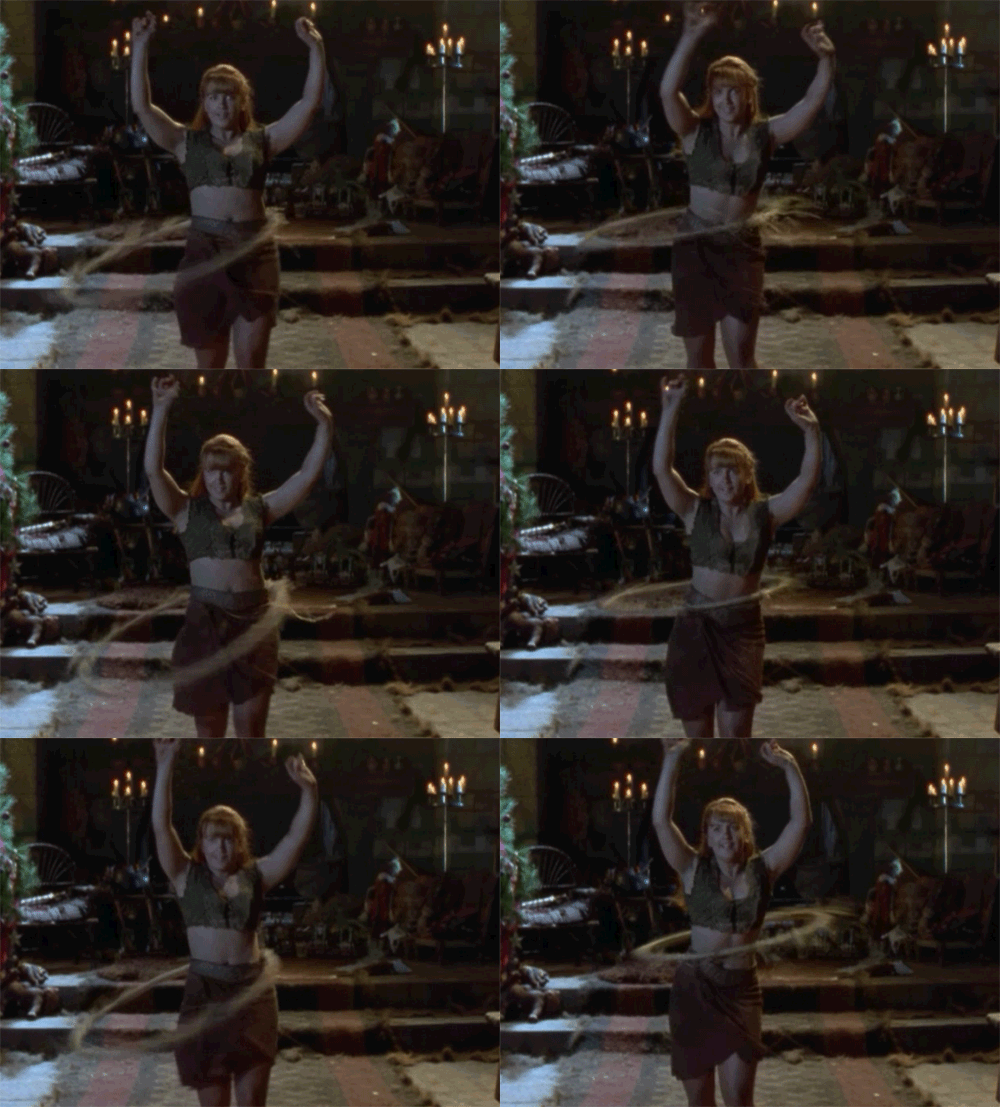
Chakrams Roasting On An Open Fire?

Complaining about historical inaccuracies in Xena: Warrior Princess is like complaining that Sam Kinison yelled too much, or that he was, you know, kind of a sexist pig.

This is even more emphatically the case when you throw in some Gabrielle hula-hooping action.

That's right. I'm talking about the infamous 1996 "Solstice Carol" episode. Hat tip to The House of Vines.

Linkages:

Wednesday, December 8, 2010

No rise in hate-crimes against Muslims in 2009

When it comes to the 2009 hate crime statistics there is good news and bad news. The bad news is that there is still hate crime. The good news is that overall the number of reported hate-crimes in 2009 was down 15% from the previous year. More good news is that 2009 saw no statistical rise in hate-crimes directed against Muslims in America when compared to the flat trend that has held since 2002.

The table below shows the hate-crime statistics for the years 2001-2009 (all data from the FBI Civil Rights division website):


YEAR - -
Blacks - -
Jews - -
Gays - -
Muslims - -
Total
20092,725965
1,3971286,604
20082,8761,0131,2371057,783
20072,6589691,2211157,624
20062,6409671,1481567,722
20052,6308489711287,163
20042,7319541,1471567,649
20032,5489271,2251497,489
20022,4869311,2341557,462
20012,8991,0431,3754819,730
[Totals include other categories of hate-crimes not listed.]


This year we have been inundated by hysterical accusations about a wave of Islamophobia sweeping across America. It was specifically claimed that the strong opposition to plans to build a mosque at Ground Zero (or an "Islamic Cultural Center" in "Lower Manhattan", whatever) was proof of a sinister fascistic trend in America that would soon rival the anti-Semitic horrors of the mid 20th century.

The 2009 FBI hate-crime statistics clearly demonstrate that opposition to the Ground Zero Mosque is not symptomatic of some long-gathering groundswell of religious bigotry directed against Muslims. That is good news.


Also see these earlier posts from this blog:

"God is a concept by which we measure our pain."

"I just believe in me, Yoko and me. And that's reality."


無無明亦無無明尽
mu-mu-myou-yaku-mu-mu-myou-jin
no ignorance and also no extinction of ignorance

乃至無老死亦無老死尽
nai-shi-mu-rou-shi-yaku-mu-rou-shi-jin
and so forth until no old age and death and no extinction of old age and death

無苦集滅道
mu-ku-shuu-metsu-dou
no suffering, origination, stopping, path

無智亦無得
mu-chi-yaku-mu-toku
no cognition also no attainment

以無所得故
i-mu-sho-tok-ko
with nothing to attain

菩提薩埵依般若波羅蜜多故
bo-dai-sat-ta-e-han-nya-ha-ra-mi-ta-ko
the Bodhisattva depends upon Prajna Paramita

心無罣礙
shin-mu-ke-ge
and mind is no hindrance

[The excerpt from the Heart Sutra along with transliteration and translation is from Brad Warner's old "doubtboy" blog here. Therein he says, "I claim no ownership or copyright of any kind on this material. So feel free to use it in any way you please without asking permission from me. Copy it. Distribute it. Re-write it as a pornographic limerick if you want."]

Tuesday, December 7, 2010

The Real Reason Sarah Palin Is Dissing JFK

In the biography, JFK: An Unfinished Life, Robert Dallek describes the atmosphere surrounding the famous speech that Kennedy gave to the Greater Houston Ministerial Association on September 12, 1960 as follows:
Religion remained an obstacle. On September 7 [1960], the New York Times carried a front-page article about the ironically named National Conference of Citizens for Religious Freedom, an organization of 150 Protestant ministers led by Dr. Norman Vincent Peale; they said that the Roman Catholic Church, with its dual role as both a church and a temporal state, make Kennedy's faith a legitimate issue in the campaign. Like Kruschev, one member declared, Kennedy was 'a captive of a system.' Although the clergymen were all conservative Republicans eager for Nixon's election (and were guilty of transparent hypocrisy in doing what they said Kennedy's church would do -- interfere in secular politics), their political machinations did not cancel out the effects of their warnings.

Estimates suggested that unless this propaganda was countered and the anti-Catholic bias overcome, Kennedy's religion might cost him as many as 1.5 million votes. The Kennedy campaign quickly organized a Community Relations division to meet the religious problem head-on. James Wine, a staff member at the National Council of Churches, headed the operation. Wine was as busy as any member of Jack's campaign team, answering between six hundred and a thousand letters a week and uring lay and clerical Protestants to combat the explicit and implicit anti-Catholicism in so much of the anti-Kennedy rhetoric.

A highly effective and much publicized appearence made before a group of Protestant ministers in Houston, Texas, on September 12 helped. Bobby, Jack's campaign staff, Johnson, and Rayburn all advised against the appearance. 'They're mostly Republicans and they're out to get you,' Rayburn told Kennedy. But Kennedy believed he had to confront the issue sometime, and he wanted to do it early in the campaign so that he could move on to more constructive matters. 'I'm getting tired of people who think I want to replace the gold at Fort Knox with a supply of holy water.' he told O'Donnell and Powers. In fact, his knowledge of Church doctrine and ties to the Church were so limited that he brought in John Cogley, a Catholic scholar, to coach him in preparation for the appearance.

Although he saw his speech and response to audience questions, which were to follow his remarks, as a crucial moment in the campaign, Kennedy went before the audience of three hundred in Houston's Rice Hotel Crystal ballroom (and the millions of television viewers across the country) with no hesitation or obvious sign of nervousness. The sincerity of what he had to say armed him against his adversaries and conveyed a degree of inner surety that converted a few opponents and persuaded some undecided voters that he had the maturity and balance to become a fine president.
[pp. 282-283]
This was not the first time that Kennedy had tackled the issue. Here is how Dallek describes the way Kennedy responded to reporters who asked about his religion when he first announced his candidacy for the Democratic nomination on January 2, 1960:
As for the likely debate to erupt over his religion, he also gave an unqualified response. He acknowledged that it would be a matter of substantial discussion. But he saw only one concern for voters: 'Does a candidate believe in the Constitution, does he believe in the First Amendment, does he believe in the separation of church and state.' Having said that, he dismissed the issue as one that had been settled 160 years ago and concluded that he saw 'no value in discussing a matter which is that ancient, when there are so many issues in 1960 which are going to be important.'
[p. 244]
In other words, Kennedy's approach to the question of his religion was principled and consistent, and he expressed his views in a clear and forceful way.

But in her new book, Sarah Palin complains that John F. Kennedy has received too much praise for his famous Houston speech, because, in her opinion, "His language was more defensive than is portrayed today, in tone and content." [p. 184]

Defensive!? In fact, Kennedy's speech is much more accurately described as defiant than as "defensive", and considering who Kennedy was addressing and where he was addressing them, his "content and tone" could arguably be said to have been downright combative.

Having been attacked very publicly by a prominent group of respected conservative Protestants, Kennedy went into the lion's den, so to speak. He stood up before a gathering of hundreds of conservative Evangelical Texans. He told them plainly and simply that in America there is an absolute separation between church and state, and because of that, the fact that he happened to be a Roman Catholic should not be an issue. And then he asked them if they had any questions. And he had the whole damned thing televised. Live.

Since Palin's characterization of the speech flies in the face of reality, we have to wonder: what is really going on?

And what is really going on is quite simple. First of all, Sarah Palin disagrees with what John F. Kennedy said on the question of religion in American politics. Kennedy emphasized the separation of church and state, a phrase that the Palinites would like to purge from American political discourse. But Kennedy went even further in his Houston speech, he said that this separation is "absolute".

The religious right has never accepted the Constitutional principle of separation of church and state, just as they refuse to accept the Constitutional right to privacy (and, in particular, the right to abortion).

Secondly, the bigots who were attacking Kennedy for being Catholic were nothing other than the 1960 forerunners of today's Tea Party movement. Kennedy succeeded in publicly shaming these bigots in a way that I doubt any 21st century American politician would be capable of pulling off.

Saturday, December 4, 2010

Voodoo Child: Angelique Kidjo

Lord knows, I'm a Voodoo Child:


And here's another version from VodPod:


And here's an oldie but goodie: Batonga (1991):


Also see this: Angelique Kidjo on Voodoo and Catholicism.


Al Jazeera's New Racist Documentary: "Magic & Murder"

Child murder among Africans "is cultural. It is tradition. It is deeply rooted in the mentality of the people." This is the claim made by a new 24 minute long documentary titled "Magic and Murder."

But this crudely racist travesty wasn't produced by some Neo-Nazi milita outfit in Bumfucque, Alabama. It is the handiwork of a British journalist with impeccable progressive credentials, and it is brought to you, complete with very high production values, by Al Jazeera.

The segment opens with a backdrop of dancing Africans apparently performing a traditional Vodou ceremony, the Al Jazeera presenter, doing an unintentionally hilarious send-up of Troy McClure, intones:
"Hello everyone, this is People and Power, and I'm Samah El-Shahat. On today's program: Magic and Murder." [They really could have used some Sammy Terry-esque organ music right here.]

[We now see on the screen an African woman holding a child in her arms. She beings to speak...] "I can't bear the thought that even though it is so hard for a woman to give birth, she could kill her child."

[Cut back to the studio with Samah El-Shahat.] "Can you imagine being so afraid of malign and evil spirits that you could allow your own child to be killed to save your family and community? To many it might sound like a practice from another century, but in the West African republic of Benin the murder of so-called child witches still occurs today. Of course infanticide is illegal in Benin, but accusing someone of witchcraft, allegations that can lead to the deaths of children, is not. And changing perceptions isn't something easily achieved in a country where the belief in sorcery is widespread and often seen as fundamental to the nation's heritage and identity. Charles Stratford has been to investigate this disquieting phenomenon."
Already, one has many questions. Such as: Since Al Jazeera has a large and loyal viewership in Saudi Arabia, and other similarly enlightened Muslim nations (nations where large majorities believe in the use of caning, or cutting off people's hands as part of the normal functioning of "justice", and even that changing one's religion should be treated as a crime punishable by death!), why does Samah El-Asshat say that acts of barbaric violence based on superstitious beliefs "might sound like a practice from another century", when in fact they sound like everyday occurrences in the Muslim world, as everyone knows.

Also note well how the narrative is, from the beginning, framed in terms of claiming that belief in magic leads to the murder of children!

But let's return to the program, which now switches over to crack reporter Charles Stratford's dispatch from the field:
[After shots of ominously boiling pots and what appears, non-ominously, to be a goat skin staked out on the ground, the camera focuses in on a black man (is he supposed to look ominous?) squatting in a thatched roof hut...] "The ritual has been practiced for centuries." [a small bell is rung, and then the man produces a chicken who appears to have some idea of what is coming next...] "A traditional healer, or so-called witchdoctor, recites incantations to the village spirit. He wants guidance on how to heal members of his community who believe they've been cursed." [Then the chicken starts to squawk, and the scene cuts to what looks like a few moments later, with the chicken's blood now spattered on the ground next to some cowry shells...] "After the sacrifice, the consultation continues. He searches for signs in the shells. The spirit is a source of good, which he can use to fight evil. But that evil is sometimes possessed .... by children."
From this it goes to an interview with a man identified as a "traditional healer - witchdoctor", who states plainly that he has never killed a child under any circumstances. But then claims, vaguely, that some "elders" are involved in such killings, "but nobody will tell you who is doing the killings."

Indeed, throughout the entire 24 minute "documentary" we are never once told of even an allegation of a specific instance of a child ever being killed! Instead we are treated to lurid third hand reports which are passed along in a way highly reminiscent of Geraldo Rivera stationed breathlessly outside of Al Capone's vault.

There is not one piece of actual evidence ever presented that in any way connects the practice of Vodou in Benin (or anywhere else) to violence against children. But this Al Jazeera after-school-special does not attempt to convince. Rather it merely appeals to a certain kind of prurient racist mentality that is eager to be regaled with stories of primitive African savagery and superstition.

Meanwhile, there does exist, tragically, a mountain of well-documented evidence demonstrating a very clear correlation between (1) the spread of Pentecostalism in certain parts of Africa, and (2) acts of violence, including killings, of (at least) thousands children who have been accused of witchcraft by Christians. In fact, the recent UNICEF report on "Children Accused of Witchcraft" explicitly warns that the phenomenon of violence against children accused of witchcraft is "often falsely associated with 'African tradition'".

I might write more about this later, but I'm not sure if I can bring myself to even think about this any more. It's such a toxically perfect shit-storm of vile racist garbage and unfiltered religious bigotry. If you are up to it, you can check it out for yourself here.

Much more on the phenomenon of "child witches" in Africa can be found here (scroll down to "The Christian Roots of the 'Witch Children' Phenomenon in Africa").

"FIGURING SHIT OUT"


From the PoorLifeChoices.Com blog here.

Friday, December 3, 2010

Who Supports Al Qaeda? Over 100 Million Muslims. That's Who.

Just one month after the September 11, 2001 terrorist attacks, Fareed Zakaria published his now famous essay, Why Do They Hate Us?, in which he wrote:
"The problem is not that Osama bin Laden believes that this is a religious war against America. It's that millions of people across the Islamic world seem to agree."
Zakaria is not some reactionary Islamophobe. He himself is Muslim and his father was a respected Islamic scholar. Zakaria can be safely categorized as a liberal (and the Right consistently attacks him for it). He has compared Bush's invasion of Iraq to Hitler's invasion of Poland, and he strongly supports the establishment of a mosque at Ground Zero (or an "Islamic Center" in "Lower Manhattan", whatever).

Today, of course, all right-thinking liberals are required to insist loudly that only a tiny minority of Muslims support violent Jihadism. But the truth turns out to be that even Zakaria's October 2001 estimate of "millions of people across the Islamic world" who "seem to agree" with Osama bin Laden was a low-ball estimate!

Who supports Al Qaeda? Well, according to recent data gathered by the good folks at the Pew Reseach Center (link: Muslim Publics Divided) the answer to that question is, in part: one third of all Muslims in Jordan, half of all Muslims in Nigeria, one fourth of all Muslims Indonesia, and one fifth of all Muslims in Egypt. In those four countries alone this represents one hundred million Muslims who support Al Qaeda.

Here's a quick and dirty breakdown using CIA factbook stats combined with the Pew survey results:

Jordan: population 6.2M, 93% Muslim, 34% support Al Qaeda = 2M
Nigeria: population 149M, 50% Muslim, 49% support Al Qaeda = 37M
Indonesia: population 238M, 86.1% Muslim, 23% support Al Qaeda = 47M
Egypt: population 78.9M, 91% Muslim, 20% support Al Qaeda = 14M
Total = 100M

If we add to this the data from Lebanon and Turkey where only 3% and 4% (respectively) of those surveyed support Al Qaeda, that adds another 0.7M and 3.1M (respectively) for a grand total (from these 6 countries) of 104M jihadist extremists. That's quite a lot for a tiny minority!

But wait. There's more. These six countries have a total Muslim population of about 555M, while the total Muslim population in the world is at least 1.1B and even as high as 1.5B. And there's also the fact that in addition to Al Qaeda there are other, competing, violent extremist currents in the Muslim world (such as Shia extremists, often supported by Iran, who are deadly enemies of Sunni extremists like Al Qaeda).

A very conservative approach would be to assume that the rest of the Muslim world has only half the number of extremists as that found in the countries surveyed by Pew, which would yield a world-wide headcount of 150 million Muslim supporters of Al Qaeda and other groups like it!

Oh, but it turns out that this is the good news! What? That's right. Because, you know, 150M isn't tiny, but it is still a minority among Muslims. Fell better? Well, don't.

The bad news is that huge majorities (ranging from 72% to 95%) of Muslims in five of the countries polled support a "large role for Islam in politics". In one other country, Jordan, there is still a majority, but a smaller one: 53%. In Turkey 45% (that's still a very respectable 34M) think this is a good idea, while only 38% say it is a bad idea. In fact, Pew did not find any Muslim country where a majority said that a large role for Islam in politics was a bad idea. See what I mean about bad news?

Well, you might object, that's kind of vague. "A large role for Islam", why, that could mean very different things to different people. Maybe it means they all want to have peace and harmony and government subsidized Sufi dancing? Uh, no. Pew also found that there is a clear correlation between the number of people who want a "large role for Islam in politics" and the numbers of people who support such things as (1) stoning adulterers to death, (2) cutting off the hands of thieves, and (3) the death penalty for apostasy. Oh. Does Karen Armstrong know about this?

If we do the math just looking just at Pakistan, Indonesia, Egypt, Jordan and Nigeria, a whopping 250M+ Muslims in those five nations (all of which are considered to be "U.S. allies", btw) believe that anyone who is born a Muslim but who chooses to leave that religion should be put to death!

And if all of that isn't enough to scare the crap out of you, well, there's this (source):


Further reading: