Sunday, June 19, 2011

Christina Larner on the Meaning of "Witchcraft"

The two excerpts below are both from Christina Larner's Enemies of God: The Witch-Hunt in Scotland. For more on Larner see this other recent post: Witchcraft: Black and White in Color. Both excerpts emphasize the historical reality of Witches being associated with beneficial magic, including healing, divination, and love magic.
1.

White witchcraft is concerned with the healing arts, with prophecy, with finding lost objects, with the supply of love potions, and with performance and rituals designed to counter black witchcraft. White witchcraft always involves manipulative sorcery [that is, the use of incantations and/or ritual objects]. Black witchcraft or malefice may or may not involve sorcery, but some indication, whether articulate and precise cursing, gnomic utterance, or scarcely audible mumbling, is usually necessary to establish that the mobilization of powerful ill will has been attempted.

Most societies make this distinction. European Civil Law decreed that white witchcraft, though culpable, was not punishable by death, whereas black witchcraft was [Larner here cites Book IX, Title 18 of the Codex Justinianus, which explicitly exempts from punishment those who use "incantations" either to cure illnesses or to protect crops from hail or flood while condemning to death (often specifying particular means of torture and execution) all enchanters, magicians, Pagan priests, astrologers, soothsayers, etc.] The distinction was eroded by Canon Law and the commentators specializing in demonology in that all supernatural power not emanating from the Church was deemed to be demonic. Those claiming to heal outside the context of the Church must have got their powers from the Devil. The abolition of the distinction did find an echo in peasant experience in that the healer as a person of power was potentially threatening. Power was neutral but could be used to harm as well as to heal, and it became a common feature of European witch-trials that the accused was said to have both laid on and taken off disease. The most extreme position with regard to the conflation of black and white magic may well have been that taken in the Scottish Witchcraft Act of 1563 in which the consulters of witches were said to be worthy of death in same manner as the practitioners. Any acknowledgment of an unofficial source of power was to be supressed. The attitude of a polity towards white witchcraft is an indication of the level of anxiety about non-conformity. England continued to tolerate cunning men and women (who were quite distinct from black witches) throughout the period of the prosecution. Major witch-hunts in Scotland and on the continent on the other hand tended to engulf the healer along with the curser.
[p. 9]

2.

Amidst the diversity of beliefs about healing, the factor which stands out most clearly is the figure of the healer herself. It was she who had the power, and this power was strengthened, as it is in modern medicine, by secrecy, impressive procedures, mystery, and arduous performances by the patient. The sufferer was not expected to understand exactly how he was being healed or the purpose of the consultation and the relationship between him and the healer would disssolve. The same held true when the healer was brought in for veterinary purposes. When Robert Hutton's mother-in-law sent for Bessie Paine to cure a sick cow 'the said Bessie Paine ... caue the Cow to be put throw ane hanck of green yairne speaking some words which the personnes present did not understand and yreftir the Cow was cured.' Agnes Johnstoun's accusation against Bessie Graham in 1650 included her response to a request to heal her child. Bessie 'Tuik the bellt and wettit it' (a common form of divination) 'muttering some speiches with greit gauting eftir which she told the said Agnes that the chyld was seik and wald not leive and it provit so and the chyld died presentlie'.

In fact the charm, the failed charm, the favourable prophecy, the unfavourable prophecy, and the curse are close closely connected, and essentially fall from the lips of the same person, the person of power. In seventeenth-century Scotland blessing adn cursing, black and white magic, went hand in hand, and this assumptino was shared by peasant and lawyer alike -- and by victim and practitioner. Popular belief and practic reinforced Canon Law rather than Civil Law.

Accusations of healing, such as that cited, were listed alongside accusations of malefice, and Bessie Paine was not only said to have cured. It was alleged that she came to a house in which she had formerly lived (from which we may assume she had been evicted) after the new tenant had moved in, 'and sitting down upon her knees upon the hearth staene she said "all the witchcraft which I have I leave it here"'. The new tenant, Robert Sturgeon, as a result of this curse upon his house, was reckoned to have lost within a year and a quarter above thirty cattle dead, 'and nothing he took in hand did prosper during his possession of that rowme (place).'
[p. 142]

Saturday, June 18, 2011

"Maleficia Ad Sanandum": Healing By Means of Witchcraft

.
1. "the Church believed that all magic, including beneficent magic, was the work of the Devil."


The following is from Brian P. Levack's (John E. Green Regents Professor in History, University of Texas, Austin) Introduction to Witchcraft, Healing, and Popular Diseases, which is Volume 5 of the series New Perspectives on Witchcraft, Magic, and Demonology, published in 2001 by Routledge.
One of the traditional functions performed by magicians in all societies, especially those without an organized medical profession, has been healing. The use of magic to treat a variety of ailments has been traditionally one of the most common forms of magic. Healers, often known in early modern Europe as wise women or wise men, did not rely exclusively on magic for the performance of their art. They often employed natural remedies, such as herbs, to nurse a person back to health. In this regard they can be considered as practitioners of folk medicine ....

Healing is by definition a beneficient activity, and when its practice involves magic it could be classified as beneficent or "white" magic. Certainly the neighbors and clients of these healers valued their services and considered them beneficial to the community. Healers who also served as midwives, as many of them did during the early modern period, were also regarded as indispensable guardians of the health of the community ....

Clerical authorities agreed to prosecute healers for witchcraft because the Church believed that all magic, including beneficent magic, was the work of the Devil. Clerics also claimed that those who could cure by magical means could use the same demonic power to cause harm. Mary O'Neil writes about the prosecution of healers and practitioners of love magic by the Roman Inquisition in Modena in the late sixteenth century.
[pp.vii-viii]
2. "accusations of maleficium were invariably against healers."

Now lets take a look at what Mary O'Neil (Associate Professor, Italian Renaissance and Reformation, University of Washington) has to say in Magical Healing, Love Magic and the Inquisition in Late Sixteenth-century Modena (to which Brian Levack refers above):
Despite the arguments of Renaissance intellectuals for a 'reformed and learned natural magic', mainstream theologians since the Church Fathers had maintained that magical effects were achieved only with the aid of the devil, and were necessarily implicitly diabolical. It was because of this orthodox assumption that magical powers derive only from a pact with the devil (whether implicit or explicit), which in turn implied apostasy from the true faith, that the Inquisition had acquired jurisdiction over cases categorized as superstitious.

In the climate of post-Tridentine reform, the local officies of the Roman Inquisition prosecuted such cases with increased frequency. After an intensive period of heresy trials against Protestants from the 1540s to the 1570s, magical and superstitious offenses came to constitute the major focus of late sixteenth- and early seventeenth-century Inquisitorial activity ....

The verbatim trial records reveal a world in which magical remedies were used to deal with the routine hazards of life, especially illness and disease. The major categories of superstitious error prosecuted by the Inquisition were magical healing, love magic and divination, with the largest number of cases directed against healers. Divination techniques were used in a variety of situations, most frequently to find lost and stolen objects including buried treasure, and to identify thieves ....
[pp. 173-174]

Concerning healers, according to O'Neil, "Depositions by witnesses indicate that relationships between healers and their clients could be tense, marked by fear and apprehension." More specifically: "Many healers were denounced to the Inquisition by their former clients, especially after an unsuccessful cure." As an illustraion, O'Neil tells the story (from 1599) of Diamante de Bisa, who had been called to treat a sick two-year old girl. Two hours after Diamente bathed the child first in water and then in ashes, the girl died.
Diamante was thus denounced to the Inquisition for 'having destroyed [guasta] and killed a child' through witchcraft. Failed cures often resulted in such charges even against healers with solid reputations and loyal clients. In Modena, accusations of maleficium were invariably against healers and bear a certain resemblance to malpractice suits.

But the response of the court to these charges is an instructive one, for the Dominican Inquisitor, Giovanni di Montefalcono, resisted the perception of Diamante as a strega which was put forward by the bereaved family.
[pp. 179-180]
So here we have a case of a professional healer accused of Witchcraft by her neighbors. But that "perception" of the accused is "resisted" by the Inquisitor. According to O'Neil, this case typifies the Roman (and also Spanish) Inquisition for "the moderation of its approach to magical crimes." [p. 174]

In the specific case of Diamante, the popular perception of her as a Strega (Witch) was rejected by the Inquisition as inappropriate in her case. Instead, she was found guilty of the lesser charge of "superstition". This came after Diamante's own testimony in which she recounted "numerous successful cures."
The court resisted her accusers charge of witchcraft, but Diamante's testimony about her healing methods placed her firmly in the category of 'superstitious healer'. She was asked to explain the methods she uses .... Her lengthy replies describe cures which used ointments and herbs along with the sign of the cross .... She was guilty in the eyes of the court, but of performing 'superstitious medications,' not of maleficium. The vocabulary of witchcraft (striga, malefica, guastare) is introduced in this trial only by witnesses and is passed over by the court, which uses instead the vocabulary of 'superstition'. Diamante received a standard penance of standing in front of the parish church during Sunday mass, fasting on bread and water on vigils at the Virgin's feastdays and reciting weekly rosaries for a year.
[p. 181]
At least in Modena there is clear evidence that according to popular beliefs, the ability to heal by itself was considered evidence of Witchcraft. Even in cases that fit the "malpractice" paradigm, many witnesses would present testimony that focused on successful healings performed by the accused. One person who took the stand in 1579 against Maria Mariani, from Villa di Fre, gave just such testimony and justified doing so by stating that "it is commonly said that those who know how to heal also know how to do harm."
This perception that the power to heal, especially the power to heal the bewitched (maleficati, affaturati or guastati), implied the opposite power to harm was a standard facet of of learned and popular witch beliefs alike. The theological category of maleficia ad sanandum (healing by means of witchcraft) succinctly expresses the same ambivalence, which was, moreover, theoretically required by the implicitly diabolical nature of any magical cure.
[p. 181]
3. Maleficia ad amorem

Another major category of accusations brought before the Inquisition in Modena pertained to love magic. It is well worth quoting O'Neil at length on the subject of Incanti Ad Amorem:
The most extreme penalties handed out by the Modenese Inquisition are to be found not in trials against healers accused of malefium, but in the functionally distinct sphere of love magic. Notwithstanding the difference between causing harm and inducing affection, historians have tended to include these cases in studies of witch trials. This practice has been questioned by one recent scholar; calling for closer attention to the specific acts attributed to and the social roles occupied by persons accused of witchcraft, Richard Horsley [Who Were the Witches?, 1979, scroll down for full citation] has argued that since love magic had a 'good end' it should not be dealth with as equivalent to the harm done by maleficium.

Yet the theologians did exactly that. No distinction between 'good' and 'bad' magic existed in the eyes of the church, for its concern focused on the means employed, not on the moral status of the end pursued in any magical act. Officially classified as maleficia ad amorem, techniques designed to induce passion in another person were particularly objectionable to theological opinion. For in addition to their implicitly (when not explicitly) diabolical source, the express goal of love charms were coercion to sin through the subversion of free will. Interrogations in these trials centered on the question of whether the defendant believed that the devil could force man's will into sin. Counter Reformation theology was particularly sensitive to attacks on free will associated with predestinarian Protestantism, and was determined to maintain the sinner's responsibility for his own sins.

Paradoxically, this confessional polemic undermined assumptions of the diabolical efficacy of love magic. The abjurations written for Moranda da Fanano, denounced for incantations and furfanterie in 1600, illustrates this point:
I swear that I believe with my heart and confess with my mouth that the demon cannot force the will and free choice [volunta e libero arbitrio] of man to do evil, and consequently I abjure and detest that heresy which says and upholds the opposite, of which I have been judged lightly suspect for the superstitions and diabolical experiments performed and taught by me to give passion to others.
In effect, Moranda's trial for the superstitious use of love charms turned into a trial for the heretical denial of free will implicit in her actions. Inquisitors in the field, starved for the hard theological issues in which they had been schooled, thus exercised their abilities by detecting the finer heretical implications of what were essentially predoctrinal popular errors. The persons tried on charges of love magic were guilty of various things, from heretical opinions on the freedom of the will to 'apostasy from Christ to the devil' for believing that their implicitly diabolical spells would work, but they were not, in the theologians' eyes, able to do what they attempted and wanted to do. By asserting the impossibility that such incantations could cause a person to sin against his will, even with the aid of the devil, the church effectively assumed a skeptical attitude about the reality and efficacy of love magic.

Popular belief did not reach this sophisticated theological level. While sceptics do turn up in the trial records, they were often disappointed users of love charms whose disillusionment with the results of their experiments followed an initial credulity. Many of the 'spontaneous denunciations sent from confession' were made by people who had requested that some love charm be performed on their behalf; they were required to denounce themselves as well as the person who had assisted them. Providers of these services often claimed economic motiation and denied that they in fact believed in what they were doing, but since the Inquisition was concerned above all with the issue of belief, their testimony was clearly self-serving and may not reflect their real attitudes.

Depositions by and about victims of love magic represent the clearest evidence of a general assumption that such procedures were efficacious. The socially inappropriate love affairs in which these people were involved were routinely perceived as the consequences of maleficia ad amorem. From the point of view of the relatives and friends of the socially superior individual, for whom such a misalliance defiend fundamental principles of social hierarchy, this hypothesis served a crucial explanatory function. For those of lower status, love charms conversely held out hopes of a sudden (indeed magical) transformation of their circumstances. Most of the people accused of using such charms in sixteenth century Modena were women; upper-crust names figure prominently in the lists of men magically pursued by their amorously ambitious inferiors.
[pp. 182-183]
It should be pointed out that O'Neil later rejects Richard Horsely's claim that accusations associated with love magic should be treated separately from other witchcraft accusations. Here is her reasoning:
The idea that one can distinguish between 'good' and 'bad' types of magic, like the proposal to classify love charms as 'good magic' of an essentially different order from harmful maleficia, is not supported by sixteenth-century perceptions, whether popular or learned. The difficulty in making such a distinction lies in the fundamental moral ambiguity of all magical operations.
[p. 188]
It must be emphasized that from the Christian perspective (at least that of the sixteenth-century), it is not really accurate to say that all magic is morally "ambiguous", for the fact is that all magic, or at least any magic that actually worked, was seen, by definition, as automatically diabolical. Therefore anyone capable of, for lack of a better phrase, "real magic", must have (at the very least) an implicit pact with Satan even if no formal pact had been explicitly entered into. (This view even has a modern parallel, for among some contemporary Pagans there is the saying, attributed to Victor Anderson, that "White Magic is poetry, Black Magic is anything that actually works.")

One further passage from the section on love magic is also quite interesting:
The people who used love magic were determined to achieve their goals by any means available. If many drew on the power of orthodox ceremonies or called on the assistance of the saints, some went further. Moranda da Fanano was required to 'abjure, detest and curse' her hertical use of an oratione ad una stella, and to confirm that 'it is not licit for faithful Christians to offer prayers to the stars in the manner of pagans.'
[p. 188]
4. Conclusion: Witches, Sorceresses, and Maleficae, Oh My!

In her own Conclusions, Mary O'Neil quotes from the official document Instructio pro formandis processibus in causis strigum, sortilegiorum et maleficiorum (Instructions for trying cases against streghe, sorceresses, and evil-doers), which had been drawn up by the Holy Office in Rome and circulated starting in the 1620s:
when a woman is convicted of or confesses to having performed incantations or maleficia in order to heal or for any other purpose, it does not however necessarily follow that she is a formal strix, since the sortilegio can be performed without formal apostasy to the Demon.
According to Henry Charles Lea (1825-1909) in his Materials Toward a History of Witchcraft, which contains (in Part III, "The Delusion At Its Height") lengthy extracts from the Instructio along with excerpts from a 1636 commentary by Caesar Carena, the section of the Instructio quoted above continues on like this:
although it is not without suspicion, either light or vehement, according to the character of the sorceries. Therefore when a good judge prosecutes a woman, either confessed of convicted of such sorceries, he must not be ready to believe that she is a formal apostate to the demon, though she may be; but when it comes to torture her he should question her as to whether she has had to do with the demon, in accordance with what is said below about torture. Judges must pay special attention to this, for many are thus deceived, thinking that this kind of sorcery necessarily involves formal apostasy to the demon, when arise the greatest wrongs to women accused of it, for inexperienced or careless judges, misled into this presupposition by reading books on sorcery and witches, leave no way, however undue, untried to extort confessions from women who are induced, by evil and unlawful methods, to confess what they had never thought of.
[p. 958 in the 2004 Kessinger edition]
The Instructio serves to emphasize just how unclear the definition of "Witch" was at the time. Looking over the court records from Modena makes it clear that this lack of clarity holds whether we are talking about the theological definition of "Witch", or its legal definition, or its popular usage. But one thing that is absolutely clear is that whether we look to the Church, the Law, or "the people", we find incontrovertible evidence to support what all Pagans, Witches, and genuine historians already know: "Witches heal".


Friday, June 17, 2011

Ayn Rand Opposed Ronald Reagan Because He Was Anti-Choice

.
Oh Sweet Tap Dancing Jesus.

Hat tip to DangerousMinds.Net:
"I urge you, as emphatically as I can, not to support the candidacy of Ronald Reagan. I urge you not to work for or advocate his nomination, and not to vote for him. My reasons are as follows: Mr. Reagan is not a champion of capitalism, but a conservative in the worst sense of that word—i.e., an advocate of a mixed economy with government controls slanted in favor of business rather than labor (which, philosophically, is as untenable a position as one could choose—see Fred Kinnan in Atlas Shrugged, pp. 541-2). This description applies in various degrees to most Republican politicians, but most of them preserve some respect for the rights of the individual. Mr. Reagan does not: he opposes the right to abortion."
Ayn Rand, November, 1975
Go to DangerousMinds.Net. There's more. Srsly:
Ayn Rand Absolutely Hated Ronald Reagan


Soyolmaa Davaakhuu: Amazing Mongolian Woman Artist

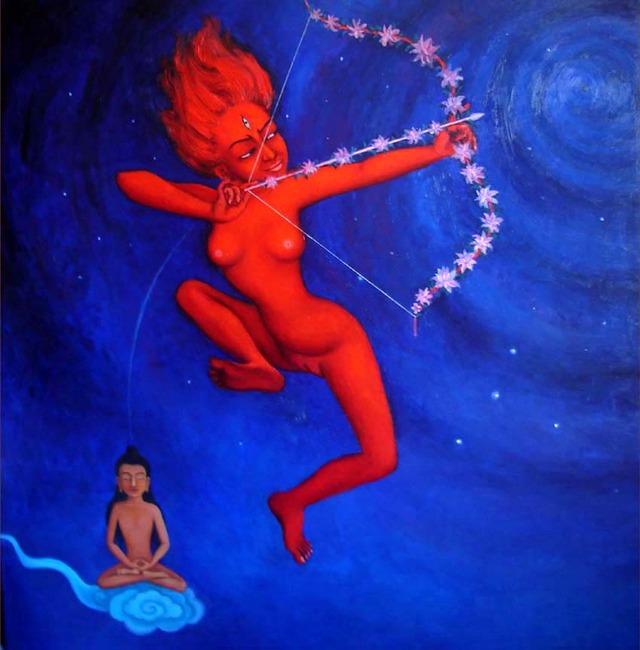
Recently I was looking around for images of the Hindu/Buddhist Goddess Kurukulla, and I came upon the website of the amazing Mongolian artist Soyolmaa Davaakhuu. Wow.

Prints of her gorgeous paintings are available for sale at her ImageKind website (linked to above). In addition, she has also published a book, Deep Knowing: A Woman's Journey in the Buddha Dharma Reflected in the Art of Soyolmaa Davaakhuu. (Scroll down to see a 6 minute video based on the book.)

The following biography is taken directly from her website (linked to above):
Soyolma Davaakhuu’s parents were prominent artists under the Communist regime, who managed to keep their Mongolian cultural and Buddhist art heritage alive to pass on to their talented daughter. Soyolma attended the Ulaan Baatar Fine Arts College and the University of Arts and Culture in Ulaan Baatar, both of which she graduated with honors. She has worked as a professional artist since her graduation in 1998 and has participated in dozens of exhibitions in Mongolia and abroad.

In 2008, Soyolma was named Female Artist of the Year by the Union of Mongolian Artists. The award is especially coveted because the recipient is chosen by the greatest artists in the country.

Soyolma is known for her eclectic approach which includes the traditional Mongolian Buddhist arts such as thangka painting, embroidery, appliqué, temple dance masks and costumes, etc., to contemporary urban expressionism.

Her work, from traditional to surreal, is always transformative, exploring themes of dreaming and awakening, the hidden and revealed, and more often than not, celebrates enlightenment manifest in feminine form.

And here is the description of the Goddess Kurkulla, also taken from the website (here is a link directly to the painting "Woman of Power", depicting the Goddess):
Kurukulle (Kurukulla) is translated in Tibetan as Rigiyedma meaning “She who is the cause of Knowledge”. She is also sometimes called Red Tara. She symbolizes desireless desire and the ability to achieve goals without attachment to outcomes. Her bow symbolizes the aiming for a goal and letting go. She is very popular in Tibetan folk magic as she is pre-eminently the Buddhist deity of enchantment and has the ability to bewitch other beings. Kurukulle may be called upon to exercise her powers of enchantment and bewitchment to subjugate evil spirits, demon and humans working against the welfare of humanity and spiritual evolution. She is often called upon at new beginnings such as the building of monastery, starting a business or other venture to subdue all forces that stands in the way. She represents empowerment of the feminine in a patriarchal milieu.

More than any other figure in the Buddhist pantheon, Kurukulle has becomes the Buddhist goddess of love and sex, corresponding to the Western goddess Venus. In this capability her flower-entwined bow and arrow serves as Cupid bow rather that the huntress Diana seeking a goal. According to the texts Kurukulle embodies perfect and alluring feminine form; she has a beautiful face and voluptuous body. She is red in color signifying enchantment and magnetism. She is single faced because she embodies non-dual wisdom beyond conventional distinctions of good and evil, and naked because she is unconditioned by discursive thoughts. She holds bow and arrow entwined with flowers because she can give rise to thoughts of desire in others minds. Her compassionate activity energetically manifests in both Samsara and Nirvana. She dances, and as she dances, she enchants and subjugates demon of ego. Most modern scholars believe Kurukulla originated in Uddiyana as a tribal goddess and because of her popularity became associated with the Bodhisattva Tara. She has also been adopted by Hinduism.


Southern Poverty Law Center: There They Go Again (On the SPLC's Nazi-Pagan Calumnies)

The Southern Poverty Law Center is often a good source of information on the worst of the worst of racist and would-be fascist groups in America. But the SPLC also has a sick obsession with the Big Lie that there is some connection between Nazism and Paganism. And in the most recent issue of their journal, Intelligence Report (Spring 2011 issue), they are at it again with an article titled "Former Neo-Nazi Explains ‘Esoteric Nazism’".

The article consists of a very brief (<1,000 words, even including the questions), and thoroughly superficial interview with Nathan Pett, a former member of the White Order of Thule, a group that only just barely ever existed, and that has been disbanded for over a decade.

The most important passage in this interview is the following:
"Let’s face it — the White Order of Thule had such a small amount of people. The chapter in Virginia was just Michael Lujan and a P.O. box. The same with me in Washington state. I was the only guy there. I had one or two people I knew who I tried to get interested, but it was so bizarre to most white supremacists to do the weird mix of philosophy. Most people just didn’t want to get into it, you know? It was so esoteric. People couldn’t understand what the hell it meant, including me."
The second most important thing about this article is that nothing is ever "explained" about so-called "Esoteric Nazism." Instead, Nathan Pett serves up a bizarre word salad that makes the Unabomber sound like Thomas freaking Jefferson. For example, we are told that the group was made up of "pseudo-intellectuals" who admired Nietzsche, Hitler ... and Joseph Stalin. This promotion of Stalin "as a good leader", Pett tells us, made it difficult for the WOT to be taken seriously by the other white nationalists! As to the supposedly "pagan" content of the WOT's ideology, Pett says that this amounted to a mixture of Christian mysticism, Theosophy and Greco-Roman Paganism, and that this made it difficult for the WOT to be taken seriously even by white nationalists who pose as "neopagans", because these tend to "obsessed with the Nordic thing."

Meanwhile, the main article in the same issue of the Intelligence Report is the SPLC's annual round up of violent right-wing yahoos: The Year in Hate and Extremism, 2010. The focus of this overview is on nativist/anti-immigrant and "Patriot" groups. There is no mention anywhere of groups that promote any kind of Paganism or Heathenism.

It is no secret that there is only one religion that has always been and always will be intimately associated with racist and neo-fascist groups in America, and that religion is Christianity. Christianity is the religion of the Ku Klux Klan, and it was the religion of Adolf Hitler and the Nazi party. It is also the religion of the overwhelming majority of those most active in the nativist and "Patriot" movements. It is also the religion of the Tea Party, Glenn Beck, Sarah Palin, Mitt Romney, Michelle Bachmann, etc.

So why does the SPLC continue with this pattern of misinformation and slanders against Paganism? At least part of the answer seems to be that the SPLC is to a great extent run by a single person, Mark Potok, who has some kind of personal vendetta against Paganism. In 2006 Potok was widely quoted (in USA Today and elsewhere) describing Paganism as "a theology that celebrates raw physical power and domination." For that reason, Potok said the kind of person who is drawn to Paganism is "a white man who is looking for justification for extreme violence, who is looking for an ideology which explains why he should be the boss." (Apparently, Potok has never read the Bible or the Quran, if he thinks that a "white man" has to turn to Paganism to find such a "theology"!)

The SPLC has in the past been criticized for it's bigoted Pagan-bashing by prominent Heathens and Pagans including Chas Clifton, Jason Pitzl-Waters, and Dave Haxton. Lets hope that this most recent episode will elicit a similar response.


Related posts from this blog:

Thursday, June 16, 2011

Witchcraft: Black and White in Color

"The logical conclusion of the idea of the demonic pact was the abolition of the traditional distinction between black and white magic. The power of the witch sprang from the demonic pact and was therefore evil, whether it was used for healing or harming."

1. The Witch Hunts and the Christianization of the European Peasantry

For those unfamiliar with Christina Larner, the following is from the Forward (available here online) to Larner's book Witchcraft and Religion, a posthumous collection of her writings published in 1984 (the Forward is by Alan Macfarlane):
At the time of her tragic death at the age of 49 in April 1983, Christina (Kirsty) Larner had already established her scholarly reputation in a number of ways. She was the foremost expert on the history of witchcraft in Scotland. She was thought to be one of the most important social historians of Scotland. Her work was one of the most interesting examples in the cross-disciplinary field of historical sociology. Finally, she had contributed significantly to legal history and archival history through her study of Scottish records and court processes. All this had been established on the basis of one book, Enemies of God, The Witch-hunt in Scotland, published in 1981, a duplicated Source-Book of Scottish Witchcraft compiled with Christopher Lee and Hugh McLachlan (Glasgow, 1977) a number of articles, unpublished lectures and an unpublished doctoral thesis ....

One of the striking features of Dr Larner's work is a sceptical attitude towards simple and universal explanations. Yet, in the last chapter of Enemies of God, tentative suggestions are made concerning the necessary, if not sufficient, causes of the witch-hunt. The preconditions are a peasant economy, a witch-believing peasantry, and an active belief in the Devil among the educated. Four more proximate causes explain the specific timing of witch- hunts. First, was a judicial revolution, consisting of a shift from restorative justice' (where the case is brought by the injured) to retributive Justice' (where it is brought by the state), applying general and abstract standards. Second, there was the rapid development of printing and literacy. Third, what is termed the 'Christianization of the peasantry', that is to say the move from a largely animistic and ritual world to one where personal salvation and Christian belief became predominant. Finally, there was the rise of the Christian nation state. The witch-hunts coincided exactly with the period of the Godly state, when Christianity became the official ideology of the new-born nation state. The fruitful ideas hinted at towards the end of Enemies of God became central themes in the Gifford lectures which constitute the second half of this volume. Although these factors do not work particularly well in explaining English witchcraft prosecutions, they throw a great deal of light on the horrendous mass witch-hunts on the Continent.

Below is an excerpt from Christina Larner's essay James VI and I and Witchcraft, which makes up the first chapter in Witchcraft and Religion:
In primitive societies two types of witchcraft are identified: white witchcraft or the craft of healing, and black witchcraft or maleficium. This distinction was known to Roman law, and dominated all dealings with witchcraft accusations in Europe until the late fifteenth century. It is also common ground in most studies of contemporary primitive societies. Historians of the sixteenth and seventeenth centuries however have to add a third witchcraft which existed only from the fifteenth to the early eighteenth century and which has no contemporary equivalent. It differed from the simple concepts of black and white witchcraft in its origins. Far from being an experience of village life, it was evolved by churchmen and lawyers from Christian theology, canon law, and certain philosophical ideas. It differed also in content. Christian witch theorists gave a central position to the idea of the demonic pact. The witch became a witch by virtue of a personal arrangement with the Devil who appeared to his potential recruit in some physical form. At this meeting, in return for renunciation of baptism, services on earth and the soul of the witch at death, the Devil promised material advantages and magical powers. In addition, an integral part of the Christian witch theory was that the witch did not operate alone. Witchcraft involved midnight meetings to worship the Devil, to receive his orders and to have sexual intercourse with him or his subordinate spirits.

The development of this theory in Europe, and its application in witchcraft trials, had a drastic effect on the rate of prosecutions. The change from the isolated local harrying of individuals to a widespread crusade against witchcraft, to a recognisable mania and persecution, began fairly abruptly in northern Italy and southern Germany in the late fifteenth century, and spread widely through the Continent during the following century. There are three main reasons why the introduction of the Christian witch theory had such a catastrophic effect. The first is that it was developed by the ruling classes. If we except the traditional vulnerability of rulers to soothsayers and astrologers, there had previously been a fairly sharp contrast between village credulity and intellectual scepticism. Now the power of the local witch was heavily reinforced by the conviction of the authorities that her power was real and to be feared. At the same time, the capacity to punish her was intensified by the codification of the laws against witchcraft, both in canon law and later in the statute law of Protestant countries. The other reasons are connected with the theory itself. The logical conclusion of the idea of the demonic pact was the abolition of the traditional distinction between black and white magic. The power of the witch sprang from the demonic pact and was therefore evil, whether it was used for healing or harming. This meant that the village healer was as likely to be prosecuted as the local scold.
[pp. 3-4]

2. Christianization and the literal demonization of African Traditional Religions


In Africa, the traditional attitude toward magic has survived to this day. Like any other natural force, "spiritual power" (every African language has its own highly developed vocabulary for religion and magic) can be beneficial or harmful, and those who know how to work with such power can be responsible for wealth and progress or for disease and death. Richard Dowden has this to say on the subject of this "sense of spiritual power" in his Africa: Altered States, Ordinary Miracles:
In Africa, every event has a spiritual cause or actor. Success in exams or football games, and disasters such as disease or death, all have agents, human or divine. There is no such thing as chance. Wealth and progress are obtained with the help of spirits or magic medicine. A Big Man has power, and that power cannot be challenged or questioned because behind his wealth or position lies spiritual power that enables him to accrue wealth and an important job. That sense of spiritual power is common to almost all Africa.
[p. 30]
While the naturalistic view of magic has persisted into the 21st century, it must now coexist uneasily with a new attitude that has been aggressively promoted by Christian missionaries starting in the 19th century. Richard Dowden has quite a bit to say on that subject:
Traditional African religions were denigrated by the European Christian missionaries and imperial rulers who frequently saw them as devil worship and tried to stamp them out. In West and Central Africa and in South Africa these religions or their offspring sects are strong and open, but in East Africa they are hidden, not spoken of in public . . . .

While Christianity teaches that only humans have souls, African religions hold that all objects, animate or inanimate, can be moved by spirits. Africa senses spirits in animals, trees and rocks as well as in people. So the river and the spirit of the river are one and the same. The spirit allows the substance to change, the person to become something else . . . .

Steve Biko, the South African writer and activist, wrote that religion in Africa was not a specialized function observed only on one day a week in a special building, but 'it featured in our wars, our beer drinking, our dances and customs in general'. That is something the Western world has lost . . . .

Given the prevalence of traditional religion, it is strange that so few prominent Africans identify with it in public. How different from Japan where Shintoism -- in many ways similar to aspects of African religions -- is widely practiced. In Japan respect for the ancestors is expressed by millions of Japanese visitors to ancient temples to salute the ancestors. Many Japanese proudly display in their homes the souvenirs of the holy shrines they have visited. ... In Africa traditional religion may be central to beliefs but its leaders and rituals still remain in the background . . . .

One reason that African traditional religion and beliefs are hidden is that in many parts they are still associated with evil. Today hardly a week goes by without some report from Africa about witchcraft or the killing of witches. Africa's local press is full of them, the details reported as factually as a politician's speech or the football scores.
[pp. 312-318]
For more on Dowden's book, here are three reviews:

The attitude of Christian missionaries to African culture has been, and continues to be to this day, little, if any, different from that expressed by Duarte Pacheco Pereira, a late fifteenth-century Portuguese explorer, who said of the Kingdom of Benin: "The way of life of these people is full of abuses and witchcraft and idolatry." (D.A. Low, "Converts and Martyrs in Buganda", in C.G. Baeta, ed., Christianity in Tropical Africa, p. 257)

Elizabeth Isichei, in her A History of Christianity in Africa, describes the view toward traditional African culture by late 19th century missionaries like this: "There was a natural tendency for those writing in missionary periodicals to stress the darker side of African society . . . . Some, both Catholic and Protestant, described African society as demonic." [p. 82]

Isichei provides two quotes from the writings of missionaries as examples:
(1) "May many come willingly to labour in pulling down the strongholds of Satan's kingdom, for the whole of the Ibo district is his citadel."

(2) "All those who go to Africa as missionaries must be thoroughly penetrated with the thought that the Dark Continent is a cursed land, almost entirely in the power of the devil."

Isichei also remarks on how the missionary attitudes toward African culture included even condemnation of the practice of building round houses instead of proper, Christian rectangular houses!

In a word, conquest and conversion taught Africans to systematically despise and reject every aspect of their own cultures. Not just their evil religion, whose priests were "sorcerers" and whose wise-women were "witches", but their clothes, their food, their languages, their architecture, and so forth. They were also taught to hate their own leaders and elders, unless these were appropriately compliant both to the colonial authorities and to the church.

The unrestrained contempt of Europeans for African culture held steady, or even increased, throughout the years of colonialism. Isichei cites the 1949 case of "an exemplary Nigerian priest" (as he was described by the Irish bishop who wrote his letter of recommendation, in vain, as it turned out) who sought admission to a Cistercian monastery, but was refused not due to any personal fault or failing, but simply because no "coloured men" were allowed. [p. 87]

3. Summary and Conclusions

The word "Witch" has always been ambiguous, in that the range of its meanings has always included both (1) "wise women", "cunning folk", healers, soothsayers, and other practitioners of beneficial magic, and (2) those who are capable of and willing to use magic to cause harm to others.

To speak as plainly and as clearly as possible, if anyone claims that "Witch" has historically been synonymous with malefica, "evil-doer", then the person making such a claim is either:
(1) woefully ignorant of the most basic facts well-known to every historian who has studied Witchcraft and Witch Trials in European history, or
(2) lying.

In the specific case of a professional historian who equates 'Witch" with malefica (especially if said historian claims expertise in the subject of European Witchcraft and Witch Hunting) then this can only be seen as an act of scholarly malpractice, or of intellectual depravity, or, most likely, both.

And what is true of English is also true of other European languages, so that what has already been said about the word "Witch" can also be said about "Hexe", "Strega", "Sorcière", "Bruja", "Bruxa", "Heks", etc.

In non-European, or, more to the point, non-Christian cultures the same ambiguity is found. For example, those who are labeled as "Witches" by Christians in Africa may or may not be involved in harmful magical workings. They could just as easily be healers or fortune tellers as perpetrators of maleficia. In fact, those accused by Christians of practicing Witchcraft can, and often are, the very people who are sought out for magical protection against curses.

Today there are still some who try to equate Witchcraft with "attempting to harm others by magical means", as Ronald Hutton has done and continues to do. All those who do so not only carry on a truly malevolent tradition based firmly in the ideology of the Christian Witch-Hunters of the past, but they also ally themselves with those today in Africa, Latin America and elsewhere who are actively engaged in that most virulent form of cultural genocide known as "Christianization."

Tuesday, June 14, 2011

Ronald Hutton vs The Witch of Endor

The main part of this post consists of a list, spanning over 400 years, of primary sources attesting to the use of the English word "Witch" (or in some cases an equivalent word in another European language) to refer to someone whose magical workings are beneficial to others, including especially persons who perform healing, mediumship, or divination, or who can provide protection against (and/or relief from) malefic magic ("curses").

Several of the works cited are inspired by the Biblical story of the so-called "Witch of Endor," who is portrayed as a medium/prophetess/necromancer. When Jerome wrote the Vulgate (Latin) version of the Bible he referred to her as "mulier habens pythonem in Aendor" at I Sam. 28:7. The modern Webster's Online Dictionary (here) tells us that a "pythoness" (the most direct rendering in English of "mulier habens pythonem") is:

1. A witch with powers of divination.[Wordnet]
2. (Greek mythology) the priestess of Apollo at Delphi who transmitted the oracles.[Wordnet]
3. The priestess who gave oracular answers at Delphi in Greece.[Websters]
4. Any woman supposed to have a spirit of divination; a sort of witch.[Websters].

The important thing about all four of these definitions above is that they have not so much as a whiff of maleficium about them. Even more importantly is the fact that pythoness unambiguously refers back to pre-Christian magico-religious practices and beliefs that were revered and respected by ancient Pagans and that played a central and highly prestigious role in their mainstream/traditional religious cults. Therefore the list below strongly argues against Ronald Hutton's claim that two of the primary characteristics of a Witch are that she is a person who (1) "cause[s] misfortune or injury to other humans", and (2) "earns general social disapproval, usually of a very strong kind". The list also argues against one of the secondary characteristics of Witches according to Hutton, namely that they perform their magic "from motives of malice and spite." (See Hutton 2004, Hutton 2011, and also: Ronald Hutton: Witches Are "Inherently Evil").
  1. c. 1510 Jacob Cornelisz Van Oostsanen (1477-1533) "Saul bij Heks van Endor" (painting)
  2. 1584 Reginald Scot (c. 1538 - 1599; In his Discoverie of Witchcraft Scot has multiple references to "white witches" and he also equates "witch" with "wise woman".
  3. 1597 DAEMONOLOGIE by King James VI of Scotland (King James I of England) attests to the fact that not only "that Pythonisse that Saul consulted with", but also "these wise men of Pharaohs, that counterfeited Moyses miracles" and "Simon Magus in the new Testament" were at the time commonly thought of and referred to as Witches.
  4. c. 1600 William Perkins (1558-1602) Perkins once delivered a sermon titled "The Good Witch Must Also Die."
  5. 1635 Matthias Stom - "Saul en de heks van Endor" (painting)
  6. 1649 "Divels Delusions" (account of the trial of John Palmer, et al, ) Two of those whose trial is recounted herein were at first thought to be "good witches", but were later convicted as "black witches." (see Wallace Notestein's 1909 A history of witchcraft in England from 1558 to 1718, Appendix A.5.)
  7. 1656 Thomas Ady's Candle in the Dark contains multiple references to "good witches", whom Ady explicitly equates with "cunning" persons, and whom Ady portrays as healers, soothsayers, and also as providing protection against curses.
  8. 1688 "Saul e la pitonessa di Endor" by Salvator Rosa (painting)
  9. 1702 Cotton Mather (1663-1728) Mather refers, matter-of-factly, to the "Witch of Endor" in his Magnalia Christi Americana, in Chapter XXVIII (on the life of Samuel Whiting). Mathers also refers to her as an "enchantress".
  10. 1739 Georg Friedrich Händel SAUL An Oratorio; or Sacred Drama, words by Charles Jennens. The "Witch of Endor" appears as a character in Act Three, Scene Two.
  11. 1754 Saulus Consulit Sagam An earlier engraving by Gerard Hoet was reproduced in Robert Goadley's An Illustration of the Holy Scriptures, by Notes and Exposition. This book was published in Sherborne, in 132 parts, between 1754 and 1759. "It also shows that representations of the Witch of Endor as attractive and young existed throughout the eighteenth century." (quoted from here) The caption that appears in Goadley's edition is multilingual and refers to the Witch as "Sagam", "Divineresse", "Tooveresse", "Zauberin", as well as simply "Witch" and also using her Hebrew appellation from the First Book of Samuel, בעלת אוב, baalath ob, "the mistress of the Obidiah or Pythonic spirit - one who had a familiar spirit, whom she could invoke when she pleased, and receive answers from him relative to futurity," according to Adam Clarke's commentary on the Whole Bible (1832).
  12. c 1760 John Wesley in his commentary on Exodus 22:18, "Thous shalt not suffer a witch to live," portrays Witchcraft as a full-blown religious alternative to Christianity (albeit framed by a boilerplate Satanic gloss): "Witchcraft not only gives that honour to the devil which is due to God alone, but bids defiance to the divine providence, wages war with God's government, puts his work into the devil's hand expecting him to do good and evil." Wesley's focus is on malefic magic "whereby hurt shall be done to any person", but he also states plainly that "pretending to tell where goods lost or stolen may be found, is an iniquity punishable by the judge, and the second offence with death."
  13. c. 1830 Sir Walter Scott (1771-1832; Scott wrote about "Agnes Simpson, or Sampson, called the Wise Wife of Keith ... seems to have been a kind of white witch, affecting to cure diseases by words and charms ..." Sampson was executed in 1591. See Letter IX in Collected Works, volume I)
  14. 1866 Gustave Doré (1832-83) Saül et la sorcière d'En Dor (engraving).
  15. 1895 Arden Holt's "Fancy Dresses Described; Or, What to Wear at Fancy Balls" includes (figure 48) a "White Witch" Fancy Dress. [found at sexywitch]
  16. 1900 The Wonderful Wizard of Oz by Frank L. Baum, featuring two, count 'em two, Good Witches.
  17. 1921 "Charming Little Witch" Halloween postcard from 1921 reads:

    Though witches weird on Hallowe’en
    I must admit alarm me,
    I know a little witch like you
    Who never fails to charm me.

Wednesday, June 8, 2011

Ronald Hutton: Witches Are "Inherently Evil"

In 2004, Ronald Hutton published an article in which he "offered a definition of the traditional witch figure." ("Anthropological and Historical Approaches to Witchcraft", Historical Journal, vol. 47, 2004, 413–34.) At present this article is not available online, but there are plans to remedy that. In the meantime, Hutton has just come out with a new retrospective article (published in The Pomegranate journal, and available for download in pdf format at their website), in which he provides us with his own summary of his definition:
Traditionally, a witch uses apparently supernatural means to cause injury to other members of the same community; is inherently evil and not merely working for profit; operates in a tradition, by inheritance or initiation; and can be effectively opposed by counter-magic or physical punishment.
It must be emphasized that Hutton offers this not as merely a definition of the "witch figure" in the English speaking world, or just in Europe and/or the Christian world, but as a cross-cultural definition "which could hold up worldwide." Hutton also makes it clear that this definition is intended to be applicable not just to the modern world, but also to medieval and early modern European Christendom, as well as to pre-Christian societies of Europe, North Africa and the Middle East. In other words, this is Hutton's definition of the very essence of Witchcraft itself as a universal (or at least ubiquitous) phenomenon found in widely divergent human societies throughout the world today, and also found throughout human history going back at least thousands of years.

The problem, though, is that Hutton's definition of "the witch figure" is at odds with how the English word "witch" is actually used and has been used for centuries. Nor does Hutton's definition accurately reflect the usage of words like "Hexe", "Strega", "Bruja", "Sorcière", and so forth. Nor does Hutton's definition correspond to witchcraft-related and/or magical terminology found in any non-European languages, either. In all of these cases, the words in question are ambiguous with respect to whether or not the magic performed by the "Witch" (or Bruja, etc) is beneficial or harmful. In particular, all of these terms can be used to refer to people who perform magic (or, for the imagination impaired, "are thought to perform magic") to the following beneficial ends (this is only a partial list, many more examples of beneficial magic could be added):
  • magical healing
  • divination
  • good weather
  • successful harvest
  • health of cattle
  • financial success
  • success in love
  • mediumship (communication with the dead)
  • spiritual blessings of various kinds
  • protection from harmful magic
There is, however, one, and as far as I know only one, example of a term that is only used, and logically can only be used, to refer to someone who is intrinsically evil and who performs magic only in order to cause harm. With a little reflection, it should be obvious (but apparently is not) that this one word is the Latin word "malefica", which means, simply "evil-doer". The use of this term, a term that unambiguously refers to someone who must be intrinsically evil, to refer to magical practitioners generally is of course one the gifts that the Christian religion has bestowed upon humanity.

I have previously discussed the ambiguous meaning of "Witch" and other related terms in European languages in this earlier post: Good Witches, and in the specific case of the English word "Witch", I discuss how the use of this term to refer to practitioners of beneficial magic is documented in Thomas Ady's 1656 book Candle In The Dark in this post: "Shew me in all the scriptures where Witchcraft went without Idolatry".