Friday, June 24, 2011

More Reactions to Geert Wilders' Acquittal

.
Here are some more reactions from around the world to yesterday's acquittal of Geert Wilders:

Thursday, June 23, 2011

An Erotic & Magical Greek Lesson: "What then can Love be?" "A great Demon, O Socrates"

The text for today's lesson is Plato's Symposium. If you wish to follow along at home (or wherever you are), please refer to the Stephanus numbering given below.

First, the warm-up . . . .

[202d]
[Diotima:] 'you have admitted that Eros, from lack of good and beautiful things, desires these very things that he lacks.’
[Socrates:] ‘Yes, I have.’
[Diotima:] ‘How then can he be a God, if he is devoid of things beautiful and good?’
[Socrates:] ‘By no means, it appears.’
[Diotima:] ‘So you see, you are a person who does not consider Eros to be a God.’
[Socrates:] ‘What then,’ I asked, ‘can Love be? A mortal?’
[Diotima:] ‘Anything but that.’
[Socrates:] 'Well, what?'

. . . . and then the main attraction:

ὥσπερ τὰ πρότερα, ἔφη, μεταξὺ θνητοῦ καὶ ἀθανάτου.
As I previously suggested, between a mortal and an immortal.

τί οὖν, ὦ Διοτίμα;
And what is that, O Diotima?

δαίμων μέγας, ὦ Σώκρατες: καὶ γὰρ πᾶν τὸ δαιμόνιον
A great Demon, O Socrates: and all of the Demonic realm

[202ε] μεταξύ ἐστι θεοῦ τε καὶ θνητοῦ.
is between the immortal and the mortal.

τίνα, ἦν δ᾽ ἐγώ, δύναμιν ἔχον;
having what power? [asks Socrates]

ἑρμηνεῦον καὶ διαπορθμεῦον θεοῖς τὰ παρ᾽ ἀνθρώπων καὶ ἀνθρώποις τὰ παρὰ θεῶν,
[Diotima answers:] Interpreting and transporting [ἑρμηνεῦον καὶ διαπορθμεῦον] human things to the Gods and Divine things to humans;

τῶν μὲν τὰς δεήσεις καὶ θυσίας,
entreaties [δεήσεις] and sacrifices [θυσίας] from below,

τῶν δὲ τὰς ἐπιτάξεις τε καὶ ἀμοιβὰς τῶν θυσιῶν,
and ordinances [ἐπιτάξεις] and requitals [ἀμοιβὰς] from above:

ἐν μέσῳ δὲ ὂν ἀμφοτέρων συμπληροῖ, ὥστε τὸ πᾶν αὐτὸ αὑτῷ συνδεδέσθαι.
being midway between, it makes each to supplement the other, so that the whole [πᾶν] is combined in one.

διὰ τούτου καὶ ἡ μαντικὴ πᾶσα χωρεῖ καὶ ἡ τῶν ἱερέων τέχνη τῶν τε περὶ τὰς θυσίας καὶ τελετὰς
Through it are conveyed all divination [μαντικὴ] and priestcraft [ἱερέων τέχνη] concerning sacrifice [θυσίας] and ritual [τελετὰς]

[203α] καὶ τὰς ἐπῳδὰς καὶ τὴν μαντείαν πᾶσαν καὶ γοητείαν.
and incantations [ἐπῳδὰς], and all soothsaying [μαντείαν] and sorcery [γοητείαν].

θεὸς δὲ ἀνθρώπῳ οὐ μείγνυται,
The Divine with mortals does not mingle:

ἀλλὰ διὰ τούτου πᾶσά ἐστιν ἡ ὁμιλία καὶ ἡ διάλεκτος θεοῖς πρὸς ἀνθρώπους, καὶ ἐγρηγορόσι καὶ καθεύδουσι:
but the Demonic is the means of all society and converse [ἡ ὁμιλία καὶ ἡ διάλεκτος] of humans with Gods and of Gods with humans, whether waking or asleep.

καὶ ὁ μὲν περὶ τὰ τοιαῦτα σοφὸς δαιμόνιος ἀνήρ, ὁ δὲ ἄλλο τι σοφὸς ὢν ἢ περὶ τέχνας ἢ χειρουργίας τινὰς βάναυσος. οὗτοι δὴ οἱ δαίμονες πολλοὶ καὶ παντοδαποί εἰσιν, εἷς δὲ τούτων ἐστὶ καὶ ὁ Ἔρως.
Whosoever has skill in these affairs is a spiritual person [δαιμόνιος ἀνήρ], to have it in other matters, as in common arts and crafts, is for the mechanical. Many and multifarious are these Demons, and one of them is Love.’

[A little further on [203d], Socrates adds the following by way of summing up the nature of Eros]:

κατὰ δὲ αὖ τὸν πατέρα ἐπίβουλός ἐστι τοῖς καλοῖς καὶ τοῖς ἀγαθοῖς,
he takes after his father in scheming [ἐπίβουλός] for all that is beautiful [καλοῖς] and good [ἀγαθοῖς];

ἀνδρεῖος ὢν καὶ ἴτης καὶ σύντονος,
for he is brave, strenuous and high-strung

θηρευτὴς δεινός, ἀεί τινας πλέκων μηχανάς,
a famous hunter, always weaving some stratagem;

καὶ φρονήσεως ἐπιθυμητὴς καὶ πόριμος, φιλοσοφῶν διὰ παντὸς τοῦ βίου,
desirous and competent of wisdom, throughout life ensuing the truth;

δεινὸς γόης καὶ φαρμακεὺς καὶ σοφιστής:
a master of sorcery [γόης], witchcraft [φαρμακεὺς], and sophistry [σοφιστής].


------------------------------------------

The Greek and the English translation are both taken from Perseus. Here is a direct link. The translation is from Fowler (1925), but I have taken certain liberties.

To recap: all of the following are attributed to Eros and the Demonic realm:
  1. Interpreting and transporting [ἑρμηνεῦον καὶ διαπορθμεῦον] human things to the Gods and Divine things to humanity
  2. communicating prayers [δεήσεις] and sacrifices [θυσίας] from us to the Gods
  3. communicating injunctions [ἐπιτάξεις] and requitals [ἀμοιβὰς] from the Gods to us
  4. filling in all the space between humans and the Gods, so that everything [πᾶν] is bound to everything else [ἐν μέσῳ δὲ ὂν ἀμφοτέρων συμπληροῖ, ὥστε τὸ πᾶν αὐτὸ αὑτῷ συνδεδέσθαι.]
  5. divination [μαντικὴ]
  6. priestcraft [ἱερέων τέχνη] concerning sacrifice [θυσίας] and ritual [τελετὰς]
  7. incantations [ἐπῳδὰς]
  8. soothsaying [μαντείαν]
  9. sorcery [γοητείαν]
  10. all society and converse [ἡ ὁμιλία καὶ ἡ διάλεκτος] of humans with Gods and of Gods with humans, whether waking or asleep
  11. the ability to be a true spiritual person [δαιμόνιος ἀνήρ] (or is that a truly Demonic person?)
  12. In general, all interaction, of any kind, between the Divine and mortals must be by way of the intermediary realm of the Demons. Otherwise, the Divine and mortals do not mingle directly [θεὸς δὲ ἀνθρώπῳ οὐ μείγνυται].


J.K. Rowling Announces "Pottermore"

(Here is a direct link to Pottermore. Scroll down for press release ....)


From the official press release (full text available at the DailyGrail.Com):
J.K. Rowling today, Thursday 23rd June, answered mounting speculation about the nature of her new project and announced Pottermore, a unique and free-to-use website which builds an exciting online experience around the reading of her hugely successful Harry Potter books, and is partnered by Sony.

The announcement today was heralded by the revealing of the website’s name via an online search for its letters, and a ‘coming soon’ holding page which received over a million visits within 36 hours of launching.

For this groundbreaking collaborative project, J.K. Rowling has written extensive new material about the characters, places and objects in the much-loved stories, which will inform, inspire and entertain readers as they journey through the storylines of the books. Pottermore will later incorporate an online shop where people can purchase exclusively the long-awaited Harry Potter eBooks, in partnership with J K Rowling’s publishers worldwide, and is ultimately intended to become an online reading experience, extending the relevance of Harry Potter to new generations of readers, while still appealing to existing fans. As the Pottermore Shop develops, it is intended that it should include further products designed specifically for Harry Potter fans, offering a potential outlet for Sony products and services related to Pottermore. In keeping with Harry Potter’s international appeal, the site will launch in English, French, Italian, German and Spanish, with more languages to follow.

Geert Wilders: "The Dutch are still allowed to speak critically about islam, and resistance against islamisation is not a crime."

A major victory for freedom of speech has occurred. Here is what Geert Wilders was told by the judges presiding over his trial for "hate speech" against Islam:
"You are being acquitted on all the charges that were put against you. The bench finds that your statements are acceptable within the context of the public debate."

And here is a round-up of world headlines on the acquittal of Geert Wilders:

Reuters:
Geert Wilders acquitted of hate speech against Muslims

Radio Netherlands:
Positive reactions to Wilders' acquittal

Telegraph:
Geert Wilders acquitted on hate speech charges

Bloomberg:
Dutch Court Acquits Freedom Party Leader Geert Wilders of Defaming Muslims

Al Jazeera:
Dutch MP acquitted in 'hate' trial

Agence France-Presse (via yahoo news):
Dutch anti-Islam lawmaker Wilders acquitted

Deutsche Welle:
Dutch court acquits Geert Wilders in hate speech trial

Jerusalem Post:
Dutch court acquits Geert Wilders in hate speech case

MSNBC:
Dutch court acquits lawmaker Geert Wilders of Muslim hate speech charges

BBC:
Geert Wilders cleared of hate charges by Dutch court

New York Times:
Dutch Court Acquits Anti-Islam Politician

RTÉ News:
Geert Wilders acquitted of inciting hatred

Wednesday, June 22, 2011

Her New Name For A Blog

Just in case anyone didn't get the memo, Hecate Demetersdatte, one of the brighter lights in the Pagan blogging firmament, has moved her blog to wordpress:
http://hecatedemeter.wordpress.com/

Tuesday, June 21, 2011

Margaret Murray's Thesis "Contained A Kernel Of Truth" (Carlo Ginzburg)

0.
Here is the first of several follow-ups to my previous post: Margaret Murray has been completely rejected by everyone ... except for everyone who has not completely rejected Margaret Murray. Most of this post consists of two excerpts from Carlo Ginzburg's groundbreaking studies The Night Battles (1966) and Ecstasies (1989). Following those two excerpts there is a very brief note concerning Ginzburg's accusation that Margaret Murray "cut" and "manipulated" the data to fit her theory.

1.
Here is an excerpt from Carlo Ginzburg's The Night Battles: Witchcraft & Agrarian Cults in the Sixteenth & Seventeenth Centuries, first published in Italian in 1966:
According to Murray, the conventicles described by the accused were real, and witchcraft was a very ancient religion, a pre-Christian fertility cult, in which the judges, more or deliberately, chose to see only a diabolical perversion. Although this thesis contained a kernel of truth, it was formulated in a wholly uncritical way; moreover, the reconstruction of the general characteristics of this supposed fertility cult was based on very late trials in which the assimilation of the inquisitorial schema (sabbat, nuptials with the devil, etc) was by now complete. And yet, despite these serious defects, Murray's 'thesis', which was rejected by anthropologists and folkorists when it first appeared, ended by prevailing. what had been lacking then, and the need persists today if I'm not mistaken, was an all-encompassing explanation of popular witchcraft: and the thesis of the English scholar, purified of its most daring affirmations, seemed plausible where it discerned in the orgies of the sabbat the deformation of an ancient fertility rite. In this mitigated form it was reformulated by W.E. Peukert, among others.

And yet it is not so easy to demonstrate that popular witchcraft (as distinct from generic supsertitions, such as love potions, spells, etc., which are not traceable to a precise cult) actually went back to an ancient agricultural fertility cult. One primary objection has already been raised about Murray's work: we cannot rely uncritically on the confessions of the witches without attempting to distinguish in them between what is of inquisitorial provenance and what is of genuinely popular origin. But this is not a fatal objection . . . .

[Then Ginzburg spends a few sentences discussing the work of J. Marx, L. Weiser-Aall and A. Meyer, before moving on to his main point.]

The present research now establishes, in an area such as the Friuli, where Germanic and Slavic traditions came together, the positive existence at a relatively late date (from c. 1570) of a fertility cult whose participants, the benandanti, represented themselves as defenders of harvests and the fertility of fields. On the one hand, this belief is tied to a larger complex of traditions (connected, in turn, with the myth of nocturnal gatherings over which female deities named Perchta, Holda, Diana presided) in an area that extends from Alsace to Hesse and from Bavaria to Switzerland. On the other hand, it is found in an almost identical form in the land which once comprised Livonia (present day Latvia and Estonia). Given this geographic spread it may not be too daring to suggest that in antiquity these beliefs must once have covered much of central Europe. In the span of a century, as we shall see, the benandanti were transformed into witches and their nocturnal gatherings, intended to induce fertility, became the devil's sabbat, with the resulting storms and destruction. We can thus state for a fact that for the Friuli diabolical witchcraft grew out of the deformation of a preceding agrarian cult. Of course it is impossible to extend this conclusion by simple analogy to other parts of Europe; nevertheless, though limited and circumscribed, it may serve as a working hypothesis for future research. At any rate the existence of this complex of beliefs over a large, key area implies, in my opinion, a new approach to the problem of the popular origins of witchcraft.
[pp. xix-xxi, in the 2009 JHU Press edition]

2.
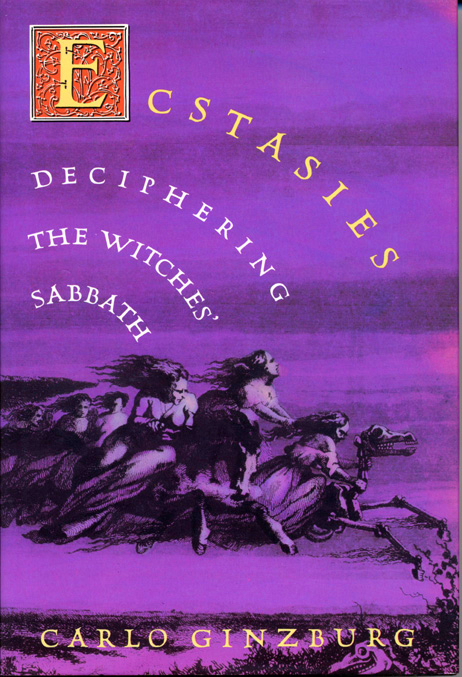
And here is an excerpt from Ginzburg's Ecstasies: Deciphering the Witches' Sabbath, first published in Italian in 1989:
In her book The Witch-Cult in Western Europe [Margaret] Murray, an Egyptologist with a keen interest in anthropology in the wake of Frazer, maintained: (1) that the descriptions of the Sabbath contained in witch trials were neither nonsense extorted by the judges, nor accounts of inner experiences of a more or less hallucinatory character, but rather, exact descriptions of rituals that had actually taken place; (2) that these rituals, deformed by the judges' diabolizing interpretation, were in reality connected with a pre-Christian fertility cult, which possibly dated back to pre-history and which has survived in Europe until the modern age . . . .

In my preface to The Night Battles [see Excerpt 1 above] I made a statement to which I still fully subscribe, even though it has earned me ex-officio enrollment in the phantom (but discredited) sect of 'Murrayists': viz., that Murray's thesis, although 'formulated in a totally uncritical manner', contained 'a core of truth'. Clearly this core is not to be sought in the first of the two points which, as we have seen, the thesis comprises. It is symptomatic that, in seeking to validate the reality of the events mentioned in descriptions of the witches' Sabbath, Murray was obliged to neglect the most embarrassing elements -- night flying, animal metamorphosis -- having recourse to cuts which amounted to veritable textual manipulation. Of course we cannot altogether exclude the possibility that in some instances mean and women devoted to magical practices assembled to celebrate rituals that included, e.g., sexual orgies; but virtually none of the descriptions of the Sabbath furnishes any proof of such events. This does not mean that they are lacking in documentary value: they simply document myths and not rituals.

Once again we must ask ourselves: whose beliefs and rituals? As mentioned before, a long tradition, harking back to the Enlightenment polemics against witchcraft trials and still very much alive, has seen in the witches' confessions the projection of the judges' superstitions and obsessions, extorted from the accused by means of torture and psychological pressure. The 'religion of Diana' -- the pre-Christian fertility cult that Murray identified, without probing it more more deeply, in descriptions of the Sabbath -- suggests a different and more complex interpretation.

The 'core of truth' in Murray's thesis is to be found here. More generally it consists in the decision, contrary to all rationalistic reduction, to accept the witches' confession -- as much more illustrious (but, paradoxically, neglected) predecessors had done, beginning with Jakob Grimm.
[pp. 8-9, in the 2004 University of Chicago Press edition]
3.
In the second of the above excerpts, Ginzburg puts forward the following very serious accusation against Murray: in order to make the evidence fit her theory, she "cut" and "manipulated" the available data. Ginzburg here relies on what he deems to be "the exhaustive demonstration of Cohn" (which Ginzburg gives as being found on pp. 111-115 of Norman Cohn's Europe's Inner Demons, although in the 2000 University of Chicago edition the numbering is pp. 155-160). But however "exhaustive" Cohn's "demonstration" may have been, Ginzburg's reliance on it is uncritical (precisely the deadly scholarly sin that Murray is supposedly guilty of with respect to confessions from the Witchcraft trials). Worse still is the fact that Ginzburg has been joined by a small army of other scholars who have all blindly accepted Cohn's "demonstration" without bothering to compare what Cohn says Murray said with what Murray actually said. I will have more to say about this in a follow-up post, but for now I refer the interested reader to Jani Farrell-Roberts' Margaret Murray and the Distinguished Professor Hutton.

Monday, June 20, 2011

Margaret Murray has been completely rejected by everyone ... except for everyone who has not completely rejected Margaret Murray.

"Mary Douglas, writing in 1992, still accepted Margaret Murray's thesis that the people accused of witchcraft in early modern Europe were practitioners of a surviving pagan religion, which had been completely discredited in the 1970s." [Ronald Hutton, 2004]

Strange, isn't it, that Mary Douglas ("the most widely read British social anthropologist of her generation," according to her obituary in the May 18, 2007 Guardian) was unaware of the "complete" discrediting of Margaret Murray?

First of all, Hutton has the year wrong (by nearly a decade). Here is the proper citation for the article in which Mary Douglas "still accepted Margaret Murray's thesis":

Sorcery Accusations Unleashed, by Mary Douglas, Africa 69 (1999), pp. 177-193.

And here is what Douglas says that Ronald Hutton finds so unacceptable:
The Egyptologist and medieval historian Margaret Murray argued in 1921 that witchcraft in Europe should be interpreted as access to supernatural powers claimed by the suppressed pagan religions, and therefore by the Christian Church claimed to be heresy. So the Christians who were charged with witchcraft by ecclesiastical authorities were actually charged with trying to draw on these discredited resources, consulting or behaving as old-time healers, laying on unconsecrated hands, claiming to be visionaries, fortune tellers and exorcists whose lore--Egyptian, zodiacal, or whatever--derived from pre-Christian religions. It was likely, on this argument, that Joan of Arc and Gilles de Raie were rightly accused of witchcraft in that sense. Kaegi (1966) described a close parallel in fifth-century Byzantium.

Other historians remind us that Christianity has always been rough on rival religions. A modern version of Margaret Murray's thesis is offered by Ginzburg (1983) to account for the burning of witches in sixteenth-century Italy. The Catholic Church, highly centralised and thus more distanced from the lowly concerns of its flock, felt threatened by the practitioners of the old religions, who were offering the faithful more immediate help and healing. So the Inquisition prosecuted the religious irregulars for witchcraft and heresy. Had the young Lele priests who were suspended by their superiors wanted to defend their actions historically, they could have found plenty of precedents. But as Catholics they suffered from lack of an accepted demonology. In modern Zaire the Catholic Church is no doubt suffering from religious pluralism. Catholic missionaries are disadvantaged in competition with Protestant Churches and the neo-apostolic movement, Christian denominations which have clearly defined their doctrines concerning demons in a way that accommodates local sorcery beliefs (Ngokwey, personal communication).
It is obvious from the above that Mary Douglas was referring not to the kind of extreme caricatures of Margaret Murray's ideas that haunt the imaginations of the Ronald Huttons and Jacqueline Simpsons of this world, but rather to a much more modest thesis that does not necessarily claim anything more radical than this: the beliefs and practices of those persecuted during the Witch-Hunts of the fifteenth through eighteenth centuries were "derived from pre-Christian religions."

But even that is already too much for Hutton, far too much, and he will have none of it. For he has made it clear that his position is that Margaret Murray must be dishonorably drummed out Academia altogether. It is not enough to criticize aspects of her scholarship, the scholar herself must be personally mocked and vilified. And Mary Douglas makes things worse, much worse, by saying that it isn't so much Murray's thesis that she actually has in mind as Carlo Ginzburg's writings, which Douglas sees as a "modern version of Margaret Murray's thesis." But ... but why would one of the world's most celebrated living historians have put forward a "modern version" of a thesis that had already been "completely discredited"?

Hmmmm. It makes one wonder if anyone else didn't get the memo? "As it turns out" (which, as it turns out, is what Apple Store employees are trained to say instead of "unfortunately" when "it turns out" that your warranty expired before your PowerBook's logic board did) the list of scholars in whose eyes Margaret Murray's ideas are not completely discredited is rather long, and includes, in addition to Mary Douglas and Carlo Ginzburg: Christina Larner, Ruth Martin, Dorothy Watts, Alan Macfarlane, P.G. Maxwell-Stuart, Anne Barstow, George Luck, Emma Wilby, Richard Horsley, Eva Pocs, Lizzie Henderson, and Keith Thomas, just to name a dozen off the top of my head.

But before going any further, let's get clear on what is actually meant by "Margaret Murray's thesis". As it turns out, this phrase can mean one of the two following things:

(1) The "Incomplete Christianization of Europe Thesis" (ICET) claims that the Witch-Hunts were launched as a kind of theologico-military mopping-up operation to eliminate surviving Pagan beliefs and practices still left over from the pre-Christian religions of Europe.

(2) The "Maximal Witch Cult Thesis" (MWCT) claims that an organized religion, constituting a homogenous cult throughout Europe, had survived intact and virtually unchanged since the Stone-Age, and that this was the Pagan religion of the Witches who were persecuted during the Burning Times.

While it is true that Murray herself claimed something more than the ICET, it is also true that she did not claim as much as the MWCT. But it is the MWCT that Hutton, Simpson, and their ilk, consistently attribute to Murray, while dishonestly treating all instances of support for any portion of the ICET as amounting to blind acceptance of the full-blown MWCT.

In follow-up posts I will provide specific citations, along with excerpts and commentary, for each of the twelve scholars mentioned above whose work lends at least partial support to the "Incomplete Christianization of Europe Thesis."


Follow-up posts:

Margaret Murray's Thesis "Contained A Kernel Of Truth" (Carlo Ginzburg)

"I've found a more personal, pagan kind of religion to satisfy the spiritual side of things."

"We were very provocative,
very disdainful and superior.
It must have been annoying."


Star Foster (of Patheos fame) tweeted this quote last Friday from Julian Clary: "I've found a more personal, pagan kind of religion to satisfy the spiritual side of things."

As soon as I saw it I had to track down the source. It's such a perfect little quote -- I was afraid it wasn't real. Too perfect. You know? And on top of that, it is usually given without any specific attribution.

But it is for real. It's from a piece about Clary written by Elizabeth Grice for the UK Telegraph: 'Revenge was always my motivation'. It first appeared on June 6, 2006. Here's an excerpt.
There was never a moment when Clary told his Roman Catholic parents he was homosexual, nor did they bring the subject up. Perhaps it was just too obvious. Perhaps their levels of tolerance and belief in personal privacy were unusually high. They sound like amazing people. Concerned mainly about his health and happiness, the nearest they came to criticism was: "Don't be quite so obvious. It's not a problem, but you don't have to go on about it."

But the point about Julian Clary is that he did have to go on about it. It was his deliberate way of dealing with taunts, even as a prepubescent schoolboy. At his secondary school, run by Benedictine monks who beat him, he and his gay friend, Nick Reader, exaggerated their effeminacy to an outrageous degree. "The bullying was hideous and relentless," he says, "and we turned it round by making ourselves celebrities. We found humour in the situation. We were very provocative, very disdainful and superior. It must have been annoying."

When he started to draw cabaret audiences for being the very thing he had been persecuted for, revenge was sweet. "It was a reversal of all I had experienced at school. I was vindicated. It was all about wanting to get revenge. Pathetic, really, but it still is the motivation."

For a time, he carried on going to church with his mother when he went home at weekends, "just to keep her company", but he found it traumatic to be stared at. "I thought they were staring at me because I was gay. But it was because I was on the telly." Though he's currently "in an interesting correspondence with a nun about forgiveness", his links with homophobic Catholicism have dissolved. "In a way, I miss it. But I've found a more personal, pagan kind of religion to satisfy the spiritual side of things."

Sunday, June 19, 2011

Christina Larner on the Meaning of "Witchcraft"

The two excerpts below are both from Christina Larner's Enemies of God: The Witch-Hunt in Scotland. For more on Larner see this other recent post: Witchcraft: Black and White in Color. Both excerpts emphasize the historical reality of Witches being associated with beneficial magic, including healing, divination, and love magic.
1.

White witchcraft is concerned with the healing arts, with prophecy, with finding lost objects, with the supply of love potions, and with performance and rituals designed to counter black witchcraft. White witchcraft always involves manipulative sorcery [that is, the use of incantations and/or ritual objects]. Black witchcraft or malefice may or may not involve sorcery, but some indication, whether articulate and precise cursing, gnomic utterance, or scarcely audible mumbling, is usually necessary to establish that the mobilization of powerful ill will has been attempted.

Most societies make this distinction. European Civil Law decreed that white witchcraft, though culpable, was not punishable by death, whereas black witchcraft was [Larner here cites Book IX, Title 18 of the Codex Justinianus, which explicitly exempts from punishment those who use "incantations" either to cure illnesses or to protect crops from hail or flood while condemning to death (often specifying particular means of torture and execution) all enchanters, magicians, Pagan priests, astrologers, soothsayers, etc.] The distinction was eroded by Canon Law and the commentators specializing in demonology in that all supernatural power not emanating from the Church was deemed to be demonic. Those claiming to heal outside the context of the Church must have got their powers from the Devil. The abolition of the distinction did find an echo in peasant experience in that the healer as a person of power was potentially threatening. Power was neutral but could be used to harm as well as to heal, and it became a common feature of European witch-trials that the accused was said to have both laid on and taken off disease. The most extreme position with regard to the conflation of black and white magic may well have been that taken in the Scottish Witchcraft Act of 1563 in which the consulters of witches were said to be worthy of death in same manner as the practitioners. Any acknowledgment of an unofficial source of power was to be supressed. The attitude of a polity towards white witchcraft is an indication of the level of anxiety about non-conformity. England continued to tolerate cunning men and women (who were quite distinct from black witches) throughout the period of the prosecution. Major witch-hunts in Scotland and on the continent on the other hand tended to engulf the healer along with the curser.
[p. 9]

2.

Amidst the diversity of beliefs about healing, the factor which stands out most clearly is the figure of the healer herself. It was she who had the power, and this power was strengthened, as it is in modern medicine, by secrecy, impressive procedures, mystery, and arduous performances by the patient. The sufferer was not expected to understand exactly how he was being healed or the purpose of the consultation and the relationship between him and the healer would disssolve. The same held true when the healer was brought in for veterinary purposes. When Robert Hutton's mother-in-law sent for Bessie Paine to cure a sick cow 'the said Bessie Paine ... caue the Cow to be put throw ane hanck of green yairne speaking some words which the personnes present did not understand and yreftir the Cow was cured.' Agnes Johnstoun's accusation against Bessie Graham in 1650 included her response to a request to heal her child. Bessie 'Tuik the bellt and wettit it' (a common form of divination) 'muttering some speiches with greit gauting eftir which she told the said Agnes that the chyld was seik and wald not leive and it provit so and the chyld died presentlie'.

In fact the charm, the failed charm, the favourable prophecy, the unfavourable prophecy, and the curse are close closely connected, and essentially fall from the lips of the same person, the person of power. In seventeenth-century Scotland blessing adn cursing, black and white magic, went hand in hand, and this assumptino was shared by peasant and lawyer alike -- and by victim and practitioner. Popular belief and practic reinforced Canon Law rather than Civil Law.

Accusations of healing, such as that cited, were listed alongside accusations of malefice, and Bessie Paine was not only said to have cured. It was alleged that she came to a house in which she had formerly lived (from which we may assume she had been evicted) after the new tenant had moved in, 'and sitting down upon her knees upon the hearth staene she said "all the witchcraft which I have I leave it here"'. The new tenant, Robert Sturgeon, as a result of this curse upon his house, was reckoned to have lost within a year and a quarter above thirty cattle dead, 'and nothing he took in hand did prosper during his possession of that rowme (place).'
[p. 142]