Wednesday, June 29, 2011

"A thousand deaths of right belong to the good Witch." ("The Good Witch Must Also Die", Part Two)

This post is Part Two of the series "A Good Witch Must Also Die". Scroll down for links to other posts in this series as I get them out.

The following picks up immediately where the previous post left off. It is from Chapter Five of William Perkins' Discourse of the Damned Art of Witchcraft.

Here observe, that both have a stroke in this action: the bad Witch hurt him, the good healed him; but the truth is, the latter hath done him a thousand times more harme then the former. For the one did only hurt the body, but the devil by meanes of the other, though he have left the body in good plight, yet he hath laid fast hold on the soule, and by curing the body, hath killed that. And the party thus cured, cannot say with David, The Lord is my helper; but the devil is my helper; for by him he is cured.

Of both these kindes of Witches the present Law of Moses must be understood. This point well considered, yieldeth matter both of instruction and practise. Of instruction, in that it shewes the cunning and crafty dealing of Satan, who afflicteth and tormenteth the body for the gaine of the foule. And for that purpose hath so ordered his instruments, that the bad Witch gives the occasion, by annoying the bodie or goods; and the good immediately accomplisheth his desire, by intangling the soule in the bands of errour, ignorance, and false faith. Againe, this sheweth the blindnesse of naturall corruption, specially in ignorant and superstitious people. It is their nature to abhorred hurtfull persons, such as bad Witches be, and to count them execrable; but those that doe them good, they honour and reverence as wise men and women, yea, seeke and sue unto them in times of extremitie, though of al persons in the world, they be most odious: and Satan in them seemes the greatest friend, when he is most like himselfe, and intendeth greatest mischiefe. Let all ignorant persons be advised here of in time, to take heed to themselves, and learne to knowe God and his word, that by light from thence they may better discerne of the subtill practises of Satan and his instruments.

For matter of practise; Hence we learne our dutie, to abhorre the Wizzard, as the most pernicious enemie of our salvation, the most effectuall instrument of destroying our soules, and of building up the devils kingdome: yea, as the greatest enemie to Gods name, worship, and glorie, that is in the world next to Sathan himselfe. Of this sort was Simon Magus, who by doing strange cures and workes, made the people of Samaria to take him for some great man, who wrought by the mighty power of God, whereas he did all by the devil. He therefore beeing a good Witch, did more hurt in seducing the people of God, then Balaam a bad one could with all his curses. And we must remember that the Lord hath set a lawe upon the Witches head, he must not live, and if death be due to any, then a thousand deaths of right belong to the good Witch.


The text above is found on page 638 of the 1618 Cambridge edition of the Collected Works of William Perkins. Here is a direct link to an image of the original of that page, and here is a direct link to the table of contents for the entire work. And here is a link to the full text of Perkins' Discourse (scanned). Those three links go to pages that are part of the Cornell University Witchcraft Collection.


"The Good Witch Must Also Die"

Tuesday, June 28, 2011

"The Good Witch Must Also Die", by William Perkins (1558-1602)

William Perkins died in 1602 at the age of 44. He was an influential Calvinist theologian and a leader of the Puritan movement inside the Church of England. Perkins was a prolific writer, and his books sold extremely well not only in England, but throughout the Western world.

The text of the following sermon was included in several editions of Perkins' Collected Works that appeared after his death. It is part of a longer (55 pages) piece that was published under the full title:
"A DISCOURSE OF THE DAMNED ART OF WITCHCRAFT; SO FARRE forth as it is revealed in the Scriptures, and manifest by true experience. FRAMED AND DELIVERED BY M. WILLIAM PERKINS, IN HIS ORDINARIE COURSE of Preaching, and published by THOMAS PICKERING Batchelour of Divinitie, and Minister of Finchingfield in Essex. Printed by CANTRELL LEGGE, Printer to the Universitie of Cambridge. 1618."
The earliest edition of this title (apparently) was in 1608, also published by Cantrell Legge of Cambridge. The year 1608 is often given as the date of the work itself, although this is six years after the death of the author. Here is a link to the full text at the Cornell University Witchcraft Collection.

Be warned. It is unspeakably evil.

The good Witch is he or shee that by consent in a league with the deuill, doth vse his helpe, for the doing of good onely. This cannot hurt, torment, curse, or kill, but onely heal and cure the hurts inflicted upon men or cattell, by badde Witches. For as they can doe no good, but onely hurt; so this can doe no hurt, but good onely. And this is that order which the deuill hath set in his kingdom, appointing to seuerall persons their seuerall offices and charges. And the good Witch is commonly tearmed the vnbinding Witch.

Now howsoeuer these both be euil, yet of the two, the more horrible & detestable Monster is the good Witch, for look in what place soeuer ther be any bad Witches that hurt onely, there also the deuill hath his good ones, who are better known than the bad, beeing commonly called Wisemen, or Wise-women. These will appear by experience in most places in these countries. For let a mans childe, friend, or cattell be taken with some sore sickness, or strangely tormented with some rare and vnknown disease, the first thing he doth, is to bethink himselfe and inquire after some Wiseman or Wise-woman, & thither he sends and goes for helpe. When he comes, he first tells him the state of the sicke man; the Witch then beeing certified of the disease, prescribeth either Charmes of words to be vsed ouer him, or other such counterfeit meanes, wherein there is no cure, if it come by Witchcraft. Well, the meanes are receiued, applied, and vsed, the sicke partie accordingly recouereth, and the conclusion of all is, the vsual acclamation; Oh happie is the day, that euer I met with such a man or woman to helpe me!
[Taken from Chapter Five, on page 638 of the 1618 Cambridge edition of the Collected Works of William Perkins.]


"The Good Witch Must Also Die"

"In the name of the Father, the Son, King Arthur, and Queen Elspeth."

The first Witchcraft trial in Scotland for which the "dittay" (indictment) has been preserved largely intact, is that of Janet Boyman in 1572. (Variations on her name are Janet Bowman and Jonet Boyman.) The documentary evidence leaves no room for doubt that this accused Witch was someone sought after for her abilities as a healer.
"Jonet Boyman of Canongate, Edinburgh, accused in 1572 of witchcraft and diabolic incantation, the first Scottish trial for which a detailed indictment has so far been found. Indeed, it is one of the richest accounts hitherto uncovered for both fairy belief and charming, suggesting an intriguing tradition which associated, in some way, the fairies with the legendary King Arthur. At an 'elrich well' on the south side of Arthur's Seat, Jonet uttered incantations and invocations of the 'evill spreits quhome she callit upon for to come to show and declair' what would happen to a sick man named Allan Anderson, her patient. She allegedly first conjured 'ane grit blast' like a whirlwind, and thereafter appeared the shape of a man who stood on the other side of the well, and interesting hint of liminality. She charged this conjured presence, in the name of the father, the son, King Arthur and Queen Elspeth, to cure Anderson. She then received elaborate instructions about washing the ill man's shirt, which were communicated to Allan's wife. That night the patient's house shook in the midst of a huge, and incomprehensible ruckus involving winds, horses and hammering, apparently because the man's wife did not follow the instructions to the letter. On the following night the house was plagued by a mighty din again, caused, this time, by a great company of women."
[Scottish Fairy Belief by Lizanne Henderson and Edward J. Cowan (2001) 127-128.]

For more on Jonet Boymen, also see P.G. Maxwell-Stuart's Satan's Conspiracy: Magic and Witchcraft in 16th Century Scotland (2001), pp. 62-66.

Friday, June 24, 2011

More Reactions to Geert Wilders' Acquittal

.
Here are some more reactions from around the world to yesterday's acquittal of Geert Wilders:

Thursday, June 23, 2011

An Erotic & Magical Greek Lesson: "What then can Love be?" "A great Demon, O Socrates"

The text for today's lesson is Plato's Symposium. If you wish to follow along at home (or wherever you are), please refer to the Stephanus numbering given below.

First, the warm-up . . . .

[202d]
[Diotima:] 'you have admitted that Eros, from lack of good and beautiful things, desires these very things that he lacks.’
[Socrates:] ‘Yes, I have.’
[Diotima:] ‘How then can he be a God, if he is devoid of things beautiful and good?’
[Socrates:] ‘By no means, it appears.’
[Diotima:] ‘So you see, you are a person who does not consider Eros to be a God.’
[Socrates:] ‘What then,’ I asked, ‘can Love be? A mortal?’
[Diotima:] ‘Anything but that.’
[Socrates:] 'Well, what?'

. . . . and then the main attraction:

ὥσπερ τὰ πρότερα, ἔφη, μεταξὺ θνητοῦ καὶ ἀθανάτου.
As I previously suggested, between a mortal and an immortal.

τί οὖν, ὦ Διοτίμα;
And what is that, O Diotima?

δαίμων μέγας, ὦ Σώκρατες: καὶ γὰρ πᾶν τὸ δαιμόνιον
A great Demon, O Socrates: and all of the Demonic realm

[202ε] μεταξύ ἐστι θεοῦ τε καὶ θνητοῦ.
is between the immortal and the mortal.

τίνα, ἦν δ᾽ ἐγώ, δύναμιν ἔχον;
having what power? [asks Socrates]

ἑρμηνεῦον καὶ διαπορθμεῦον θεοῖς τὰ παρ᾽ ἀνθρώπων καὶ ἀνθρώποις τὰ παρὰ θεῶν,
[Diotima answers:] Interpreting and transporting [ἑρμηνεῦον καὶ διαπορθμεῦον] human things to the Gods and Divine things to humans;

τῶν μὲν τὰς δεήσεις καὶ θυσίας,
entreaties [δεήσεις] and sacrifices [θυσίας] from below,

τῶν δὲ τὰς ἐπιτάξεις τε καὶ ἀμοιβὰς τῶν θυσιῶν,
and ordinances [ἐπιτάξεις] and requitals [ἀμοιβὰς] from above:

ἐν μέσῳ δὲ ὂν ἀμφοτέρων συμπληροῖ, ὥστε τὸ πᾶν αὐτὸ αὑτῷ συνδεδέσθαι.
being midway between, it makes each to supplement the other, so that the whole [πᾶν] is combined in one.

διὰ τούτου καὶ ἡ μαντικὴ πᾶσα χωρεῖ καὶ ἡ τῶν ἱερέων τέχνη τῶν τε περὶ τὰς θυσίας καὶ τελετὰς
Through it are conveyed all divination [μαντικὴ] and priestcraft [ἱερέων τέχνη] concerning sacrifice [θυσίας] and ritual [τελετὰς]

[203α] καὶ τὰς ἐπῳδὰς καὶ τὴν μαντείαν πᾶσαν καὶ γοητείαν.
and incantations [ἐπῳδὰς], and all soothsaying [μαντείαν] and sorcery [γοητείαν].

θεὸς δὲ ἀνθρώπῳ οὐ μείγνυται,
The Divine with mortals does not mingle:

ἀλλὰ διὰ τούτου πᾶσά ἐστιν ἡ ὁμιλία καὶ ἡ διάλεκτος θεοῖς πρὸς ἀνθρώπους, καὶ ἐγρηγορόσι καὶ καθεύδουσι:
but the Demonic is the means of all society and converse [ἡ ὁμιλία καὶ ἡ διάλεκτος] of humans with Gods and of Gods with humans, whether waking or asleep.

καὶ ὁ μὲν περὶ τὰ τοιαῦτα σοφὸς δαιμόνιος ἀνήρ, ὁ δὲ ἄλλο τι σοφὸς ὢν ἢ περὶ τέχνας ἢ χειρουργίας τινὰς βάναυσος. οὗτοι δὴ οἱ δαίμονες πολλοὶ καὶ παντοδαποί εἰσιν, εἷς δὲ τούτων ἐστὶ καὶ ὁ Ἔρως.
Whosoever has skill in these affairs is a spiritual person [δαιμόνιος ἀνήρ], to have it in other matters, as in common arts and crafts, is for the mechanical. Many and multifarious are these Demons, and one of them is Love.’

[A little further on [203d], Socrates adds the following by way of summing up the nature of Eros]:

κατὰ δὲ αὖ τὸν πατέρα ἐπίβουλός ἐστι τοῖς καλοῖς καὶ τοῖς ἀγαθοῖς,
he takes after his father in scheming [ἐπίβουλός] for all that is beautiful [καλοῖς] and good [ἀγαθοῖς];

ἀνδρεῖος ὢν καὶ ἴτης καὶ σύντονος,
for he is brave, strenuous and high-strung

θηρευτὴς δεινός, ἀεί τινας πλέκων μηχανάς,
a famous hunter, always weaving some stratagem;

καὶ φρονήσεως ἐπιθυμητὴς καὶ πόριμος, φιλοσοφῶν διὰ παντὸς τοῦ βίου,
desirous and competent of wisdom, throughout life ensuing the truth;

δεινὸς γόης καὶ φαρμακεὺς καὶ σοφιστής:
a master of sorcery [γόης], witchcraft [φαρμακεὺς], and sophistry [σοφιστής].


------------------------------------------

The Greek and the English translation are both taken from Perseus. Here is a direct link. The translation is from Fowler (1925), but I have taken certain liberties.

To recap: all of the following are attributed to Eros and the Demonic realm:
  1. Interpreting and transporting [ἑρμηνεῦον καὶ διαπορθμεῦον] human things to the Gods and Divine things to humanity
  2. communicating prayers [δεήσεις] and sacrifices [θυσίας] from us to the Gods
  3. communicating injunctions [ἐπιτάξεις] and requitals [ἀμοιβὰς] from the Gods to us
  4. filling in all the space between humans and the Gods, so that everything [πᾶν] is bound to everything else [ἐν μέσῳ δὲ ὂν ἀμφοτέρων συμπληροῖ, ὥστε τὸ πᾶν αὐτὸ αὑτῷ συνδεδέσθαι.]
  5. divination [μαντικὴ]
  6. priestcraft [ἱερέων τέχνη] concerning sacrifice [θυσίας] and ritual [τελετὰς]
  7. incantations [ἐπῳδὰς]
  8. soothsaying [μαντείαν]
  9. sorcery [γοητείαν]
  10. all society and converse [ἡ ὁμιλία καὶ ἡ διάλεκτος] of humans with Gods and of Gods with humans, whether waking or asleep
  11. the ability to be a true spiritual person [δαιμόνιος ἀνήρ] (or is that a truly Demonic person?)
  12. In general, all interaction, of any kind, between the Divine and mortals must be by way of the intermediary realm of the Demons. Otherwise, the Divine and mortals do not mingle directly [θεὸς δὲ ἀνθρώπῳ οὐ μείγνυται].


J.K. Rowling Announces "Pottermore"

(Here is a direct link to Pottermore. Scroll down for press release ....)


From the official press release (full text available at the DailyGrail.Com):
J.K. Rowling today, Thursday 23rd June, answered mounting speculation about the nature of her new project and announced Pottermore, a unique and free-to-use website which builds an exciting online experience around the reading of her hugely successful Harry Potter books, and is partnered by Sony.

The announcement today was heralded by the revealing of the website’s name via an online search for its letters, and a ‘coming soon’ holding page which received over a million visits within 36 hours of launching.

For this groundbreaking collaborative project, J.K. Rowling has written extensive new material about the characters, places and objects in the much-loved stories, which will inform, inspire and entertain readers as they journey through the storylines of the books. Pottermore will later incorporate an online shop where people can purchase exclusively the long-awaited Harry Potter eBooks, in partnership with J K Rowling’s publishers worldwide, and is ultimately intended to become an online reading experience, extending the relevance of Harry Potter to new generations of readers, while still appealing to existing fans. As the Pottermore Shop develops, it is intended that it should include further products designed specifically for Harry Potter fans, offering a potential outlet for Sony products and services related to Pottermore. In keeping with Harry Potter’s international appeal, the site will launch in English, French, Italian, German and Spanish, with more languages to follow.

Geert Wilders: "The Dutch are still allowed to speak critically about islam, and resistance against islamisation is not a crime."

A major victory for freedom of speech has occurred. Here is what Geert Wilders was told by the judges presiding over his trial for "hate speech" against Islam:
"You are being acquitted on all the charges that were put against you. The bench finds that your statements are acceptable within the context of the public debate."

And here is a round-up of world headlines on the acquittal of Geert Wilders:

Reuters:
Geert Wilders acquitted of hate speech against Muslims

Radio Netherlands:
Positive reactions to Wilders' acquittal

Telegraph:
Geert Wilders acquitted on hate speech charges

Bloomberg:
Dutch Court Acquits Freedom Party Leader Geert Wilders of Defaming Muslims

Al Jazeera:
Dutch MP acquitted in 'hate' trial

Agence France-Presse (via yahoo news):
Dutch anti-Islam lawmaker Wilders acquitted

Deutsche Welle:
Dutch court acquits Geert Wilders in hate speech trial

Jerusalem Post:
Dutch court acquits Geert Wilders in hate speech case

MSNBC:
Dutch court acquits lawmaker Geert Wilders of Muslim hate speech charges

BBC:
Geert Wilders cleared of hate charges by Dutch court

New York Times:
Dutch Court Acquits Anti-Islam Politician

RTÉ News:
Geert Wilders acquitted of inciting hatred

Wednesday, June 22, 2011

Her New Name For A Blog

Just in case anyone didn't get the memo, Hecate Demetersdatte, one of the brighter lights in the Pagan blogging firmament, has moved her blog to wordpress:
http://hecatedemeter.wordpress.com/

Tuesday, June 21, 2011

Margaret Murray's Thesis "Contained A Kernel Of Truth" (Carlo Ginzburg)

0.
Here is the first of several follow-ups to my previous post: Margaret Murray has been completely rejected by everyone ... except for everyone who has not completely rejected Margaret Murray. Most of this post consists of two excerpts from Carlo Ginzburg's groundbreaking studies The Night Battles (1966) and Ecstasies (1989). Following those two excerpts there is a very brief note concerning Ginzburg's accusation that Margaret Murray "cut" and "manipulated" the data to fit her theory.

1.
Here is an excerpt from Carlo Ginzburg's The Night Battles: Witchcraft & Agrarian Cults in the Sixteenth & Seventeenth Centuries, first published in Italian in 1966:
According to Murray, the conventicles described by the accused were real, and witchcraft was a very ancient religion, a pre-Christian fertility cult, in which the judges, more or deliberately, chose to see only a diabolical perversion. Although this thesis contained a kernel of truth, it was formulated in a wholly uncritical way; moreover, the reconstruction of the general characteristics of this supposed fertility cult was based on very late trials in which the assimilation of the inquisitorial schema (sabbat, nuptials with the devil, etc) was by now complete. And yet, despite these serious defects, Murray's 'thesis', which was rejected by anthropologists and folkorists when it first appeared, ended by prevailing. what had been lacking then, and the need persists today if I'm not mistaken, was an all-encompassing explanation of popular witchcraft: and the thesis of the English scholar, purified of its most daring affirmations, seemed plausible where it discerned in the orgies of the sabbat the deformation of an ancient fertility rite. In this mitigated form it was reformulated by W.E. Peukert, among others.

And yet it is not so easy to demonstrate that popular witchcraft (as distinct from generic supsertitions, such as love potions, spells, etc., which are not traceable to a precise cult) actually went back to an ancient agricultural fertility cult. One primary objection has already been raised about Murray's work: we cannot rely uncritically on the confessions of the witches without attempting to distinguish in them between what is of inquisitorial provenance and what is of genuinely popular origin. But this is not a fatal objection . . . .

[Then Ginzburg spends a few sentences discussing the work of J. Marx, L. Weiser-Aall and A. Meyer, before moving on to his main point.]

The present research now establishes, in an area such as the Friuli, where Germanic and Slavic traditions came together, the positive existence at a relatively late date (from c. 1570) of a fertility cult whose participants, the benandanti, represented themselves as defenders of harvests and the fertility of fields. On the one hand, this belief is tied to a larger complex of traditions (connected, in turn, with the myth of nocturnal gatherings over which female deities named Perchta, Holda, Diana presided) in an area that extends from Alsace to Hesse and from Bavaria to Switzerland. On the other hand, it is found in an almost identical form in the land which once comprised Livonia (present day Latvia and Estonia). Given this geographic spread it may not be too daring to suggest that in antiquity these beliefs must once have covered much of central Europe. In the span of a century, as we shall see, the benandanti were transformed into witches and their nocturnal gatherings, intended to induce fertility, became the devil's sabbat, with the resulting storms and destruction. We can thus state for a fact that for the Friuli diabolical witchcraft grew out of the deformation of a preceding agrarian cult. Of course it is impossible to extend this conclusion by simple analogy to other parts of Europe; nevertheless, though limited and circumscribed, it may serve as a working hypothesis for future research. At any rate the existence of this complex of beliefs over a large, key area implies, in my opinion, a new approach to the problem of the popular origins of witchcraft.
[pp. xix-xxi, in the 2009 JHU Press edition]

2.
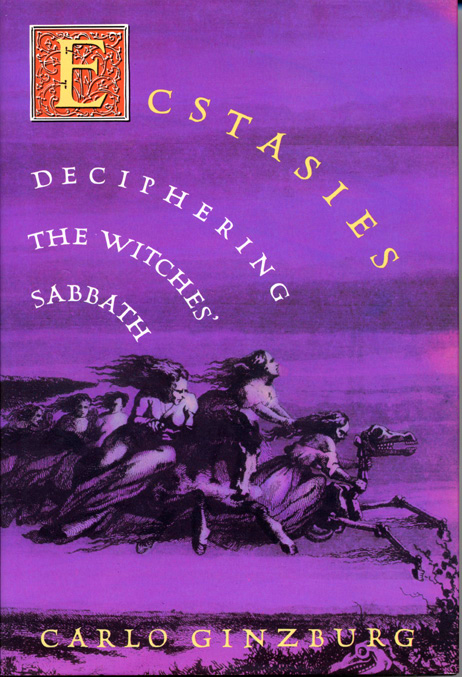
And here is an excerpt from Ginzburg's Ecstasies: Deciphering the Witches' Sabbath, first published in Italian in 1989:
In her book The Witch-Cult in Western Europe [Margaret] Murray, an Egyptologist with a keen interest in anthropology in the wake of Frazer, maintained: (1) that the descriptions of the Sabbath contained in witch trials were neither nonsense extorted by the judges, nor accounts of inner experiences of a more or less hallucinatory character, but rather, exact descriptions of rituals that had actually taken place; (2) that these rituals, deformed by the judges' diabolizing interpretation, were in reality connected with a pre-Christian fertility cult, which possibly dated back to pre-history and which has survived in Europe until the modern age . . . .

In my preface to The Night Battles [see Excerpt 1 above] I made a statement to which I still fully subscribe, even though it has earned me ex-officio enrollment in the phantom (but discredited) sect of 'Murrayists': viz., that Murray's thesis, although 'formulated in a totally uncritical manner', contained 'a core of truth'. Clearly this core is not to be sought in the first of the two points which, as we have seen, the thesis comprises. It is symptomatic that, in seeking to validate the reality of the events mentioned in descriptions of the witches' Sabbath, Murray was obliged to neglect the most embarrassing elements -- night flying, animal metamorphosis -- having recourse to cuts which amounted to veritable textual manipulation. Of course we cannot altogether exclude the possibility that in some instances mean and women devoted to magical practices assembled to celebrate rituals that included, e.g., sexual orgies; but virtually none of the descriptions of the Sabbath furnishes any proof of such events. This does not mean that they are lacking in documentary value: they simply document myths and not rituals.

Once again we must ask ourselves: whose beliefs and rituals? As mentioned before, a long tradition, harking back to the Enlightenment polemics against witchcraft trials and still very much alive, has seen in the witches' confessions the projection of the judges' superstitions and obsessions, extorted from the accused by means of torture and psychological pressure. The 'religion of Diana' -- the pre-Christian fertility cult that Murray identified, without probing it more more deeply, in descriptions of the Sabbath -- suggests a different and more complex interpretation.

The 'core of truth' in Murray's thesis is to be found here. More generally it consists in the decision, contrary to all rationalistic reduction, to accept the witches' confession -- as much more illustrious (but, paradoxically, neglected) predecessors had done, beginning with Jakob Grimm.
[pp. 8-9, in the 2004 University of Chicago Press edition]
3.
In the second of the above excerpts, Ginzburg puts forward the following very serious accusation against Murray: in order to make the evidence fit her theory, she "cut" and "manipulated" the available data. Ginzburg here relies on what he deems to be "the exhaustive demonstration of Cohn" (which Ginzburg gives as being found on pp. 111-115 of Norman Cohn's Europe's Inner Demons, although in the 2000 University of Chicago edition the numbering is pp. 155-160). But however "exhaustive" Cohn's "demonstration" may have been, Ginzburg's reliance on it is uncritical (precisely the deadly scholarly sin that Murray is supposedly guilty of with respect to confessions from the Witchcraft trials). Worse still is the fact that Ginzburg has been joined by a small army of other scholars who have all blindly accepted Cohn's "demonstration" without bothering to compare what Cohn says Murray said with what Murray actually said. I will have more to say about this in a follow-up post, but for now I refer the interested reader to Jani Farrell-Roberts' Margaret Murray and the Distinguished Professor Hutton.