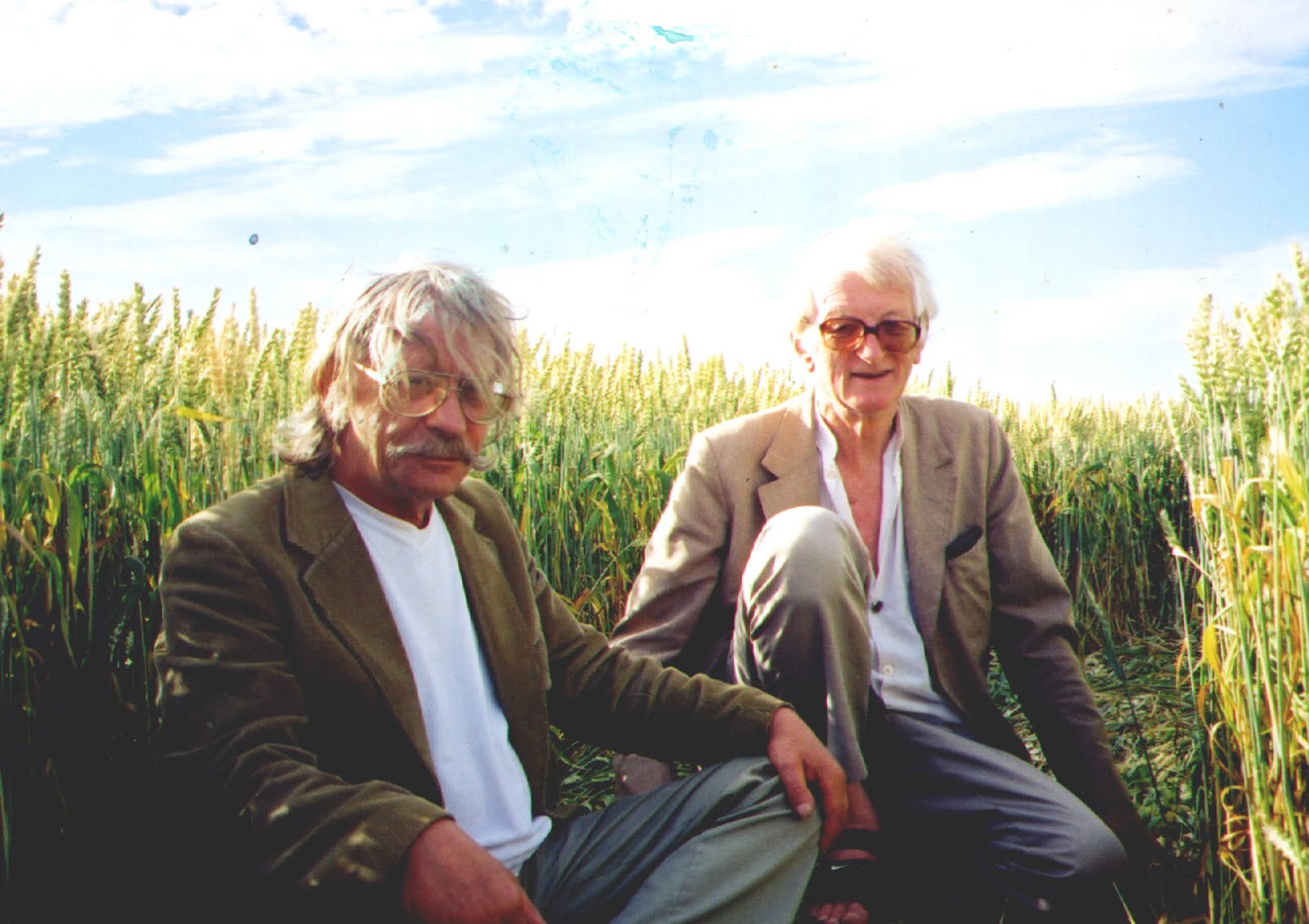
.
"These are all really complex subjects that you can't just boil down into a soundbite, but lets just start by saying that we really both hate fascism."
"We do, we do hate fascism. And we are against it."
[The following is a transcript of an interview of Amy Hale by Jason Pitzl-Waters. The interview was conducted on April 1, as part of the second installment of a new series of podcasts sponsored by The Wild Hunt. I think the content of this interview is of great interest to a great many people in the Pagan and Esoteric communities. I will have more to say by way of my own analysis - hopefully soon. The time stamps are approximate and refer to the whole podcast, of which this interview is just one segment.]
 Jason Pitzl-Waters
: [38m52s] Now for
this segment on the Wild Hunt Podcast I'm talking to anthropologist and folklorist Dr. Amy Hale, she is the author of a new paper that's in the latest edition of
The Pomegranate, it is entitled
John Michell, Radical Traditionalism and the Emerging Politics of the Pagan New Right. Welcome Amy, thank you for taking some time out to talk to me today.
Amy Hale: Hi Jason, thank you for having me.
JPW: So, there's a lot of stuff to kind of break down and parse in this article. I guess we have to talk about what is Radical Traditionalism, who is John Michell, why is he important to Radical Traditionalism, and what is the New Right? These are all really complex subjects, you can't just boil down into a soundbite, but lets just start by saying that we really both hate fascism.
AH: We do, we do [39m58s] hate fascism, and we are against it. One thing that I definitely want to clarify, one of the reasons why this topic tends to get very heated, there are a number of reasons why it tends to get very heated, because frankly a lot of people first of all, really hate fascism. The thing is, though, people tend to throw around words like "fascist", and its very common for people to say, "oh, I don't like you, you are doing X thing that I don't like, therefore you are a fascist." And because of that, in the public discourse when we talk about things like the New Right, when we talk about nazism or neonazism or fascism or historical fascism or neofascism, these are all actually very precise terms, but because of their use in popular discourse, a lot of people get very very upset, and I think rightfully so. So I want to make sure that everybody listening to this knows that when we talk about things like fascism [41m4s] in this context, I'm going to be using some fairly precise definitions of what that is and what that is not, because in the case of the New Right in particular and some of these movements, some of the things that are happening, there are a lot of people who say, people on the New Right, who absolutely very much disagree with that label. I think as we go on we'll talk about that a little bit more, so I can help clarify some of that for the audience as we go through the conversation.
JPW: OK. And as you said, fascism in the modern right and left, at least in American politics, is thrown around all the time. You know: "this Republican's a fascist," "Obama's a fascist," basically it's like, anyone who's doing something we don't like is a fascist.
 AH
AH: Exactly. The other thing is that even people academically who are writing in political science, there is not a firm agreement on what is and is not to be considered fascist, which is why when you read different political scientists and different historians, people have to do a lot of defining of their own terms for the purpose of their own studies. So there are different schools of thought that have slightly different emphases, and so when I use those terms very specifically, and precisely, I have scholars who's work has influenced me on this, and so I think it's really important that when we're using terms like this that we are precise and that we're careful so that we can actually get into the meat of what we're talking about, rather than having a lot of crazy rhetoric floating around that makes people mad. [42m48s] However, having said that, I do have particular definitions of fascism that will still make people unhappy. So there you go.
JPW. OK. So, why don't we start with John Michell. He was a Traditionalist, he was a New Age, proto-New-Age guru, he was an Earth Mysteries guy, he kind of came up with all kinds of crazy theories about Atlantis and about Britain as a New Jerusalem. So, and for a good portion of his career was basically embraced by hippies if I understand that correctly. So, certainly not, at first anyway, a figure that would be used for, like, right-wing infiltration or nasty extremist politics.
 AH
AH: Well, and this is one of the reasons why historically John Michell is such a fascinating character. By way of a little bit of background, in my own interest in this, I've actually worked in the UK for over 20 years now and I've studied the cultural politics of broadly speaking Celtic identities. Most of my work has been in Cornwall, where there are a lot of Earth Mysteries, there's a lot of interest in Earth Mysteries there, a lot of people live there for that reason because there's so much incredible stuff happening with the landscape. There's also a huge tourism industry devoted to Earth Mysteries at Cornwall. So, for me, John Michell ended up, when I first started doing this work, becoming this very interesting figure where this whole range of cultural ideas and politics and subcultural motifs come together. So again to give a little bit of background about him: as you rightly he was a very very important figure in the British counter-culture and in the Earth Mysteries, developing Earth Mysteries scene, and his most famous work related to this, "The View Over Atlantis", was really about the way in which people could interact with the sacred landscape of Britain, although he believed that sacrality and the sacred energies running underneath ley lines in Britain, that this was a universal phenomenon, that you could find this anywhere, and he really just kind of blew some things apart. Obviously there had been this idea of sacred landscape and ley lines in Britain, this is something that people had been into since the 1920s, but what he really popularized was the notion that these were connected to energy currents, telluric currents that ran under the earth. Now, although he popularized this in Britain, this is something that, the idea of telluric currents was that were affiliated with sacred sites, this is something that was already pretty well established for people who were doing Earth Mysteries on the Continent, and in Germany. So this is something that he didn't invent, it was something that he picked up on that was happening in Esoteric cultures elsewhere. So that's part of his importance, was taking the idea of ley lines and really kind of bumping it up a notch with the notion that these were connected to sacred currents, earth currents, that people could contact by visiting these sacred sites and by going along ley lines.
 JPW
JPW: [46m47s] I think a lot of modern New Age and Pagan authors sort of inadvertently reference [John] Michell and his work, without maybe even knowing that they're doing that. So I guess he was this formative author, and actually as you point out in your article, he actually wasn't himself that much of a big hippie liberal, he was actually pretty conservative in his personal life, and towards the end of his life he [John Michell] started interacting with, if I'm getting this right, interacting with figures from the European New Right. Is that correct?
AH: That is correct, as I understand it that is correct. And one of the other reasons that he is such an interesting figure in this is that one of the characteristics of the New Right is that they see themselves as being, they call themselves the New Right, and this is a reference actually to the old,
old right in Europe, which is something that we don't really understand in American politics, because we have our own characteristics of right and left. And John Michell, he really kind of fits with this idea of old European right, which is really neither right nor left. So what ends up happening is you get his ideas, which translate into neotribalism and a lot of really incredibly libertarian ideas. He was very, uh, he was an advocate of legalized marijuana and things like that, and so there were a lot of reasons why the hippies found him, I mean, you know, he was being really radical about some of these things which appear to be very left wing. At the same time he was also quite royalist, from my understanding, and there were many ways in which he was comforted by the notion of traditional society, traditional hierarchy--he really thought that Britain needed to go back to the time period before the Reformation, and that establishing that kind of traditional society with traditional hierarchies would really be more in line with what Britain needed in order to actually reach its own most sacred state would be to go back to that kind of society. So you can kind see in his work and in his personal ideology this interesting mixture of what looks like a really radical social commentary with something that is traditionally based in a way that I think a lot of us kind of have trouble understanding.
JPW: Right I think the classical notion of conservatism, sort of this person who stands athwart history and says, "here, and no further." And Michell, as you point out, was quite a radical in that he actually wanted to turn back the clock [AH: yes] to a golden age, and it's really this sense of a golden age, and of a distrust of modern thought, that sort of made him very appealing to the New Right and from what I understand, to explore what the New Right is, because I think, as you say, these terms are very different in European politics than in American politics, where we understand right and left as the Republican Party and the Democratic Party, or even in Great Britain where we understand it as the Tories and the Labor Party. [AH: exactly] And what we're talking about here as right is actually these New Right groups, are always what they call "third positionist" in they see themselves as above the right left fray, and that they are bringing forward a new paradigm in politics that is taking the best in their minds from classical conservative and liberal values.
 AH
AH: Absolutely, that's exactly what they're doing. And it's important to understand that there are a whole bunch of these third positionist, and New Right groups that have very different views on social structure. There are a number of features that they share but some are starch [sic?] monarchists, some are what would be called anarcho-monarchists, some are kind of much more libertarian, have different views on democracy and representation, so there's actually kind of a spectrum of activity over there as well, and sometimes it really is very hard for us to get our heads around what it is that they are promoting when we're thinking of strictly a right-left divide, because it actually is true [52m24s] that they really don't fit that category particularly well. And I think that one thing I don't want to do is to because of what's happening ... [ garbled] ... "Confessions of a Radical Traditionalist is something that was edited toward the end of his life. And from what I've read from his biographer, in his biography, he was trying to kind of shed this hippy image. It's really hard to know exactly what his involvement with New Right politics was or would have been. So I don't want to overstate that he was all of a sudden becoming some sort of crazy activist, because I don't have that specific data. But it is clear that he was knowledgable about it, and from what he wrote and from other aspect of his life, I think we can certainly say he was conscious of it and sympathetic to some of their aims."
JPW: Right. So, here we bring up another term, which is Radical Traditionalist [both laugh], and I think this is where our conversation is going to start getting into the weeds [more laughter] of political jargon, and so our listeners will have to forgive us if we get a little bogged down here. In your article you quote Tamir Bar-On from his article
Fascism to the Nouvelle Droite: The Dream of Pan-European Empire [54m1s], and he says, the New Right has a list negations which it shares with historical fascism, which is anti-modernism, anti-capitalism, anti-immigration, anti-materialism, anti-egalitarianism, and anti-Americanism. So I guess if we're going to place the New Right on a spectrum, would you say that there are benign New Right groups that are merely sort of yearning for a golden age and want to rise above partisan politics and then there perhaps is another portion of the New Right spectrum that are, as this other scholar [Bar-On] notes, sympathetic with historical fascism?
 AH
AH: Yes. I absolutely think that there is a continuum of beliefs, interests and activities among these groups. I think that there are a number of people who not maybe identify as Radical Traditionalists but who might identify as Traditionalists within certainly the Pagan community who would find any notion of of ethnic separatist politics to be odious and disturbing, and really what they're interested in, they might be perhaps of an anti-modernist bent, may perhaps be of an anti-corporate-capitalist bent, perhaps even into more collective living, into maybe radical environmentalism, and are most interested in the notion of resacralizing the world which is a key idea within Traditionalism and within Radical Traditionalism. And so I think that there are a number of Traditionalists, Prince Charles, for one, actually qualifies as a Traditionalist. A key to Traditionalism is that there is a single Tradition, with a capital "T", that really represents the sacrality of the world and when one is in touch with this, then life, the universe and everything will be in harmony. So yes, I think that there are a number of Traditionalists who, and maybe even some Radical Traditionalists, who are not interested in these politics, and maybe not even aware of them. But what I hope we talk about a little bit later is the frameworks underneath these that actually cause, in my view, potentially a bit of a slippery slope.
JPW: So, Radical Traditionalism would you say is a movement within the broader umbrella of the New Right?
AH: Yes. My view is, and again, I just want anybody to know that if there are other perspectives on this that I am very happy to listen to the data on this. I believe that Radical Traditionalism is really the, it's emerged within a Pagan framework, in an explicitly Pagan framework, and it is, um, it really is, uh, I think a way to help merge some of the politics, political views, with the New Right, specifically those of Julius Evola, Rene Guenon, and to take those, and to put them in a more Pagan and Esoteric framework, to help build a more Pagan culture, around the ideas of the European New Right.
 JPW
JPW: Obviously I've encountered Radical Traditionalism at several points over the years doing journalist work, and at first it just seemed sort of like, like you said, mostly and largely benign, "we're harkening back to a golden age when men were men and women were women and Tradition was important," you know, and it was sort of this yearning for, I guess, a purer time. And it was very Pagan, explicitly so, and often allied itself with several underground bands, especially in the neofolk subculture in Europe. So it really was trying very hard to be something that would appeal to a very specific subculture. I guess what my issue here is that [59m18s], how much of Radical Traditionalism as a movement, how much of it do you think is co-opted by extremists, racists and people who believe in a sort of virulent ethnic superiority.
AH: Well, I think that, uh, one thing I want to look at within this is certainly the idea of ethnic superiority because, uh, well, to answer the first part of your question I will say that I believe that there is a lot of what is called Radical Traditionalism that has some politics that I personally believe and would define to be what we call little 'f' fascism. Which means not historical fascism which is defined by the Nazism and Italian Fascism during the interwar and WWII period. And so yes I do believe that there are some in my view rather challenging[?] politics that are promoted by these groups. Now the difficulty is that there are some who I have seen who are absolutely promoting white supremacist views. And I know that there are some people who are going to be very upset by that but I'm sorry, there are. There are some who are actually allied with white supremacist organizations. That is also true. I am very sorry if you do not want to hear that. However, there are a number of people involved with Radical Traditionalism who are separatist rather than supremacist, and I think it's important to make that distinction. A lot of them feel that they are actually promoting diversity by promoting separatism and the idea within their framework that what the world needs in order to be more diverse and happy is for everybody to be within their own ethnically homogenous enclave, and people like myself don't find that that is viable, nor is it a particularly good idea, and it also just doesn't reflect the way that culture works. I mean there are no pure cultures. Cultures, like people, thrive off of contact. In some ways, culture works well biologically if we use that kind of biological model where the cultures that are the most vibrant are actually the ones that have had the most contact. That kind of [garbled] doesn't actually promote them. I think it's very difficult that the rhetoric, and I do believe it is rhetoric, that many of them use about diversity, I find that it's more almost co-opting the strategies of leftist discourse in order to, that the real agenda is this type of separatist enclave.
JPW: It does seem to me to be almost a smoke-screen for a more noxious form of politics. That the "separatism" is really a, I'm not saying that there aren't, who don't have any underlying agenda, but it just seems that most of the rhetoric I've read online about these homogenous separatist communities are really sort of a polite supremacism.
 AH
AH: Some of it is a polite supremacism, and some of it is a very impolite supremacism, and as I've been following this movement over the past couple of years, it's gone from being implicit to explicit. You know I visited one website that markets to the Esoteric community that was basically issuing blog points about Black History Month, and why there shouldn't be one. In my view, well, thanks for letting me know how you really feel. And they put it out there, so, there you go. But one thing I want to mention though about this is we can look certainly within Paganism and see how certain attempts at actually being culturally sensitive have opened the door to this, and I want to talk about is the notion of cultural preservation and appropriation, because I think that a lot of Pagans are very sensitive to cultural appropriation and think its a bad thing and don't want to do it ...
JPW: Right, and I want you to continue that thought, but I just wanted to point out that obviously within reconstructionism especially there are very strong ideas of preserving cultures and preserving religious cultures and about not appropriating cultures that you don't belong to.
AH: Exactly. And it ends up being a kind of a sticky issue theoretically, because I have been professionally involved with minority cultures and with cultural preservation for most of my career, in both a professional and a personal context, and I feel very strongly about these issues, however, they're not cut and dry. So what ends up happening is you get a lot of good Pagan folk, and folk in general who really want to try to do it right, so, well, we don't want to appropriate anything, and we also want to preserve culture because we think that cultural preservation is a good thing in general. So what do we do? Well, gee, we need to only work within the tradition that belongs to us. Well, how do you define that? Well, you pick and choose. A lot of people do. So a lot of people try to find traditions that they feel are part of their genetic inheritance, which for most of us in the United States, well, for most of us anywhere, that's a choice we make, we choose to [garbled] we call our genetic inheritance, because as I was saying earlier, culture doesn't work like that. So I think that this notion of trying to do things, like a lot of the current thrust of reconstructionism, and trying to do things in a really pure, authentic, and that in really big finger quotes, way, comes out of just wanting to do things right and trying to be a good person. Unfortunately, when you start going down that road, it's not very far to making arguments about cultural purity in the name of preservation. And what we need to remember is that when we are talking about things like cultural appropriation, there are a lot of really good reasons to not do it, and a lot of those are dictated by economic, cultural genocide and exploitation that a lot of us just don't want to be a part of and associated with. But when you look at cultural borrowing, that's something that most of us do on a daily basis whether we are aware of it or not, and what I'd like to see within the Pagan community is for us to be more aware, more sophisticated about how culture works, what's the difference between appropriation and borrowing? When it is OK to do that? When is it not? In what context do we do this? Because if we don't get better at having those conversations, and if we're not more sophisticated then we come up with unsophisticated responses. And in my view, the notion of cultural purity and trying to maintain this crazy notion of cultural-genetic inheritance, that is an unsophisticated response.
 JPW
JPW: I want to kind of bring this all together now, and what I think what your paper hints at is that John Michell as a figure is indicative of a much larger trend, which is [1h8m57s], which is taking these popular figures and thinkers throughout history, especially our modern history, and then using them as advertisements for I guess what you could call a cryptofascist ideology, and then selling that back to esoteric and Pagan communities in hopes of swelling their own ranks. Would you say that's a fair assessment?
AH: Yes, and I know that a lot of people aren't going to want to hear that. I think that we tend to see this, we might tend to see this impulse more in music, which is another conversation that we could have, a huge and probably even more controversial conversation would be the role of music in all of this, but the interesting about John Michell was when I first started looking at this particular volume [Confessions], I mean a lot of his work, if you look at a whole bunch of his work, you probably wouldn't see it. You might say, [1h10m16s] "oh, that's a bit odd, a bit quirky." You might read some of his essays, if you can even find them, some of his older essays and say, "that's seems a bit strange for somebody whose been so allied with the left." But this particular volume was done in my view in a complicit way. He was working with people who were trying to make a point with his work. So they were cherry picking essays that were sympathetic to and supporting a particular political viewpoint. And at first I was, it took me a while to realize, "oh hey, wait, he was OK with this because he was part of this of this program. He supported the positions of Julius Evola, who is a very complicated writer, a very controversial writer, um, had a lot of very interesting things to say. So he [Michell] was part of a program to give wider attention to his [Evola's] work and to place Evola's thoughts in perhaps a number of different contexts. So, yes, I think that in doing this, it's opening up and showing his work in a new light and in fact might be turning a different group of people onto his body of work which can now be read in a very very different way than I think most people would ever consider reading it.
JPW: OK. Now as far as Michell, and you bring up Evola, which is of course a whole other bag of worms there, but I think what strikes me is that a lot of these thinkers that are used by the New Right and by Radical Traditionalists as tools to do recruiting is that, their murkiness and the difficulty of parsing where they really stand, is something that is purposefully exploited. I see this even with Aleister Crowley, is that they take thinkers who are not easy to categorize politically, and therefore that gives them a lot of ideological cover when they're trying to sell some other agenda with those thinkers.
 AH
AH: [1h12m48s]I absolutely agree, and Crowley's a good example. I have encountered a number of thinkers and theorists who really believe that Crowley represented a perspective that is very consonant with the aims and perspectives of the New Right. Sometimes I agree with that, sometimes I vigorously disagree with that. I think that Crowley probably would have had some agreement and and would have really disagreed on other grounds. So, yes, you are correct in that a lot of their rhetoric is very murky, it is designed to be so, absolutely. People affiliated with the New Right completely dismiss the term fascist when applied to their work. They don't see it at all, or they do see it and they just don't want to discuss it. I think that part of what is happening within Paganism is you find a lot of people who are promoting the New Right who will use a variety of writers who maybe have very very different views, and they will tuck them into their publications, or they will schedule a variety of bands together, so that you can't say very specifically, "oh, this is a publication that says
this", it just gives you a taste of it here and there and has enough other people involved so that if you try to say that they are promoting one view, they'll say, "but this person's in here, and they don't represent that viewpoint," and because this is something that some New Right theorists, is a tactic of entryism that they have specifically written about ts kind of easy to know ... [audio garbled] ... how it works.
JPW: So, yeah, you actually bring up the term "entryism", and that's actually a term that I've encountered as well. [1h14m54s] Basically, the terms of engagement is you don't give your full ideology, you just give little bits that are acceptable. So I guess I don't want to go too much longer, so lets, I want to wrap up by sort of asking a larger question which is, how dow we, how does the larger Pagan and Esoteric community fight infiltration by crypto-fascist groups? Is the old add that sunlight is the best disinfectant? Is it merely an issue of bringing these people to light? What do you feel is the proper response for Pagan groups that are concerned about infiltration from political groups that may fly in the face of everything that they believe in?
 AH
AH: [1h15m54s] Well, unfortunately, I think what this is going to require in my view, isn't even bringing these people to light, because what I think we need is an internal conversation with ourselves as Pagans. And I think we need to look at what we are doing and what values we are holding and what communities we're creating that are opening the door for this kind of thing to continue. And one thing that I want to see and that we need to look at, is what do we, why do we feel the way we do about the idea of "tradition"? And this is really hard because, you know, we like things that are traditional, we like folklore because its cuddly and its cozy and it makes you feel warm and yummy.
Unfortunately, "tradition" is really something that is ideologically loaded, and it's the notion of tradition that a lot of the right, both the old right and the new right, and really any flavor of right centers around, and we need to look at why we as Pagans give the notion of "tradition" and "lineage" as much power as we do. And that's going to be a really hard conversation that we're gonna have to have, because I think a lot of people tend to feel that "tradition" is the center of their practice, and it's "tradition" which gives us legitimacy. I don't agree with that. I think that we are legitimate because of what we choose to do and how we choose to practice, and we need to start dismantling this notion of "tradition", or at least understand why it is that we like it as much as we do, so we can kind of see this stuff coming.

Another thing I want us to look at is, um, or at least be aware of, is the role of radical environmentalism in this, and I think that most of us would be, "Yeah! Environmentalism, that's fantastic!" But we need to know when we are getting "blood and soil" arguments wrapped up in radical environmentalism. And when people are talking about land, and the sacrality of land, and nature and the countryside, and when we are seeing
conservative arguments rather than progressive ones. And so I think that it's going to be really a process of unpacking a lot of things that are very important to Pagans today and understanding what the roots of those are, because shining a light on somebody who has views which we might consider less than savory, uh, I don't think that's going to do the trick. [1h19m10s]
Other relevant posts from this blog:


We Christians desperately want to think we are still [sic!] having a positive effect with traditional mission efforts. And it is not hard to produce evidence that seems to support that belief. Never before have more missionaries been sent to 'foreign' fields: American missionaries, European missionaries, Korean missionaries, Indian missionaries. Tens of thousands of people convert to Christianity each year as a result of these efforts. Christianity is still the largest religion in the world, with almost two billion members.
And what do we do about these realities? We talk about the places Christianity is still growing and ignore those where it is either stagnant or in decline. We was eloquent about growth that can't be measured or confirmed--house churches in China and background believers in the Muslim world--and pretend we don't notice the closing of national borders to Christian mission workers across the 10/40 window.
Consider one aspect of the nightmare: the Buddhist world. The Christian mission movement has failed in cultures with a dominant Buddhist element. Lets generously define failure as at least a century of mission effort that has resulted in less than 25% of the people in such cultures coming to know Jesus Christ as their Lord and Savior.
Total the figures for these Buddhist countries, and you find that the Christian mission movement has resulted in an average of less than 5% of the population of these countries embracing Christianity, despite almost two centuries of mission efforts.