Friday, April 25, 2014
On Helen Ukpabio, Christianity, and African Traditions
Ukpabio represents a spiritual tradition, if it can be called that, that has it's roots not in ancient African traditions, but in the modern history of Protestant Christianity in England, Scotland and the United States of America.
Anyone with even the slightest familiarity with the writings of John Knox, King James, John Wesley, William Perkins, and Cotton Mather on the subjects of spiritual warfare, demonology and Witchcraft, will immediately recognize the ravings of the likes of Helen Ukpabio, and will have no doubt as to their true origins.
Those, like Kenaz Filan, who believe that they see in Ukpabio the regrettable "mixing" of Christianity with African traditions only reveal their own complete ignorance of both.
.
Sunday, April 13, 2014
Are You Under Attack By Mermaid Spirits? Well, Are You??
And remember: "Disconnection is free of charge."
Saturday, May 12, 2012
"Having killed and buried African traditional religions ..."
In 1998 Rev. Dr. Timothy M. Njoya published an article titled The Church as a Global Society. In the article Njoya, a minister of the Presbyterian Church of East Africa (now retired), stated very bluntly that "Africa became Christian by submission, not by conversion," and he makes it clear in the article that by "submission" he is referring directly to the enslavement and colonial conquest of Africans by European Christians.It is important to note that not only is Njoya a Christian minister, but, unlike many of his fellow African Christians, Njoya's attitude toward African Traditional Religion is uncompromisingly hostile. He has no interest in projects such as so-called indigenization or Africanization. He does not regret the Christianization of Africa, much less the extirpation of Africa's pre-Christian religious traditions, regardless of his qualms over the details of how these were accomplished. In fact he goes so far as to say, "Having killed and buried African traditional religions, Christianity should have gone to celebrate and left the task of exhuming them to archeologists."
So here we have an honest and well-informed Christian! It pains him to admit that the only reason he is a Christian is because his great-grandparents were conquered by Europeans. But still he has the honesty to admit it. And he shows no interest in trying to sugarcoat the intolerance of missionaries toward "Heathen" religions, and why should he, since he himself proudly shares that intolerance.
Wednesday, May 9, 2012
"Consider one aspect of the nightmare: the Buddhist world."
We Christians desperately want to think we are still [sic!] having a positive effect with traditional mission efforts. And it is not hard to produce evidence that seems to support that belief. Never before have more missionaries been sent to 'foreign' fields: American missionaries, European missionaries, Korean missionaries, Indian missionaries. Tens of thousands of people convert to Christianity each year as a result of these efforts. Christianity is still the largest religion in the world, with almost two billion members.
But what do these numbers mean? Consider: never before have more Buddhist, Hindu, and Muslim 'missionaries' been sent to 'foreign' fields. Tens of thousands of people convert to Buddhism and Islam each year as a result of these efforts. Islam grew faster than Christianity in the 20th century, and Buddhism has become a viable religion in both Europe and North America.
In fact, when Christian growth numbers are considered as a percentage of world population, for the last hundred years the results of the Christian mission movement have remained stagnant. According to David Barrett and Todd Johnson in World Christian Trends [link to pdf here], in the year 1900 Christians made up 34.5% of the world's population; in the year 2000, Christians made up 33% of the world's population (2001, 4).And what do we do about these realities? We talk about the places Christianity is still growing and ignore those where it is either stagnant or in decline. We was eloquent about growth that can't be measured or confirmed--house churches in China and background believers in the Muslim world--and pretend we don't notice the closing of national borders to Christian mission workers across the 10/40 window.
The growth of Christianity in the so-called southern world [sub-Saharan Africa] is indeed a wonderful story. But the status quo state of Christianity in the Middle East, North America, and Europe is a scandal. The lack of growth in Asia and South Asia is a nightmare. In those places where people have embraced an enduring world religion other than Christianity, we have had and are having little mission success.Consider one aspect of the nightmare: the Buddhist world. The Christian mission movement has failed in cultures with a dominant Buddhist element. Lets generously define failure as at least a century of mission effort that has resulted in less than 25% of the people in such cultures coming to know Jesus Christ as their Lord and Savior.
No predominantly Buddhist culture has ever been a Christian mission success, that is, with more than 25% of the people in the culture embracing Christianity.
Korea has come the closest. The most recent figures for South Korea have between 25 and 30 percent of the population identifying themselves as Christians. But if you add North Korea figures, the figures fall below our failure threshold. Other Buddhist countries don't even come close. Consider nine other Buddhist countries:
Country ... %Buddhist ... %Christian
~~~~~~~~~~~~~~~~~~~~~~~~~~~~~~~~~~~~~
Bhutan ...... 78 ........... 1
Cambodia .... 86 ........... 1
Japan ....... 55 ........... 3
Laos ........ 43 ........... 3
Mongolia .... 23 ........... 1
Burma ....... 73 ........... 8
Sri Lanka ... 68 ........... 9
Thailand .... 83 ........... 2
Vietnam ..... 49 ........... 9Total the figures for these Buddhist countries, and you find that the Christian mission movement has resulted in an average of less than 5% of the population of these countries embracing Christianity, despite almost two centuries of mission efforts.
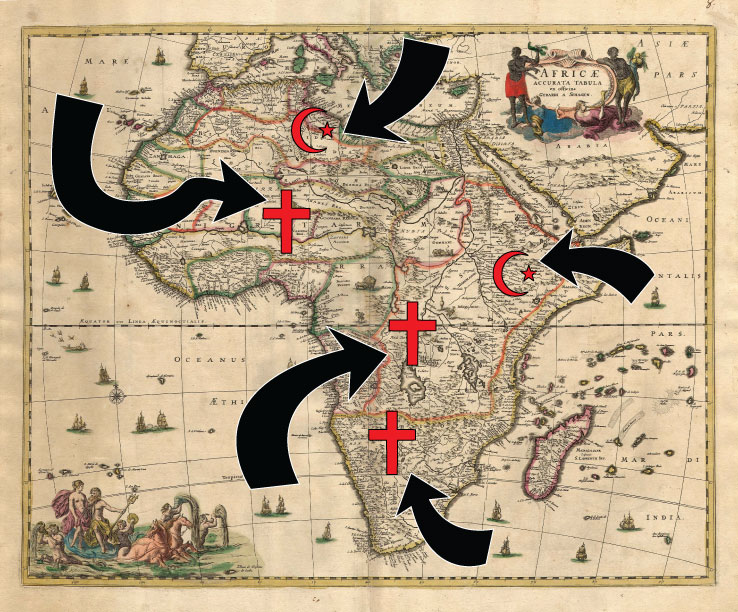
Lest we think that this is the norm for Christian mission efforts, compare it with the results from two other heavily missionized parts of the world, Oceana and Africa. The first Christian mission workers went to Africa in the seventeenth century, and by 1900, 10 million Africans knew Christ, that is, 10% of the population. By the year 2000, 360 million Africans had become Christian, 46% of the population.
The first Christian missionaries went to Oceania, the South Sea Islands, in 1843. By 1900 an astounding 76% of the population were Christian (5 million people), and by the year 2000, 83% professed Christ, 25 million people.
[pp. 8-9]

.
Tuesday, May 1, 2012
The Kristy Bamu Murder in Context: Violent Exorcisms and Non-African Christians
The horrific murder of Kristy Bamu has resulted in some amazingly wrong-headed reactions. For example, a great deal of attention is paid to the fact that the murderers are African immigrants, while very little or no attention is paid to the fact that the murderers are both Christians, and that they were acting not on the basis of "traditional African superstitions", but on the basis of the teachings of a modern sect of Christianity that originated in the United States: Pentecostalism.Some will try to argue, and just for the sake of argument I'll allow that they might be right, that Magalie Bamu and Eric Bikubi were not acting like "good" Christians or "typical" Christians when they tortured Kristy Bamu to death on Christmas Day, 2011. But there is no getting around the fact that they are Christians. The distinguished social anthropologist Jean Le Fontaine made the point very clearly in her March 1 editorial in the Guardian in which she stated bluntly: "Christianity is at fault here". (link)
In order to put things in context, it is absolutely essential to emphasize the fact that violent exorcisms, including exorcisms that lead to death, are not some peculiar feature of African Christianity.
For example, for his book American Exorcism, author Michael W. Cuneo interviewed "Pastor Mike", a Baptist minister (with strong Pentecostalist leanings) who recounted how he personally went through "at least a hundred" deliverances which were sometimes "very violent, with four or five men holding me down." These violent "deliverances" were conducted under the auspices of Win Worley. Worley, who liked to refer to himself as a "Baptecostal", began performing exorcisms in a small church on the South Side of Chicago in 1970. According to Cuneo, by 1978 "visitors from as far away as Florida and California" were coming to Worley's church "looking for treatment."
According to one of Worley's disciples, "He believed that you should force the demons to manifest. This required a team to hold people that became violent." That quote is from the "demonbuster.com" website page on "How To Do Deliverance". The church that Worley founded, the Hegewisch Baptist Church, eventually moved to Highland, Indiana, and is now headed by Pastor Mike (Michael Thierer). One of the slogans of the Church is simply: "Attack! Attack! Attack!"
Below are several examples of documented cases of violent exorcisms, none of them involving Africans:
Arizona man tased by police while performing violent exorcism on 3 year old child:
http://www.foxnews.com/story/0...
22 year old Japanese American (raised by Quakers in Indiana) arrested for physically abusing a 14 year old autistic boy during exorcism:
http://epicanthus.net/about/in...
Russian parents accused of killing their daughter during exorcism:
http://www.abc.net.au/news/201...
Young boy "slapped, scratched and hit" during exorcism in Seattle church:
http://publicola.com/2010/01/1...
Swedish pastor accused of conducting "violent exorcisms" in his "cowboy-themed church":
http://www.religionnewsblog.co...
Two London preachers kick woman to death during exorcism in 1980:
http://news.google.com/newspap...
Violent exorcism of gay 16 year old boy in Connecticut (the church was so proud they posted a video of the exorcism on youtube):
http://news.ninemsn.com.au/wor...
Police called to violent exorcism in Alabama:
http://www.franklincountytimes...
Related posts from this blog:
"Christianity is at fault here": Jean La Fontaine on the Kristy Bamu case
The Origins of Pentecostalism: Azusa Street
"And these signs shall follow them that believe": An overview of Pentecostalism
"A new Frankenstein religion"??
Christianity & the Invention of Child Witches in Africa
Pentecostalism, Spiritual Warfare & The "Witch Children"
Tuesday, March 20, 2012
"Christianity is at fault here": Jean La Fontaine on the Kristy Bamu case
Below is the complete text of Jean La Fontaine's March 1 column in the UK Guardian on the subject of the Kristy Bamu torture-murder case (link to original). La Fontaine is an anthropologist who has made extensive investigations of modern allegations of "Satanic Ritual Abuse", and is the author of Speak of the Devil: tales of Satanic abuse in contemporary England.
There are some important criticisms I could make of La Fontaine's position. In particular she is simply wrong about the meaning of the Lingala word "kindoki", which is not synonymous with "spiritual evil", and in it's traditional usage can refer to spiritual power that can be either ambiguous or decidedly positive and beneficial, in addition to referring to malefic magical power. Fontaine also overemphasizes the specific role of "fundamentalist" and Pentecostal Christianity, whose Satan-mongering and Witch-hunting are solidly based (in both theory and practice) in both Catholicism and Mainline Protestantism. That being said, La Fontaine gets the most important things right.
And if you are unfamiliar with the tragic story of the death of Kristy Bamu, here is a link to an article that goes over the case, but it is not pleasant reading.
The case of Eric Bikubi and Magalie Bamu that has just ended at the Old Bailey has drawn public attention to one form of diversity that is not celebrated in London. The spotlight has settled on ideas of witchcraft that seem to have been the motivating force behind the savage attacks on young Kristy Bamu that finally deposited him, semi-conscious in a bath of water where he drowned.
Kindoki, the Lingala word for witchcraft, is one of hundreds of words denoting spiritual evil in the hundreds of African languages spoken wherever Africans live. It has no special primacy over other such terms and may not even be understood outside a handful of states in west central Africa. However, beliefs in witchcraft are widespread – in town or countryside – and are also in present in Europe, where Africans have migrated in the last 50 years. They are a means of explaining the unequal distribution of good and bad fortune, and the occurrence of otherwise inexplicable misfortune.
As with some of the more extreme Scottish Protestants, coincidence does not exist: the hand of either God or Satan may be seen in every event. To many Africans, this evil power is witchcraft. In some areas of Africa, where civil wars and economic disasters have left society in disarray, the numbers of allegations have amounted almost to epidemics of accusations. The Congo and southern Nigeria can be particularly singled out, but accusations occur almost everywhere. Not all are taken seriously, but many are. Some are taken to pastors for exorcism, other people attempt their own.
In their present form, beliefs in witchcraft are not "traditional" – changes since earlier times are obvious. Modern beliefs see the power of witchcraft as emanating from evil spirits that possess the witch and endow him or her with the power to harm. This belief in possession by evil spirits has been promulgated in Africa by western missionaries of fundamentalist, particularly Pentecostal, Christian beliefs. It has enabled Africans to retain a modified version of their former beliefs in witchcraft, obtaining the approval and support of Satan-hunting Christians whose life is dedicated to the pursuit of evil. New churches, started by Africans with a self-proclaimed "divine mission", have sprung up everywhere.
These churches do not "control" witchcraft beliefs, although they encourage and profit from them. Nor is it true to say that it is only as witchcraft escapes from the control of the church that it becomes evil; witchcraft is evil from the beginning. Some people may feel protective of Christianity, but Christianity is at fault here. The pastors of independent African churches may identify children as witches (for a fee) and are prepared to "cure" them (for a further fee) by exorcising the evil spirits. Such exorcisms are often violent; beating and the use of cold water to cleanse and purify the possessed being is common in many Congolese churches and elsewhere in Africa, too.
A recent change is the accusation of children, who may be singled out by parents or other caretaking adults for a variety of reasons that distinguish them from among others in the household: bad dreams, bed-wetting, children who are cleverer or stupider, who have different likes and dislikes – almost anything can be the symptom of a possessing evil spirit. Often, the accused are outsiders – either stepchildren or refugees in the chaotic postwar Congolese state; trafficked children or child soldiers.
Once suspected, the "witch" must usually be made to "confess". Denial of accusations is not acceptable, but ensures further efforts are made. Much of the violence of exorcisms in the African-led churches may be the result of attempts to force "confessions" from suspects. Many children are easy to persuade. During the panic about Satanic abuse, it became obvious that children's answers to questions under pressure were unreliable evidence: children may agree that they are witches to end their ordeals. Violence may also be used to induce the evil spirit to leave the body of the possessed. It must be understood that to believers, even the body of a small child that has been identified as a witch is no longer a human being, but a shell within which a frightening demon or other spirit is lurking. If this dwelling is made sufficiently uncomfortable then the spirit will leave. Fasting, abstention from all liquid, lack of sleep are all ordeals designed to facilitate confession and force the evil spirit out of a purified body. It is the spirit that is being attacked, not the person.
Most African politicians do not see the issue of child witches as of primary importance, although the state governor of Akwa Ibom state in Nigeria has passed a law making it illegal to accuse a child of witchcraft (unfortunately with very little effect). Some politicians believe they are suffering a scourge of witchcraft, and understand the problem quite differently. Most NGOs and charities are struggling fruitlessly to find countermeasures, but short of peace and prosperity – which no one can provide – there seems little effective action that can be taken other than rescue and care for the victims.
Monday, March 19, 2012
‘the great majority of accusations of ritual murder – common as they are throughout the continent – are unfounded’
The link I have chosen is Bizarre Rumors, by Adam Kuper, Chair Anthropology, Brunel University, retired (published on the London Review of Books blog, January 12, 2010). The comments section of Kuper's blog post turned into a forum for other anthropologists to air their frustration and disgust at the racist misrepresentations of Africa in the western media in general, and in one BBC Newsnight "report" in particular (Witch-doctors reveal extent of child sacrifice in Uganda, which aired the first week in January, 2010).
There's much more at the link, including responses by Tim Whewell and others at the BBC, attempting to defend themselves.
1.
Most African herbalists cause no more damage than dispensers of alternative medicines on our high streets. Every now and then, however, a sinister practitioner will advise a very special client that while roots and animal parts are useful, the most potent medicines are made from human blood, liver, spleen and heart. Yes, it is dreadful, he whispers, but there are unscrupulous people about, and I have heard that your rival is in the market for the stuff. What choice do you have? When one big man is persuaded, his peers are immediately alerted. In consequence medicine murders tend to crop up in clusters, the clients typically rich and powerful men. The anti-human sacrifice and trafficking unit of the Uganda police recorded 26 cases in 2008 and 28 in 2009, and a number of suspects were brought to trial.Enter Tim Whewell of the BBC’s Crossing Continents programme. He found a Pentecostal preacher, Polino Angela, who claims to have murdered his own son and dozens of other children for potions. He has repented and is crusading against ‘witch-doctors’. Curiously untroubled by the police, he tells Whewell that he hopes for an amnesty from the government. In the grand tradition of generations of British missionaries crusading against barbarism, Whewell follows the repentant Angela, in the garb of a Pentecostal prophet, as he traipses through the bush destroying ancestor shrines.
The BBC swallowed the dubious story whole, broadcasting it on Newsnight, and endorsing all sorts of bizarre rumours: ‘it is widely believed’ that bodies are buried under new buildings to ensure prosperity etc.
Whewell has his own theory about these horrors. Convinced, quite wrongly, that medicine murder is ‘something new’, and that children are the preferred victims, he notes that paradoxically these horrors come ‘just as Uganda is becoming more modern’. Perhaps, he reasons, it is actually connected to modernity – born of greed spawned by consumerism.
Medicine murders are rare – after all, only the very powerful can get away with them – but the poor have more immediate worries, and these are sometimes translated into fears of witches. At times of drought, war and disease, anti-witchcraft movements may sweep the countryside, now often led by Pentecostal preachers. (The individuals fingered by Angela for the BBC are at risk of vigilante violence.)
Whewell confuses belief in spirits with belief in witchcraft, and when a Ugandan cabinet minister tells him that evil spirits really do exist, he fails to register that this is a Christian doctrine, eagerly propagated by local and visiting preachers. The current priority of Uganda’s evangelicals is a crusade against homosexuality. Egged on by American activists, they have persuaded the government to draft a bill that imposes life imprisonment for homosexuality, and the death penalty for aggravated cases, such as the grooming of minors by school-teachers.
There are important stories here. Anthropologists and local intellectuals are following them closely. Our media should treat them with the same care as stories of child abuse in religious communities in Ireland or Jersey or the Orkneys.
Adam Kuper
Chair Anthropology, Brunel University, retired
2.Prof. Adam Kuper’s riposte to Newsnight’s piece on ‘child ritual murder’ in Uganda is remarkable in its contrast with the report by BBC journalist Tim Whewell. Where Whewell presents to us – without so much as a shred of evidence – lurid and sensationalist tales derivative of 19th century clichés of the Dark Continent, Kuper’s comments stand out for their clear exposition of the facts, and also for pointing out the unintended ironies of Whewell’s report: his endorsement of real evangelical violence as a fillip against imagined witchcraft violence. The BBC reporter’s willing participation in iconoclastic shrine-torching and his manipulation of local rumours for a Western audience are reminiscent of the worst kind of colonial evangelism, and his unquestioning endorsement of the accusations he elicits represent an open invitation to would-be vigilantes and lynch-mobs.
Prof. Kuper could have emphasized still further that the great majority of accusations of ritual murder – common as they are throughout the continent – are unfounded. The fact that similar accusations commonly made against alleged sorcerers include turning people in zombies, visiting people in their dreams as a means of ‘eating’ them, thus causing the victims to fall ill in waking life, and engaging in nocturnal flight by means of home-made airplanes (to name but a few), should give Whewell pause for thought when gruesome mass-murders are alleged. The fact that impossible accusations of witchcraft activity abound should suffice to cast doubt on the apparently possible accusations.
Nor is ‘confession’ any form of evidence: alleged sorcerers regularly endorse accusations made against them as a mark of their power and efficacy as healers, and vulnerable members of society are easily coerced into confessing to witchcraft. Whewell’s gullibility regarding the literal veracity of child-murder allegations is clearly irresponsible and dangerous for those he accuses, but his uncritical journalism is potentially still more harmful if the BBC should choose to post him to other parts of Africa. In Kinshasa, it is currently not adults who are accused of killing children, but children who are accused of killing adults. One shudders to think what the consequences would be if Newsnight were to report uncritically on these children’s ‘ritual murders’ as fact.But the greatest harm that this sort of reporting does is perhaps not to Africa, but in Britain, where it spreads disinformation and perpetuates and revives myopic prejudices. By means of precise, long-term, empirical research, academic experts on Africa in British Universities have been working to rid society of such prejudices for decades, but while public broadcasters throughout Europe regularly invite cultural experts to comment on current events abroad, the BBC seem positively averse to this free resource on their doorstep. Why, when they enjoy an assured public subsidy, do they feel the need to stoop to such sensationalist rumour-mongering?
Nicolas Argenti
Senior Lecturer, Social Anthropology, Brunel University
3.
This is not the first time that BBC’s Newsnight has broadcast an inaccurate and misleading story about northern Uganda. Last time, following a barrage of complaints, the Newsnight editor of the time accepted that errors had been made. It would seem, however, that no lessons were learned. The new exotic trip by Newsnight to the region was presented as no more than an interlude in the serious news, sandwiched between the problems with the snow and a speech by President Obama. No space was made to comment on the remarkable revelations and allegations that had been made about ‘primitive’ Africans. What was the purpose of showing it? It clearly was not really about presenting facts and trying to interpret them. Was it because such salacious tales have a ready audience in the UK?I agree whole-heartedly with Adam Kuper’s points about what was shown. It is nonsense to suggest that the Newsnight reporter is the first person to have visited these kinds of shrines. It is also singularly unhelpful to use the term witchdoctor in such a generalised way, muddling it up with diverse beliefs about spirits and the equally diverse practices of local healing. The Christian churches have been waging a campaign against ‘pagan’ and ‘satanic’ practices in various parts of Uganda for decades, and have been involved in destroying all sorts of ritual objects and places. This is a far more complicated situation than the report suggests. There are, for example, big differences between different kinds of shrines. Also, so called ‘witchdoctors’ are often themselves closely linked with Pentecostal Christian sects.
Those of us who research on Uganda and other parts of Africa are well aware that shocking things linked to ideas about spirits and witches do occur – from the mass killing of millenarian Christians at Kanungu, to the activities of Joseph Kony, to the new mechanisms of ‘democratic’ witch-cleansing in which church groups and local political leaders target and violently persecute accused individuals. There have also long been rumours about the killing of children, albinos and rich men for ritual use of body parts and cannibalism. Certainly some murders do occur, as they do in all societies. Also, as Adam Kuper explains, they sometimes occur in clusters. But a few horrific incidents go a long way in spreading mass panics and all tales need to be treated with caution. In common with this case from among the Ugandan Langi people, they are likely to be as much about asserting certain ideas about moral probity as presenting facts.It is entirely appropriate for the BBC to cover sensitive issues in Africa. But surely the same standards of journalism that apply in the UK should also apply to Uganda. These events are, literally, a matter of life and death. They are not appropriate for exotic diversions on a flagship news programme.
Tim Allen
Professor of Development Anthropology
London School of Economics
4.
Having struggled with badly informed and sensationalist-driven journalists since the very day I began my research in Uganda in 1997, Tim Whewell still managed to take me by surprise. Needless to say, perhaps, I agree with the critique of Kuper, Argenti and Allen, and I only want to add to their comments by way of quoting another anthropologist, Michael Taussig, and his classic description of the construction of the colonial mindset. Whewell’s story is nothing but an example of the “colonial mirror which reflects back onto the colonialists the barbarity of their own social relations, but as imputed to the savage or evil figures they wish to colonize.”
Sverker Finnström
Associate Professor (cultural anthropology)
Stockholm University and Uppsala University
5.Tim Whewell’s response on this blog to Adam Kuper’s initial critique of his reporting from Uganda has a familiar ring to anyone, like myself, who has delved into historical accounts of “ritual murder” in Africa. The evidence of his report (he claims) is “powerful and compelling” because it comes from distressed witnesses and victims, or reputable authorities (in this case “the parents of mutilated and murdered children” and Ugandan medical and law enforcement agencies). He takes scepticism regarding the actual evidence as lack of sympathy for the victims or lack of respect for the authorities. In effect, he wonders how in such emotionally distressing circumstances anthropologists could be so unfeeling as to prioritise speaking truth to power over emotional responsiveness to acutely distressing circumstances. Well, the answer is that its our job. We work on cases where exactly the kind of evidence that has so convinced Tim Whewell evaporates in the colder light of hard analysis and further data gathering. My experience of this analytical task makes me curious about what happened to the (allegedly human) liver he filmed? I presume Tim Whewell informed the Ugandan police of his suspicions, and handed over the evidence, and that forensic analysis has since established whether it was human in origin or not. No anthropologist denies the Orwell hypothesis – that widely believed myths are sometimes put into practice in disordered times. But anthropologists are also aware of lynchings and witch burnings where emotional distress, and the misguided attention of authorities willing to pander to popular superstition in the interests of public order, lead to huge miscarriages of justice. Even in colonial times in Africa wiser heads sometimes prevailed. The British in Sierra Leone believed evidence of witnesses and mutilated bodies pointed to “cannibalism” killings for body parts until the Attorney General in 1911 noticed that although witnesses in court repeatedly described in graphic detail the four clawed device made by village blacksmiths for “leopard men” to kill their victims and rip out their entrails, no one had ever produced this device in court. In the same country, penises ripped off young boys were repeatedly ascribed to the murderous work of “baboon men”, until it was established that the damage was compatible with attacks by chimpanzees. The British then stopped executing prisoners battered into confessions of ritual murder. It was not until the advent of post colonial politics that this “crime” was revived, in a climate of political despotism that later drove the country into civil war. Anthropologists are right to be sceptical about “evidence” that can have such massively damaging long-term consequences. Tim Whewell wonders whether Adam Kuper would be “so dismissive if similar evidence came from the British police or other British authorities or agencies”. In turn, I would suggest that Tim Whewell re-reads press accounts of the “Satanic abuse of children” cases in Britain about two decades ago, and then turns to the (government commissioned) investigation undertaken by the distingsuihed anthropologist Jean Lafontaine. He might then see his own work in a different light.
Paul Richards
Emeritus Professor, Wageningen University, The Netherlands

Thursday, March 15, 2012
Countering the Big Lies against African Traditional Religion
Below is a list of academic writings by anthropologists and other scholars who have taken up the Augean labor of sorting fact from fiction concerning the farrago of lurid stories about child sex-slaves, cannibalism, human sacrifice, albino murder, organ harvesting, etc, emanating from Africa. And then below that is another list of investigative reports that have exposed some of the hoaxes, wild exaggerations, and journalistic malfeasance behind these stories (I will probably add more items to these lists over the next day or two):- ‘Child sacrifice’ in Uganda? The BBC, ‘witch doctors’ and anthropologists Pat Caplan, emeritus professor of Anthropology, Goldsmiths, University of London (published in Anthropology Today, April 2010)
- Bizarre Rumors, by Adam Kuper, Chair Anthropology, Brunel University, retired (published on the London Review of Books blog, January 12, 2010)
- Ritual Murder? Jean La Fontaine, London School of Economics (published on the Open Anthropology Collective blog, March 2 2011)
- Scotland yard in the bush: medicine murders, child witches and the construction of the occult: a literature review by Terence Ranger, emeritus fellow of St Antony's College, Oxford (published in the journal Africa, 2007)
- Imagining the Dark Continent: the Met, the media and the Thames torso by Todd Sanders, associate professor Anthropology, University of Toronto (published in Cambridge Anthropology, January 2003)
- Save Our Skins: structural adjustment, morality and the occult in Tanzania by Todd Sanders (published in the volume Magical interpretations, material realities: modernity, witchcraft and the occult in postcolonial Africa, Psychology Press 2001)
- The Fetishization of Albinos in Tanzania by Caroline Ackley, University of Chicago grad student (unpublished manuscript, December 2010)
- Uganda witch doctor 'lied to BBC' over child sacrifice 25 February 2010 BBC.co.uk
- Uganda priest nabbed for BBC hoax was paid to dramatize 25 February 2010, Afrik-News.Com
- On digging up the truth, and Marco Vernaschi
- Update on the Marco Vernaschi Uganda ethics discussion
- Marco Vernaschi and a debate about ethics
- Interview with Marco Vernaschi Retracted
- “40 000 prostitutes” – how rumours and lies become fact
- Exposed: the myth of the World Cup ‘sex slaves’.
Wednesday, November 16, 2011
Blood Libel, Witchcraft, & Ratzinger's 2011 Visit to Africa
- August 17: Ethiopia's River of Death: A handful of tribal Christians are fighting child sacrifice (Christianity Today magazine)
- September 24: Southern Africa: Breaking the Silence on Ritual Killings (IQ4 News)
- October 11: Where Child Sacrifice Is A Business (BBC)
- October 27: Catholics & UN "Collaborate to Stop the Practice of Ritual Infanticide" in Benin (Franciscans Online)
- November 2: Tanzanian witches influence child sacrifice in Uganda (Washington Times)
- November 5: Is the tide turning against the killing of 'cursed' infants in Ethiopia? (CNN)
- November 7: Christians fighting losing battle against infanticide in Ethiopia (Catholic Online)
It's enough to make one think that there must be something in the air. And, indeed, there is. The time is fast approaching for yet another Papal Visit To Darkest Africa, and the droogies are all creeping out from under their rocks to help Prepare The Way for bringing the Good News to the African Heathens.It is clear that all of the above cited sources are reading from the same script as the Holy Father himself, who recently (October 30) addressed a group of visiting bishops from Angola. Here is the full text of an article from TheVaticanInsider.Com website reporting on this speech, under the very subtle title: Pope against "witchcraft" that affects children:
Here are links to other coverage of the Pope's October 30 speech on African Witchcraft:Three weeks from his second African trip in Benin, the Pope centers his attention on one of the worst plagues of the "sick giant" (Africa), "witchcraft", whose main victims are children and defenseless people.
According to UNICEF, tens of thousands of children in Africa are tortured and killed because of witchcraft. A terrible and little known fact. Unicef has emphasized the same points as the Synod of Africa, which in 2009 denounced “witchcraft” as a “social drama”: in poor households or those affected by catastrophes, often the culprit is sought out in those who are weakest, who are then tortured or killed.
The Pope does not limit himself to condemning these facts, but points the finger at tribal practices and witchcraft, a plague in Africa, which makes its victims among children, and calls on Christians and civil authorities to monitor and repress these attitudes with rigid laws.
It is urgent, the Pope said while receiving the visiting Angolan bishops on their "Ad Limina" visit, that a "joint effort" of the Church, civil society and governments be made "to counter the "scourge" of ritual “murder” of “children and the elderly" due to “witchcraft”. And denouncing the risks of traditional rites and customs, he urged the church to educate against "practices that are incompatible" with Christianity.
The condemnation of these phenomena occupied a large part of the Pope's speech to Angolan bishops today, in which Benedict XVI recalled that the Gospel is "the first factor of development" for Africa. He also warned about "the remnants of ethnic tribalism that is perceived in the attitudes of communities that tend to close in on themselves, not accepting people from other parts of the country."
The spread of the "scourge" of "witchcraft", the Pope argued, stems from the fact that "the heart of the baptized" is often "divided between Christianity and African traditional religions." "Being a regional problem,” he recommended, “a joint effort of the ecclesial community would be important to counter this calamity, trying to determine the deep meanings of these practices, to identify the risks for pastoral and social development, and to find a method leading to its definitive eradication, with the cooperation of governments and civil society."
- Pope addresses bishops of Angola (Catholic News Agency)
- Pope says Angolans must resist customs that contradict Gospel (Catholic News Service)
- "We are strongly committed to continuing the proclamation of the Gospel to the people of Africa" (Agencia Fides: Information service of the Pontifical Mission Societies)
- Christianity, an essential factor of development in Africa (Vatican Information Service)
And if you want to learn more about African Traditional Religions, check out my big page on Africa and African Traditional Religions at EGREGORES.
Thursday, October 27, 2011
White Explorers versus Black Magic (And Black Jesus versus White Jesus)
Human sacrifice cult battles with police
By Nick Squires in Sydney 12:01AM BST 10 May 2007 UK Telegraph
Nick Squires' 2007 story about a "human sacrifice cult" in Papua New Guinea (linked to above) begins with the dire warning that Papua New Guinea was "undergoing a dramatic resurgence in sorcery and witchcraft," and that, in particular, a new "shadowy cult" had appeared that was "accused of beheading villagers and offering them as human sacrifices."These macabre goings on, we are told, were taking place in "The central highlands [which] were only penetrated by white explorers in the 1930s and belief in black magic remains strong."
The obvious implication is that these hinterlands had still been insufficiently "penetrated" by "whites" to bring about the eradication of "black magic".
Here are some similar "news" stories from around the same time:
Police manhunt for cult leader who 'eats girls' Daily Mail, 8 Feb, 2007
Cult leader on the run in Papua New Guinea Sydney Morning Herald, June 2, 2006
Cannibal 'Black Jesus' Faces Death Penalty FOX News, March 20, 2007
But wait, what's this about a "Black Jesus"?? It turns out there is more to this story. The "cult" in question was led by a man calling himself "Black Jesus". His given (that is, "Christian") name is Steven Tari, and he received his religious education not at Hogwarts (or some other school that teaches "Sorcery and Witchcraft"), but rather at Amron Bible College, where he studied to be a Lutheran minister. After leaving the Bible College (accounts differ as to whether he dropped out or was expelled) he started claiming to be "the true Christ". This caused him to run afoul of officials with both Church and State, and eventually he was being widely accused of "raping, killing and eating young sex slaves."
Tari was captured in 2005, but then he escaped. As it turns out, his escape was facilitated by the Lutheran pastor who had been given the job of counseling Tari while in prison. Tari was captured again in 2007, only to escape again in 2010, but was then recaptured quickly. In October of 2010 Tari was convicted of raping four girls between the ages of 15 and 17 and, in December, he was sentenced to 20 years in prison.
The denouement of the story is told in the following two stories:
PNG's Black Jesus guilty of rape Sydney Morning Herald, Oct 8, 2010
Cult Leader Sentenced to 20 Years, islandsbusines.com, Dec 14, 2010
But wait, there's even more. Early reports about the doings of Steven "Black Jesus" Tari say nothing about "human sacrifice", although they do accuse him of sexually exploiting underage girls (the crime for which he was eventually convicted). But it appears that the girls who testified against Tari only did so after they were themselves arrested as criminals simply for being part of Tari's "cult" (see Patrick Matbob's article referred to and linked to in the next paragraph).
In a Nov 2007 article, Patrick Matbob (writing for the Fiji based "Islands Business" website) describes the beginnings of Steven Tari's "cult" in an article titled "Cult Worries Church Authorities". We find in that article, for example, that although Tari himself dropped out of (or was possibly expelled from) the Lutheran seminary that he attended, a number of registered Lutheran pastors were supporters of "Black Jesus":
"Lutheran Church authorities in Madang are particularly concerned because a number of the church’s registered pastors have joined the cult. This has confused church members in the area who are questioning whether the cult activities are being condoned by the church."And in addition to the pastors who publicly supported Tari (while still publicly representing themselves as part of the Lutheran Church), there were others who continued to operate, in essence, as secret agents for Tari within the Evangelical Lutheran Church (about 1/5 of the PNG population is Lutheran). One of these underground supporters was none other than Pastor Logan Sepus, who masterminded a mass prison escape of Tari and his supporters in 2005.
The whole story of this "cult" and its leader and its followers is quite complex and fascinating. For a detailed "on the scene" account from someone who is highly critical of Steven Tari, check out anthropologist Nancy Sullivan's fascinating blogpost: Tari's Question. While discussing Steven Tari and how he fits in with the modern religious scene in PNG (and especially his relationship, or, at least according to Sullivan, total lack thereof) with the Dabsau Movement, founded by Yali Singina, Sullivan is primarily focussed on exposing Jared Diamond, the semi-famous author of Guns, Germs, and Steel, as a lying sack of shit. It's good stuff -- go and read it!!
Related posts to check out:
- "Wierd Negro Order Raided": Human Sacrifice In The News
- Blood Libel Against African Traditional Religions: "Child Sacrifice" Accusations Surface Again in Uganda
- Witchcraft: Black and White in Color
- A Witch Burning in Ghana: How the Role of Christianity Has Been Obscured
- Blood Libel Against Africans & African Traditional Religion
- Al Jazeera's New Racist Documentary: "Magic & Murder"

"Black Jesus Colored" (direct link) by Christopher Taylor at orbitercloud99.blogspot.com.
Wednesday, October 26, 2011
"Wierd Negro Order Raided": Human Sacrifice In The News
Coverage of the much hyped trials of Casey Anthony and Amanda Knox both involved accusations of "human sacrifice":Amanda Knox described as 'she-devil,' 'witch' (kabc, los angeles)
Minister Says Enquirer's 'Casey Anthony Human Sacrifice Ritual' Story Defamed Him (courthousenews.com)
Inspired by the recent headlines above, and also by a string of hysterical stories in the mainstream media about an "epidemic of human sacrifice in Uganda" (if you don't know what I'm talking about look here), let's take a little random walk down memory lane and look at some other notable instances (all from the 20th century and all from the United States) of Human Sacrifice In The News:
Mysterious Negro Cult Performed The Rite Of Human Sacrifice Biddeford [Maine] Weekly Journal, April 5, 1912
Woman Confesses Killing 17 Negroes; Leader of Church of Sacrifice Explains Creed Which Called for Wholesale Murders. NYT April 2, 1912
The Occult Murders by Al Profit
"The year is 1929 and Detroit is bursting at the seams, immigrants from the edges of the world burrowing their way into the city’s flesh ...."
"Human Sacrifice by Cult: Wierd Negro Order Raided" Vancouver Sun, Nov 22, 1932
[Story about a murder in Detroit connected to a cult led by a guy calling himself "Ugan Ali, God of the Asiatic Nation".]
RAIDED TEMPLE BARES GRIP OF VOODOO IN CITY Detroit Free Press, Nov 23, 1932
"Detectives investigating to learn the scope of Voodooism among ignorant and superstitious Detroit Negroes spent Tuesday night running down the myriad leads uncovered earlier in the day when they raided a fantastic "temple" and arrested a Negro who styled himself "God of the Asiatic Nation."
The Voodoo Murders David A. Spitzley's "Mythic Detroit" (collection of news items about the case)
David A. Spitzley's overview of "The Voodoo Murders"
(Wherein it is explained that, well, there was just one murder. Oh, and it had nothing to do with "Voodoo".)
Human Sacrifice Offered As Part Of Odd Ceremony Held By Cult In Kentucky St. Petersburg, Florida, Evening Independent, Feb. 9, 1933
Woman's Life Taken During Weird Rites: Sacrifice Causes 8 Arrests In Kentucky St. Joseph [Missouri] Gazette, Feb. 9, 1933
Three Convicted In 'Human Sacrifice' Trial St. Petersburg, Florida, Evening Independent, April 12, 1933
Child Slayings Linked To Cult: Mother Hunted: Girl, 5, Believed Victim Of Cult That Practices Human Sacrifice Miami News, Feb 20, 1940
Mother of Slain Tot Captured: Grandmother Claims Parents Belong To Sacrifice Cult San Jose News, Feb 19, 1940
"The Doctor Prescribes Additional Human Sacrifice" (racist cartoon from 1960 in the Sarasota Journal)
"Five bodies found believed to be part of human sacrifice" (Portsmouth [Ohio] Daily Times, Jan 5, 1990)
[Thsi story involves a "cult" that was, supposedly, a Mormon splinter group.]
13 Face Charges In Family Killlings NYT, Jan 6, 1990 (same case as above)
"Thirteen former members of a religious commune were charged with murder or conspiracy yesterday after the bodies of a family of five were found buried at an Ohio farm in what a prosecutor called a human sacrifice."
Sunday, October 16, 2011
Blood Libel Against African Traditional Religions: "Child Sacrifice" Accusations Surface Again in Uganda
Yet another variation on the tired old claims about "Child Sacrifice in Uganda" is now making the rounds. This time it is Chris Rogers, writing for the BBC, who has taken up the challenge of trying to pass this story off as legitimate. Rogers has already made a minor career out of lurid exposes involving sexual improprieties and/or violence against children (preferably both). More recently, though, Rogers has also attracted attention as a strikebreaking scab, when he took advantage of last winter's work stoppage by Britain's National Union of Journalists to get his mug on telly as a BBC One presenter (normally Rogers is restricted to those journalistic nether regions of radio and print).Since Rogers' new piece, titled "Where Child Sacrifice is a Business", neglects to mention the recent slew of imbroglios involving precisely the same yellow-journalistic claims about "child sacrifice" in Uganda that he is now trotting out, I have taken the trouble to put together some links and brief summaries below.
As to Rogers' own contribution, the most important thing to know is that his two primary "sources" are (1) a Christian missionary (named Peter Sewakiryanga) who calls his headquarters "Jesus House", and (2) a rabidly fundamentalist Christian missionary group based in the UK called Jubilee Campaign.
In addition to the educational value of comparing Chris Roger's new treatment of this predictable, recurring "story" to the farcical travesties outlined below, there is the even more important and more educational comparison with that "recurring cultural pattern in Western history" known as "blood libel". Any student of history can immediately recognize the unmistakable parallels between the modern day accusations against practitioners of African Traditional Religions and those made against European Jews as a prelude to pogroms, mass expulsions and outright genocide.
It is sadly the case that horrific violence against children is a reality of modern human societies around the world (just as it undoubtedly was in medieval European societies). For example, the rate at which children in the United States die every day as a direct result of physical abuse and neglect has nearly doubled since 1998 (see the graphic at the top of this post, which is taken from the childhelp.org website). All those who honestly draw our attention to the objective realities of this problem are doing a great public service. But when our instinctual revulsion against all forms of child abuse (and especially the murder of children) is cynically manipulated to target specific religious groups (such as, in this case, followers of African Traditional Religions) that is a completely different matter. It is difficult to imagine that a more contemptible amalgam of racism and religious bigotry could be possible.
To learn more about the ugly pattern of Blood Libel accusations against African Traditional Religions in modern "respectable" media, see the following posts from this blog:
Blood Libel Against Africans and African Traditional Religions
Al Jazeera's Racist "Documentary": "Magic and Murder"
1. Two typical examples of the "evidence"
On February 25, 2009, The Ugandan Indpendent (independent.co.ug) ran a story by Mubatsi Asinja Habati titled "Uganda's Epidemic of Child Sacrifice". The story starts out with the case of a 6-month old boy who was murdered by the child's father. But in the fourth paragraph we are finally told this: "Police later said that 30-year-old Sserubiri beheaded his son in a witchcraft-inspired ritual. Later examination, however, revealed that Sserubiri was a regular user of narcotics and had once been admitted to a mental health hospital."The story then goes on to tell about an accused "witchdoctor" named Musa Bogere. Bogere "confessed" to engaging in ritual murders, but only after being beaten by a mob that was already convinced of his guilt. Soon after his confession, Bogere died in police custody.
With a straight face the Ugandan Independent story then states that: "It is clear that the stories of Bogere and Sseribiri represent just the tip of the silent morgue of ritual murders in Uganda"!
2. The best sources money can buy
On January 7, 2010, the BBC published a story by Tim Whewell titled "Witch-doctors reveal extent of child sacrifice in Uganda." Whewell's star witness for that story was a man named Polino Angela who claimed to be a "former witch-doctor turned anti-sacrifice campaigner". Angela claimed to have been "initiated as a witchdoctor" during a ceremony in which a 13 year old boy was ritually murdered. Angela then went home and murdered his own 10-year old son. In all, Polino Angela "confessed" to a grand total of personally conducting 70 acts of ritual murder.When Ugandan officials heard about what Angela had told the BBC, they (quite naturally) decided to question this man who claimed to be a mass murderer. But the story that Angela told Ugandan police was somewhat different. He said that the BBC had paid him for his story, and that he had lied about the murders:
Uganda witch doctor 'lied to BBC' over child sacrifice 25 February 2010 BBC.co.uk
Uganda priest nabbed for BBC hoax was paid to dramatize 25 February 2010, Afrik-News.Com
3. Digging up a good story
On April 16 of 2010, photojournalist Marco Vernaschi, associated with the Pulitzer Center, came out with three stories titled "Uganda: Child Sacrifice Not a Cultural Issue", "Uganda: Babirye, The Girl from Katugwe", and "The Man Behind RACHO". These three stories were part of the Pulitzer Center's "Child Sacrifice Uganda Project." But it was soon discovered that Vernaschi had paid the people he interviewed for his stories, and that the "graphic images that may not be suitable for all audiences" were in fact staged photographs. For more on the Vernaschi saga check out these stories and other sources found therein:
On digging up the truth, and Marco Vernaschi
Update on the Marco Vernaschi Uganda ethics discussion
Marco Vernaschi and a debate about ethics
Interview with Marco Vernaschi Retracted
Thursday, June 16, 2011
Witchcraft: Black and White in Color
"The logical conclusion of the idea of the demonic pact was the abolition of the traditional distinction between black and white magic. The power of the witch sprang from the demonic pact and was therefore evil, whether it was used for healing or harming."
1. The Witch Hunts and the Christianization of the European Peasantry
For those unfamiliar with Christina Larner, the following is from the Forward (available here online) to Larner's book Witchcraft and Religion, a posthumous collection of her writings published in 1984 (the Forward is by Alan Macfarlane):At the time of her tragic death at the age of 49 in April 1983, Christina (Kirsty) Larner had already established her scholarly reputation in a number of ways. She was the foremost expert on the history of witchcraft in Scotland. She was thought to be one of the most important social historians of Scotland. Her work was one of the most interesting examples in the cross-disciplinary field of historical sociology. Finally, she had contributed significantly to legal history and archival history through her study of Scottish records and court processes. All this had been established on the basis of one book, Enemies of God, The Witch-hunt in Scotland, published in 1981, a duplicated Source-Book of Scottish Witchcraft compiled with Christopher Lee and Hugh McLachlan (Glasgow, 1977) a number of articles, unpublished lectures and an unpublished doctoral thesis ....One of the striking features of Dr Larner's work is a sceptical attitude towards simple and universal explanations. Yet, in the last chapter of Enemies of God, tentative suggestions are made concerning the necessary, if not sufficient, causes of the witch-hunt. The preconditions are a peasant economy, a witch-believing peasantry, and an active belief in the Devil among the educated. Four more proximate causes explain the specific timing of witch- hunts. First, was a judicial revolution, consisting of a shift from restorative justice' (where the case is brought by the injured) to retributive Justice' (where it is brought by the state), applying general and abstract standards. Second, there was the rapid development of printing and literacy. Third, what is termed the 'Christianization of the peasantry', that is to say the move from a largely animistic and ritual world to one where personal salvation and Christian belief became predominant. Finally, there was the rise of the Christian nation state. The witch-hunts coincided exactly with the period of the Godly state, when Christianity became the official ideology of the new-born nation state. The fruitful ideas hinted at towards the end of Enemies of God became central themes in the Gifford lectures which constitute the second half of this volume. Although these factors do not work particularly well in explaining English witchcraft prosecutions, they throw a great deal of light on the horrendous mass witch-hunts on the Continent.
Below is an excerpt from Christina Larner's essay James VI and I and Witchcraft, which makes up the first chapter in Witchcraft and Religion:
[pp. 3-4]In primitive societies two types of witchcraft are identified: white witchcraft or the craft of healing, and black witchcraft or maleficium. This distinction was known to Roman law, and dominated all dealings with witchcraft accusations in Europe until the late fifteenth century. It is also common ground in most studies of contemporary primitive societies. Historians of the sixteenth and seventeenth centuries however have to add a third witchcraft which existed only from the fifteenth to the early eighteenth century and which has no contemporary equivalent. It differed from the simple concepts of black and white witchcraft in its origins. Far from being an experience of village life, it was evolved by churchmen and lawyers from Christian theology, canon law, and certain philosophical ideas. It differed also in content. Christian witch theorists gave a central position to the idea of the demonic pact. The witch became a witch by virtue of a personal arrangement with the Devil who appeared to his potential recruit in some physical form. At this meeting, in return for renunciation of baptism, services on earth and the soul of the witch at death, the Devil promised material advantages and magical powers. In addition, an integral part of the Christian witch theory was that the witch did not operate alone. Witchcraft involved midnight meetings to worship the Devil, to receive his orders and to have sexual intercourse with him or his subordinate spirits.
The development of this theory in Europe, and its application in witchcraft trials, had a drastic effect on the rate of prosecutions. The change from the isolated local harrying of individuals to a widespread crusade against witchcraft, to a recognisable mania and persecution, began fairly abruptly in northern Italy and southern Germany in the late fifteenth century, and spread widely through the Continent during the following century. There are three main reasons why the introduction of the Christian witch theory had such a catastrophic effect. The first is that it was developed by the ruling classes. If we except the traditional vulnerability of rulers to soothsayers and astrologers, there had previously been a fairly sharp contrast between village credulity and intellectual scepticism. Now the power of the local witch was heavily reinforced by the conviction of the authorities that her power was real and to be feared. At the same time, the capacity to punish her was intensified by the codification of the laws against witchcraft, both in canon law and later in the statute law of Protestant countries. The other reasons are connected with the theory itself. The logical conclusion of the idea of the demonic pact was the abolition of the traditional distinction between black and white magic. The power of the witch sprang from the demonic pact and was therefore evil, whether it was used for healing or harming. This meant that the village healer was as likely to be prosecuted as the local scold.
2. Christianization and the literal demonization of African Traditional Religions
In Africa, the traditional attitude toward magic has survived to this day. Like any other natural force, "spiritual power" (every African language has its own highly developed vocabulary for religion and magic) can be beneficial or harmful, and those who know how to work with such power can be responsible for wealth and progress or for disease and death. Richard Dowden has this to say on the subject of this "sense of spiritual power" in his Africa: Altered States, Ordinary Miracles: While the naturalistic view of magic has persisted into the 21st century, it must now coexist uneasily with a new attitude that has been aggressively promoted by Christian missionaries starting in the 19th century. Richard Dowden has quite a bit to say on that subject:In Africa, every event has a spiritual cause or actor. Success in exams or football games, and disasters such as disease or death, all have agents, human or divine. There is no such thing as chance. Wealth and progress are obtained with the help of spirits or magic medicine. A Big Man has power, and that power cannot be challenged or questioned because behind his wealth or position lies spiritual power that enables him to accrue wealth and an important job. That sense of spiritual power is common to almost all Africa.[p. 30]
For more on Dowden's book, here are three reviews:Traditional African religions were denigrated by the European Christian missionaries and imperial rulers who frequently saw them as devil worship and tried to stamp them out. In West and Central Africa and in South Africa these religions or their offspring sects are strong and open, but in East Africa they are hidden, not spoken of in public . . . .[pp. 312-318]
While Christianity teaches that only humans have souls, African religions hold that all objects, animate or inanimate, can be moved by spirits. Africa senses spirits in animals, trees and rocks as well as in people. So the river and the spirit of the river are one and the same. The spirit allows the substance to change, the person to become something else . . . .Steve Biko, the South African writer and activist, wrote that religion in Africa was not a specialized function observed only on one day a week in a special building, but 'it featured in our wars, our beer drinking, our dances and customs in general'. That is something the Western world has lost . . . .
Given the prevalence of traditional religion, it is strange that so few prominent Africans identify with it in public. How different from Japan where Shintoism -- in many ways similar to aspects of African religions -- is widely practiced. In Japan respect for the ancestors is expressed by millions of Japanese visitors to ancient temples to salute the ancestors. Many Japanese proudly display in their homes the souvenirs of the holy shrines they have visited. ... In Africa traditional religion may be central to beliefs but its leaders and rituals still remain in the background . . . .
One reason that African traditional religion and beliefs are hidden is that in many parts they are still associated with evil. Today hardly a week goes by without some report from Africa about witchcraft or the killing of witches. Africa's local press is full of them, the details reported as factually as a politician's speech or the football scores.
- Tim Butcher's review in The Telegraph
- Nicholas Kristoff's review in The New York Times
- Susan William's review in The Independent
The attitude of Christian missionaries to African culture has been, and continues to be to this day, little, if any, different from that expressed by Duarte Pacheco Pereira, a late fifteenth-century Portuguese explorer, who said of the Kingdom of Benin: "The way of life of these people is full of abuses and witchcraft and idolatry." (D.A. Low, "Converts and Martyrs in Buganda", in C.G. Baeta, ed., Christianity in Tropical Africa, p. 257)
Elizabeth Isichei, in her A History of Christianity in Africa, describes the view toward traditional African culture by late 19th century missionaries like this: "There was a natural tendency for those writing in missionary periodicals to stress the darker side of African society . . . . Some, both Catholic and Protestant, described African society as demonic." [p. 82]Isichei provides two quotes from the writings of missionaries as examples:
Isichei also remarks on how the missionary attitudes toward African culture included even condemnation of the practice of building round houses instead of proper, Christian rectangular houses!(1) "May many come willingly to labour in pulling down the strongholds of Satan's kingdom, for the whole of the Ibo district is his citadel."
(2) "All those who go to Africa as missionaries must be thoroughly penetrated with the thought that the Dark Continent is a cursed land, almost entirely in the power of the devil."
In a word, conquest and conversion taught Africans to systematically despise and reject every aspect of their own cultures. Not just their evil religion, whose priests were "sorcerers" and whose wise-women were "witches", but their clothes, their food, their languages, their architecture, and so forth. They were also taught to hate their own leaders and elders, unless these were appropriately compliant both to the colonial authorities and to the church.
The unrestrained contempt of Europeans for African culture held steady, or even increased, throughout the years of colonialism. Isichei cites the 1949 case of "an exemplary Nigerian priest" (as he was described by the Irish bishop who wrote his letter of recommendation, in vain, as it turned out) who sought admission to a Cistercian monastery, but was refused not due to any personal fault or failing, but simply because no "coloured men" were allowed. [p. 87]
3. Summary and Conclusions
The word "Witch" has always been ambiguous, in that the range of its meanings has always included both (1) "wise women", "cunning folk", healers, soothsayers, and other practitioners of beneficial magic, and (2) those who are capable of and willing to use magic to cause harm to others.To speak as plainly and as clearly as possible, if anyone claims that "Witch" has historically been synonymous with malefica, "evil-doer", then the person making such a claim is either:
(1) woefully ignorant of the most basic facts well-known to every historian who has studied Witchcraft and Witch Trials in European history, or
(2) lying.
In the specific case of a professional historian who equates 'Witch" with malefica (especially if said historian claims expertise in the subject of European Witchcraft and Witch Hunting) then this can only be seen as an act of scholarly malpractice, or of intellectual depravity, or, most likely, both.
And what is true of English is also true of other European languages, so that what has already been said about the word "Witch" can also be said about "Hexe", "Strega", "Sorcière", "Bruja", "Bruxa", "Heks", etc.
In non-European, or, more to the point, non-Christian cultures the same ambiguity is found. For example, those who are labeled as "Witches" by Christians in Africa may or may not be involved in harmful magical workings. They could just as easily be healers or fortune tellers as perpetrators of maleficia. In fact, those accused by Christians of practicing Witchcraft can, and often are, the very people who are sought out for magical protection against curses.
Today there are still some who try to equate Witchcraft with "attempting to harm others by magical means", as Ronald Hutton has done and continues to do. All those who do so not only carry on a truly malevolent tradition based firmly in the ideology of the Christian Witch-Hunters of the past, but they also ally themselves with those today in Africa, Latin America and elsewhere who are actively engaged in that most virulent form of cultural genocide known as "Christianization."