Tuesday, February 8, 2011

Gerald Gardner, Sallustius, and Reincarnation (Modern Paganism and the Ancient Mysteries, Part Three)

On the one hand, it is, at the very least, rather unnerving that Gerald Gardner's most direct and substantive reference to the beliefs and practices of ancient Pagans, as these pertain directly to Wicca, is to be found in the chapter of Witchcraft Today that is titled "The Black Mass."

On the other hand, by invoking Sallustius' On the Gods and the Cosmos, Gardner is calling in his big guns, so to speak, in order to decisively confront and defeat what was arguably the greatest danger facing Wicca at the time. Accusations that the followers of Wicca were in league with Satan posed a genuinely existential threat to Wicca in the 1950's. At the same time, these sensationalistic allegations also directly challenged Gardner's strategy, such as it was, of actively seeking out publicity.

By linking arms with Sallustius, Gardner was able to counter the "Satanic" accusations with something far more convincing than his own claims and characterizations about Pagan beliefs. Sallustius' "authoritative Pagan creed" (as classicist Gilbert Murray had called it) had been written 16 centuries previously by a highly educated, articulate, aristocratic, and obviously pious representative of a religious tradition which he proudly shared with many of the greatest and most admired figures of the ancient world, including Pythagoras, Socrates, Plato, Ovid, Vergil and Cicero.

Moreover, Gardner could make use of a readily available English translation of Sallustius that had been published by the widely respected classicist Gilbert Murray in 1912, in his Four Stages of Greek Religion (later revised as Five Stages of Greek Religion). Gardner could count on his readers having access to this book in any decent public library, and the wisdom of this choice of this text is further supported by the fact that Murray's little book is still in print nearly 100 years after it's first publication, making it one of the most successful popular expositions of its kind in modern publishing history. And, moreover, Murray's translation of Sallustius is now freely available in multiple places on the Internet, making it a better and more useful choice than ever as an illustration of the connection between modern and ancient Paganism.

Previously, in Part Two of this series on Modern Paganism and the Ancient Mysteries we looked at how Gardner uses Sallustius to demonstrate (1) that "Wicca positively denies the existence of a Power of Evil", and (2) that the Gods of Wicca "are always good and always do good and never harm". But while Gardner has Sallustius on the stand he wishes to elucidate the 4th century Platonic initiate's expert testimony on one further topic: "the doctrines of Reincarnation and Karma":

XVIII. Why there are rejections of the Gods, and that the Gods are not injured
Nor need the fact that rejections of the Gods have taken place in certain parts of the earth and will often take place hereafter, disturb the mind of the wise: both because these things do not affect the Gods, just as we saw that worship did not benefit them; and because the soul, being of middle essence, cannot be always right; and because the whole world cannot enjoy the providence of the Gods equally, but some parts may partake of it eternally, some at certain times, some in the primal manner, some in the secondary. Just as the head enjoys all the senses, but the rest of the body only one.

For this reason, it seems, those who ordained festivals ordained also forbidden days, in which some temples lay idle, some were shut, some had their adornments removed, in expiation of the weakness of our nature.

It is not unlikely, too, that the rejection of the Gods is a kind of punishment: we may well believe that those who knew the Gods and neglected them in one life may in another life be deprived of the knowledge of them altogether. Also those who have worshipped their own kings as Gods have deserved as their punishment to lose all knowledge of the Gods.

XIX. Why sinners are not punished at once
There is no need to be surprised if neither these sins nor yet others bring immediate punishment upon sinners. For it is not only spirits who punish the evil, the soul brings itself to judgment: and also it is not right for those who endure for ever to attain everything in a short time: and also, there is need of human virtue. If punishment followed instantly upon sin, men would act justly from fear and have no virtue.

Souls are punished when they have gone forth from the body, some wandering among us, some going to hot or cold places of the earth, some harassed by spirits. Under all circumstances they suffer with the irrational part of their nature, with which they also sinned. For its sake there subsists that shadowy body which is seen about graves, especially the graves of those who have lived evil lives.

XX. On Metempsychosis, and how Souls are said to migrate into brute beasts
If the transmigration of a soul takes place into a rational being, it simply becomes the soul of that body. But if the soul migrates into a brute beast, it follows the body outside, as a guardian spirit follows a man. For there could never be a rational soul in an irrational being.

The transmigration of souls can be proved from the congenital afflictions of persons. For why are some born blind, others paralytic, others with some sickness in the soul itself? Again, it is the natural duty of souls to do their work in the body; are we to suppose that when once they leave the body they spend all eternity in idleness? Again, if the souls did not again enter into bodies, they must either be infinite in number or the Gods must constantly be making new ones. But there is nothing infinite in the world; for in a finite whole there cannot be an infinite part. Neither can others be made; for everything in which something new goes on being created, must be imperfect. And the world, being made by a perfect author, ought naturally to be perfect.

XXI. That the Good are happy, both living and dead
Souls that have lived in virtue are in general happy, and when separated from the irrational part of their nature, and made clean from all matter, have communion with the Gods and join them in the governing of the whole world. Yet even if none of this happiness fell to their lot, virtue itself, and the joy and glory of virtue, and the life that is subject to no grief and no master are enough to make happy those who have set themselves to live according to virtue and have achieved it.

But how does transmigration of souls fit into Gardner's overall apologetic strategy in The Meaning of Witchcraft? Having broadly addressed some of the hostility to Wicca, especially coming from the press, in Chapter I, Gardner spends Chapters II-XI accentuating the positive. However, a change in tone is clearly signaled with the opening sentence of Chapter XII (despite its rather innocuous title, "Signs and Symbols"): "A frequent allegation is made against witches by the sillier type of writer that they seek to desecrate Christian churches, and to wreck Christian graveyards."

The next five chapters (XII-XVI), comprising about 1/3 of the book, are much more overtly framed in terms of responding to accusations and allegations against Wicca. First, in the just mentioned Chapter XII, Gardner addresses the allegation that Witches carry out acts of vandalism and desecration against Christian churches and graveyards. But Gardner mostly uses this as a way of introducing what he claims is evidence of the continued existence of Paganism among professedly Christianized "British craftsmen of old days" who, among other things, "preserved the signs and symbols of the Old Religion ... by their so-called 'Masons' Marks' with which they used to mark the stones they worked." Gardner's argument being that Wiccans would be the last people in the world to wish to vandalize Britain's ancient churches, since these are repositories of the "signs and symbols" of the Old Religion! Nicely done, Gerald.

The very title of the following chapter, "The Black Mass", leaves no doubt as to the defensive nature of the argument to be found therein. And yet Gardner is also (almost certainly) hoping to catch the eye of casual bookshop browsers glancing through the Table of Contents. Nevertheless, Gardner is not merely appealing to the prurient interests of the book-buying public. As he did in the previous chapter, he first introduces a scurrilous accusation: "many writers about witchcraft accuse witches of performing perverted Christian ceremonies, notably a mockery of the Mass, which they call 'the Black Mass'." Then Gardner uses this accusation as a jumping off point for a serious, positive presentation or some aspect of the Old Religion. This time Gardner is focusing on connections between modern Wicca and the Mystery Religions of the ancient world, and he uses Sallustius' Peri Theon kai Kosmou as his primary source for ascertaining "what the Mysteries taught."

From the beginning of his discussion of Sallustius (before introducing several long quotations), Gardner emphasizes "Sallustius' strong belief not only in the survival of bodily death, but in the continued activity and interest of those souls who have passed beyond earth in benefiting humanity." But he then moves away from the issue of the soul's continued existence after death, to first address the Wiccan view of "evil", and then to present a defense of the Gods of Wicca as beneficent beings. Having done that, Gardner returns to the issue of reincarnation.

The introduction of reincarnation, at this point, is necessary to complete the picture of the moral order of the Sallustian/Wiccan cosmology, and to help explain how, within this moral order, the immortal human soul is given complete freedom to determine its own destiny.

Pico della Mirandola had similarly felt compelled, though he also felt the need to be circumspect, to inject metempsychosis into his own "Manifesto", The Oration on the Dignity of Man, in a way that also illuminates not just the compatibility, but the inextricable interconnectedness of (1) human freedom, (2) "metamorphoses" and "transformations" (he avoids saying metempsychosis explicitly), and (3) the cosmic order:

Hear then, oh Fathers, precisely what this condition of man is; and in the name of your humanity, grant me your benign audition as I pursue this theme.

God the Father, the Mightiest Architect, had already raised, according to the precepts of His hidden wisdom, this world we see, the cosmic dwelling of divinity, a temple most august. He had already adorned the supercelestial region with Intelligences, infused the heavenly globes with the life of immortal souls and set the fermenting dung-heap of the inferior world teeming with every form of animal life. But when this work was done, the Divine Artificer still longed for some creature which might comprehend the meaning of so vast an achievement, which might be moved with love at its beauty and smitten with awe at its grandeur. When, consequently, all else had been completed (as both Moses and Timaeus testify), in the very last place, He bethought Himself of bringing forth man. Truth was, however, that there remained no archetype according to which He might fashion a new offspring, nor in His treasure-houses the wherewithal to endow a new son with a fitting inheritance, nor any place, among the seats of the universe, where this new creature might dispose himself to contemplate the world. All space was already filled; all things had been distributed in the highest, the middle and the lowest orders. Still, it was not in the nature of the power of the Father to fail in this last creative élan; nor was it in the nature of that supreme Wisdom to hesitate through lack of counsel in so crucial a matter; nor, finally, in the nature of His beneficent love to compel the creature destined to praise the divine generosity in all other things to find it wanting in himself.

At last, the Supreme Maker decreed that this creature, to whom He could give nothing wholly his own, should have a share in the particular endowment of every other creature. Taking man, therefore, this creature of indeterminate image, He set him in the middle of the world and thus spoke to him:

"We have given you, O Adam, no visage proper to yourself, nor endowment properly your own, in order that whatever place, whatever form, whatever gifts you may, with premeditation, select, these same you may have and possess through your own judgement and decision. The nature of all other creatures is defined and restricted within laws which We have laid down; you, by contrast, impeded by no such restrictions, may, by your own free will, to whose custody We have assigned you, trace for yourself the lineaments of your own nature. I have placed you at the very center of the world, so that from that vantage point you may with greater ease glance round about you on all that the world contains. We have made you a creature neither of heaven nor of earth, neither mortal nor immortal, in order that you may, as the free and proud shaper of your own being, fashion yourself in the form you may prefer. It will be in your power to descend to the lower, brutish forms of life; you will be able, through your own decision, to rise again to the superior orders whose life is divine.''

Oh unsurpassed generosity of God the Father, Oh wondrous and unsurpassable felicity of man, to whom it is granted to have what he chooses, to be what he wills to be! The brutes, from the moment of their birth, bring with them, as Lucilius says, "from their mother's womb'" all that they will ever possess. The highest spiritual beings were, from the very moment of creation, or soon thereafter, fixed in the mode of being which would be theirs through measureless eternities. But upon man, at the moment of his creation, God bestowed seeds pregnant with all possibilities, the germs of every form of life. Whichever of these a man shall cultivate, the same will mature and bear fruit in him. If vegetative, he will become a plant; if sensual, he will become brutish; if rational, he will reveal himself a heavenly being; if intellectual, he will be an angel and the son of God. And if, dissatisfied with the lot of all creatures, he should recollect himself into the center of his own unity, he will there become one spirit with God, in the solitary darkness of the Father, Who is set above all things, himself transcend all creatures.

Who then will not look with awe upon this our chameleon, or who, at least, will look with greater admiration on any other being? This creature, man, whom Asclepius the Athenian [see note 9. below], by reason of this very mutability, this nature capable of transforming itself, quite rightly said was symbolized in the mysteries by the figure of Proteus [see note 10. below]. This is the source of those metamorphoses, or transformations, so celebrated among the Hebrews and among the Pythagoreans; for even the esoteric theology of the Hebrews at times transforms the holy Enoch into that angel of divinity which is sometimes called malakh-ha-shekhinah and at other times transforms other personages into divinities of other names; while the Pythagoreans transform men guilty of crimes into brutes or even, if we are to believe Empedocles, into plants.
[A link to the complete text of this public domain English translation can be found at Theodore Gracyk's website at MSU-Morehead University as part of the materials for his class on Human Spirit in Art.]
Pico's references to Asclepius and Proteus are especially worthy of closer consideration. Masimo Riva, professor of Italian Studies at Brown University, provides the following very helpful footnotes (numbered 9 & 10, as below, in the online text at this link. This is from the Pico Project/Progetto Pico, a joint undertaking of scholars at Brown University and Bologna University.):

9. Asclepius. Lat. Aesculapius. Legendary Greek physician, son of Apollo and Coronis and god of healing (also related to the Egyptian Imothep). His first teacher was the wise centaur Chiron (on the cult of Asclepius in ancient Greece, see the work of the late S. B. Aleshire, The Athenian Asklepieion, Amsterdam 1989 and Asklepios at Athens, Amsterdam 1991 ). Pico, however, seems to refer again to that composite collection of texts known as the Corpus Hermeticum (already quoted in the opening paragraph of the Oratio) that Marsilio Ficino started to translate from Greek into Latin in 1463; namely, to the so-called Latin Asclepius (Ficino’s edition of the Asclepius was printed in 1469). Pico’s text clearly echoes the Hermetic Asclepius (the interlocutor and disciple of Hermes Trismegistus, also understood to be a descendant of the great Asclepius, just as Hermes is a grandson of of the great Egyptian god Toth). At page 69 of a recent English translation (Hermetica, ed. by Brian Copenhaver, Cambridge Un. Press, 1992) we read the following passage (paragraphs 5-6): “ [5…] The form of humankind is multiform and various…Human are they who remain content with the middle status of their kind, and the remaining forms of people will be like those kinds to whose forms they adjoin themselves. [6] Because of this, Asclepius, a human being is a great wonder…”

10. Proteus: In Pico’s Conclusions on the ways of interpreting Orpheus’s Hymns according to Magic, we find the following aphorism (n. 28): "Frustra adit naturam et Protheum, qui Pana non attraxerit" ("He who cannot attract Pan, in vain approaches Proteus” - see TL, gl. 37). Edgar Wind explains this obscure passage as follows (Pagan Mysteries in the Renaissance, New York, W.W. Norton, 1968, p. 241): "Mutability, according to Pico, is the secret door through which the universal invades the particular. Hence Proteus transforms himself continuously because Pan [All] is within him.” This enigma seems to describe the unique situation of the human being in relation to the divine. According to Pico, the human being is like a Chameleon and a Proteus, capable of changing shape (effingere, see below) as well as contemplating all forms and “names.” The human being is thus effectively an agent of God but its “demiurgic” abilities also reflect a degree of free will and free choice. Commenting on this passage, Wind seems to qualify Pico’s radical mysticism (267): "This doctrine provides a convincing mystical justification for an eminently rational mental state."

In conclusion, Gardner uses Sallustius as an authoritative source of Pagan beliefs and practices in order to take the intellectual high road while deflecting and deflating the low-brow hysterical misrepresentations of Wicca in popular opinion and the popular press of the 1950's. Gardner is eager, also, to point to Sallustius' embrace of "the doctrines of reincarnation and karma" because (1) this is an essential ingredient in the Pagan vision of a moral cosmic order, (2) it is an equally essential ingredient in the Pagan vision of the individual's responsibility for spiritual progress (or the lack thereof), and (3) it provides yet another clear and undeniable parallel between modern and ancient Paganisms.

[The painting "Reincarnation" by artist Sara Avery is for sale at her online store at fineartamerica.com/profiles/sara-avery.html.]

Modern Paganism and the Ancient Mysteries:
  1. Part One: Sallustius, Gardner & Wicca: "A general statement of their creed."
  2. Part Two: Gerald Gardner, Sallustius, and the Problem of Evil
  3. Part Three: Gerald Gardner, Sallustius, and Reincarnation
  4. Part Four: "Divested of their garments"


Thursday, February 3, 2011

Sallustius, Gardner & Wicca: "A general statement of their creed." (Modern Paganism and the Ancient Mysteries, Part One)

"Have we any way of ascertaining what the Mysteries taught?"

According to Gerald Gardner, ancient Paganism managed to survive in Europe, despite all attempts by the Christians to extirpate it, in the form of the so-called witch cult, a term he takes over from Margaret Murray. It was this witch cult, in Gardner's view, that served as the primary matrix from which Wicca was born.

In Chapter XIII of The Meaning of Witchcraft, Gardner states (on page 170 of the 2004 Weiser edition), regarding ancient forms of Paganism and their relevance to Wicca, that "the only kinds of paganism with which we are concerned here are those which may have had some influence on the witch cult." Gardner then names three such sources of influence in particular: (1) "Druidism, the religion of the Celts", (2) "the religion of the Great Mother Goddess or the old Hunting God", and (3) "the Mystery Cults of the ancient world".

Having cited the Mystery Religions as an important part of Wicca's connection with the ancient Pagan past, Gardner then poses the question, "have we any way of ascertaining what the Mysteries taught?" To which he immediately provides the answer:
"Fortunately, we have. In the fourth century A.D., when paganism was engaged in a fierce struggle with the new creed of Christianity, Sallustius, who was a close personal friend of the Emperor Julian (called the Apostate because he tried to restore the old religion), wrote a treatise called Peri Theon kai Kosmou, About the Gods and the World. It is probable that this treatise was a kind of manifesto of the highest type of paganism prevailing at that time, and it is evident that its author was an initiate of the Mysteries."
[p. 171]
At this point, Gardner launches into an extended commentary on the contents of Sallustius' "Pagan Manifesto", with lengthy quotations from several sections of that work. (Gardner uses the English translation of classicist Gilbert Murray, the full text or which is available online in several places, such as: diipetes.tripod.com, hermetic.com, and goddess-athena.org. The translation was originally published in Murray's Five Stages of Greek Religion.) At the end of this, having given a fairly detailed summation of selected aspects of Sallustian Paganism, Gardner then states:
"Now the thing that will, I think, strike most the consciousness of the reader who is well versed in the teaching of the higher type of spiritualist and occult circles generally is not the antiquity of this teaching of Sallustius, but its startling modernity. It might have been spoken yesterday. Further, it might have been spoken at a witch meeting, at any time, as a general statement of their creed .... [T]he spirit of his teaching, the spirit of the Mysteries of his day, which is also the spirit of the beliefs of the witch cult, is timeless."
[p. 174]
Anyone (genuinely) interested in looking for the (actual) roots of Gerald Gardner's Wicca would be well advised to think long and hard on what he has written here.

In coming installments in this series on Modern Paganism and the Ancient Mysteries, I will look in far greater detail at Sallustius' Peri Theon Kai Kosmou, as well as other sources cited by Gardner, in order to explore the relationship between ancient and modern Paganism.

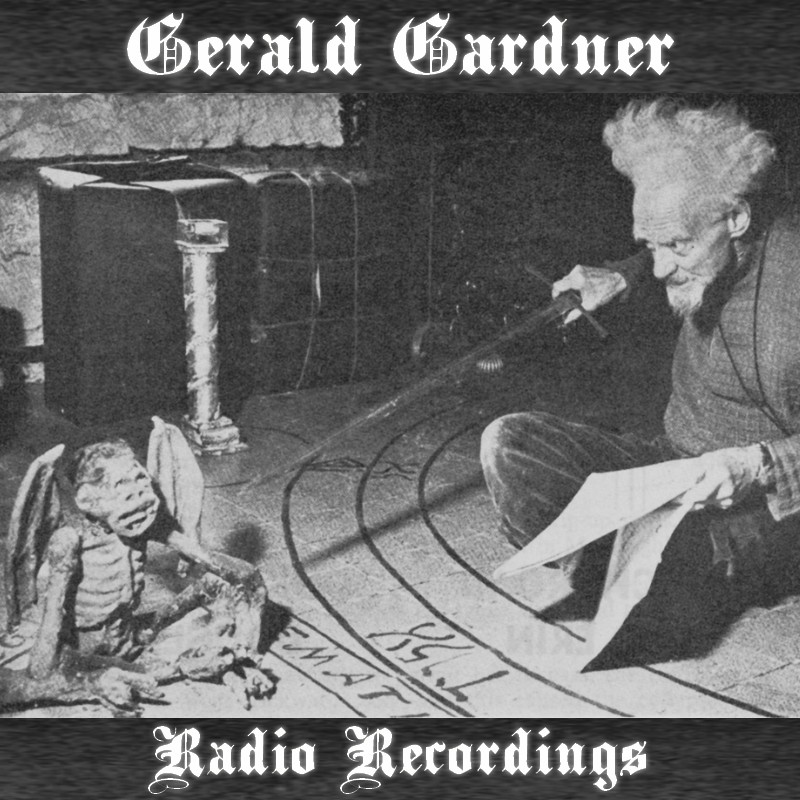
[The rather astonishing photo of Gerald Gardner at the top of this post was found at Fearlono's rather astonishing blog: The Cottage of Electric Hell.]

Modern Paganism and the Ancient Mysteries:
  1. Part One: Sallustius, Gardner & Wicca: "A general statement of their creed."
  2. Part Two: Gerald Gardner, Sallustius, and the Problem of Evil
  3. Part Three: Gerald Gardner, Sallustius, and Reincarnation
  4. Part Four: "Divested of their garments"

Erotic Metempsychosis (Ronald Hutton & Reincarnation, Part Seven)

"Unto them from whose eyes the veil of life hath fallen may there be granted the accomplishment of their true Wills; whether they will absorption in the Infinite, or to be united with their chosen and preferred, or to be in contemplation, or to be at peace, or to achieve the labour and heroism of incarnation on this planet or another, or in any Star, or aught else, unto them may there be granted the accomplishment of their wills; yea, the accomplishment of their wills. AUMGN. AUMGN. AUMGN."
[Liber XV, the Gnostic Mass]


0.
"those whom we have loved most in the present life"
[An excerpt from Ronald Hutton's talk to the 2009 Dion Fortune Symposium.]

Wicca was not merely a cobbling together of texts and ideas from existing writers and traditions. Had it ever been that, it would hardly have established itself as an important and distinctive new religion.

In particular, it has made a highly individual and effective answer to both of the key questions posed to any religious tradition: what happens to the souls of members after death, and who are the superhuman beings whom they should honour.

The Wiccan answer to the first of those is that humans reincarnate, upon this same earth. What is distinctively Wiccan about it is the assurance that we also have an ability to do so at the same moment as those whom we have loved most in the present life.

This belief in group rebirth tackles three of the most painful aspects of the human fear of death: of complete oblivion, of divine punishment for sins, and of being parted for ever from those whom we love.

There can be no doubt that it was brought into Wicca by Gerald Gardner himself, simply because it was a belief personally precious to him. It features as the central theme of his first novel, 'A Goddess Arrives', which he planned out, even according to his own testimony, before he encountered Wicca.

It is at the heart of the first recorded Wiccan Hallowe’en liturgy, suitable for a feast concerned with the dead. It is also discussed, as one of the greatest of divine truths, in a section of a higher degree initiation rite that was added in the early 1950s, under Gardner’s supervision.

Nothing like it is found in Fortune’s work, but then it is not prominent in that of any other previous writer: it is one of Gardner’s own, distinctive, contributions to religious thought.


1.
"Pining for his lost love .... "

[Some excerpts from Lynn L. Sharp's Secular Spirituality: Reincarnation and Spiritism in 19th Century France.]

In the spring of 1842, Mme Dumesnil, the beloved friend of Jules Michelet, lay dying. In an agony of spiritual suffering, Michelet cast about for resolution to the meaninglessness of death. He read the work of Pierre Leroux, De l'humanite, which assured him that collective humanity lived on, but gave him no promises for the individual soul. Michelet, convinced of the immortality of the soul, refuted Leroux's ideas with a vision of metempsychosis of the individual soul progressing toward perfection. Pining for his lost love, he refused to accept Leroux's idea that the individual personality would disappear, subsumed and reborn into humanity in general. He later pointed to Jean Reynaud as the source of his ideas on the immortality of the soul. Michelet's struggle, and the answers he came up with, are just one example of the importance in answering questions that fascinated French Romanticics: What kind of life after death exists for those who reject traditional Christianity?
[p. 1]

Two streams, East and West, brought metempsychosis to our social reformers and they drew freely from both, although Ballanche, Leroux, and Renaud would all claim they looked to Western philosophy for the truth of metempsychosis. The first, the Western sources, were as recent as the Enlightenment and as ancient as the early Greeks. Pythagoras was the earliest source to argue for metempsychosis; Plato repeatedly promoted it among his dialogues; the Romans, too, offered visions of metempsychosis, although perhaps with less enthusiasm. Cicero repeated Plato's ideas while the Life of Apollonius of Tyana (c.e. 216 by Philostratus) described Apollonius' journey to the East, to the land of the Brahmins, where he learned of metempsychosis; Plotinus too promoted the idea of multiple lives before acheiving a higher state. Several Enlightenment writers helped spread ideas of multiple incarnations, including John Toland [1670-1722], who connected it to the ancient Celts. Leibniz [1646-1716] rejected Pythagoras' version but nonetheless argued for an updated, gradualist version .... "
[p. 8]

Although German thinkers explored reincarnation, and Weimar poets such as Herder [1744-1803], Goethe [1749-1832], and Schiller [1759-1805] were fascinated by it, it is more likely that the French fascination with metempsychosis came from the Indian East than from their neighbors directly to the East. The "Oriental Renaissance" happened chiefly in France, despite the interests of the British and the Germans in these topics ....

Yet French thinkers did not lose their loyalty to the West. [Pierre-Simon] Ballanche [1776-1847] and others looked back to Plato and Pythagoras as responsible for "initiating" the West into the knowledge of Eastern thought. Ballanche argued that the East and West shared the same insights into the progress toward perfection .... [Pierre] Leroux [1797-1871] argued that the concepts of metempsychosis developed in Eastern thought had already existed in "seed form" in the great writings of the ancient West. [Jean] Reynaud [1806-1863] argued that even before the Christians, the Druids had subscribed to ideas of reincarnation, which they had taught to Pythagoras himself.
[pp. 9-10]


2.
"And he is always looking for his other half."

[The speech of Aristophanes on Eros, from Plato's Symposium. Translation by Benjamin Jowett.]

Aristophanes professed to open another vein of discourse; he had a mind to praise Love in another way, unlike that of either Pausanias or Eryximachus. Mankind, he said, judging by their neglect of him, have never, as I think, at all understood the power of Love. For if they had understood him they would surely have built noble temples and altars, and offered solemn sacrifices in his honour; but this is not done, and most certainly ought to be done: since of all the gods he is the best friend of men, the helper and the healer of the ills which are the great impediment to the happiness of the race. I will try to describe his power to you, and you shall teach the rest of the world what I am teaching you.

In the first place, let me treat of the nature of man and what has happened to it. The original human nature was not like the present, but different. The sexes were not two as they are now, but originally three in number; there was man, woman, and the union of the two, of which the name survives but nothing else. Once it was a distinct kind, with a bodily shape and a name of its own, constituted by the union of the male and the female: but now only the word 'androgynous' is preserved, and that as a term of reproach.

In the second place, the primeval man was round, his back and sides forming a circle; and he had four hands and the same number of feet, one head with two faces, looking opposite ways, set on a round neck and precisely alike; also four ears, two privy members, and the remainder to correspond. He could walk upright as men now do, backwards or forwards as he pleased, and he could also roll over and over at a great pace, turning on his four hands and four feet, eight in all, like tumblers going over and over with their legs in the air; this was when he wanted to run fast.

Now the sexes were three, and such as I have described them; because the sun, moon, and earth are three; and the man was originally the child of the sun, the woman of the earth, and the man-woman of the moon, which is made up of sun and earth, and they were all round and moved round and round because they resembled their parents. Terrible was their might and strength, and the thoughts of their hearts were great, and they made an attack upon the gods; of them is told the tale of Otys and Ephialtes who, as Homer says, attempted to scale heaven, and would have laid hands upon the gods.

Doubt reigned in the celestial councils. Should they kill them and annihilate the race with thunderbolts, as they had done the giants, then there would be an end of the sacrifices and worship which men offered to them; but, on the other hand, the gods could not suffer their insolence to be unrestrained. At last, after a good deal of reflection, Zeus discovered a way.

He said: 'Methinks I have a plan which will enfeeble their strength and so extinguish their turbulence; men shall continue to exist, but I will cut them in two and then they will be diminished in strength and increased in numbers; this will have the advantage of making them more profitable to us. They shall walk upright on two legs, and if they continue insolent and will not be quiet, I will split them again and they shall hop about on a single leg.'

He spoke and cut men in two, like a sorb-apple which is halved for pickling, or as you might divide an egg with a hair; and as he cut them one after another, he bade Apollo give the face and the half of the neck a turn in order that man might contemplate the section of himself: he would thus learn a lesson of humility. Apollo was also bidden to heal their wounds and compose their forms. So he gave a turn to the face and pulled the skin from the sides all over that which in our language is called the belly, like the purses which draw tight, and he made one mouth at the centre, which he fastened in a knot (the same which is called the navel); he also moulded the breast and took out most of the wrinkles, much as a shoemaker might smooth leather upon a last; he left a few, however, in the region of the belly and navel, as a memorial of the primeval state.

After the division the two parts of man, each desiring his other half, came together, and throwing their arms about one another, entwined in mutual embraces, longing to grow into one, they began to die from hunger and self-neglect, because they did not like to do anything apart; and when one of the halves died and the other survived, the survivor sought another mate, man or woman as we call them,--being the sections of entire men or women,--and clung to that.

Thus they were being destroyed, when Zeus in pity invented a new plan: he turned the parts of generation round to the front, for this had not been always their position, and they sowed the seed no longer as hitherto like grasshoppers in the ground, but in one another; and after the transposition the male generated in the female in order that by the mutual embraces of man and woman they might breed, and the race might continue; or if man came to man they might be satisfied, and rest, and go their ways to the business of life. So ancient is the desire of one another which is implanted in us, reuniting our original nature, seeking to make one of two, and to heal the state of man.

Each of us when separated, having one side only, like a flat fish, is but the tally-half of a man, and he is always looking for his other half. Men who are a section of that double nature which was once called androgynous are lovers of women; adulterers are generally of this breed, and also adulterous women who lust after men. The women who are a section of the woman do not care for men, but have female attachments; the female companions are of this sort. But they who are a section of the male follow the male, and while they are young, being slices of the original man, they have affection for men and embrace them, and these are the best of boys and youths, because they have the most manly nature.

Some indeed assert that they are shameless, but this is not true; for they do not act thus from any want of shame, but because they are valiant and manly, and have a manly countenance, and they embrace that which is like them. And these when they grow up become our statesmen, and these only, which is a great proof of the truth of what I am saying. When they reach manhood they are lovers of youth, and are not naturally inclined to marry or beget children,--if at all, they do so only in obedience to custom; but they are satisfied if they may be allowed to live with one another unwedded;

And such a nature is prone to love and ready to return love, always embracing that which is akin to him. And when one of them meets with his other half, the actual half of himself, whether he be a lover of youth or a lover of another sort, the pair are lost in an amazement of love and friendship and intimacy, and one will not be out of the other's sight, as I may say, even for a moment: these are the people who pass their whole lives together, and yet they could not explain what they desire of one another. For the intense yearning which each of them has towards the other does not appear to be the desire of lover's intercourse, but of something else which the soul of either evidently desires and cannot tell, and of which she has only a dark and doubtful presentiment.

Suppose Hephaestus, with his instruments, to come to the pair who are lying side by side and to say to them, 'What do you mortals want of one another?'

They would be unable to explain. And suppose further, that when he saw their perplexity he said: 'Do you desire to be wholly one; always day and night in one another's company? for if this is what you desire, I am ready to melt and fuse you together, so that being two you shall become one, and while you live live a common life as if you were a single man, and after your death in the world below still be one departed soul, instead of two--I ask whether this is what you lovingly desire and whether you are satisfied to attain this?'--

There is not a man of them who when he heard the proposal would deny or would not acknowledge that this meeting and melting into one another, this becoming one instead of two, was the very expression of his ancient need.

And the reason is that human nature was originally one and we were a whole, and the desire and pursuit of the whole is called love. There was a time, I say, when we were one, but now because of the wickedness of mankind God has dispersed us, as the Arcadians were dispersed into villages by the Lacedaemonians. And if we are not obedient to the gods, there is a danger that we shall be split up again and go about in basso-relievo, like the profile figures showing only one half the nose which are sculptured on monuments, and that we shall be like tallies. Wherefore let us exhort all men to piety in all things, that we may avoid evil and obtain the good, taking Love for our leader and commander.

Let no one oppose him--he is the enemy of the gods who opposes him. For if we are friends of God and at peace with him we shall find our own true loves, which rarely happens in this world at present. I am serious, and therefore I must beg Eryximachus not to make fun or to find any allusion in what I am saying to Pausanias and Agathon, who, as I suspect, are both of the manly nature, and belong to the class which I have been describing. But my words have a wider application--they include men and women everywhere; and I believe that if our loves were perfectly accomplished, and each one returning to his primeval nature had his original true love, then our race would be happy. And if this would be best of all, the best in the next degree must in present circumstances be the nearest approach to such a union; and that will be the attainment of a congenial love.

Wherefore, if we would praise him who has given to us the benefit, we must praise the god Love, who is our greatest benefactor, both leading us in this life back to our own nature, and giving us high hopes for the future, for he promises that if we are pious, he will restore us to our original state, and heal us and make us happy and blessed.

This, Eryximachus, is my discourse of love, which, although different to yours, I must beg you to leave unassailed by the shafts of your ridicule, in order that each may have his turn; each, or rather either, for Agathon and Socrates are the only ones left.


3.
"For then each half yearned for the part from which it had been severed."
[Excerpt from The Nature of Love: Plato to Luther, by Irving Singer.]

For instance, consider the speech of the playwright Aristophanes [in Plato's Symposium]. He describes the nature of love by recounting an ancient myth. In the beginning the human race consisted of three sexes -- the male, the female, and the hermaphroditic (which combined characteristics of both male and female). Each of these primordial human beings was spherical and had four hands, four legs, two identical faces upon a circular neck, and a single head that could turn in opposite directions. They were very powerful, but also very proud. They attacked the gods, were defeated, and would have been destroyed but for the clemency of Zeus. In order to retain the honors and sacrifices afforded the gods, he allowed the human race to continue. But to preclude the possibility of future rebellion, he weakened the spherical beings by dividing each of them in two. He also let it be known that further insolence would cause him to bisect man again, leaving the unfortunate one leg to hop on and a face that resembled a bas-relief or a profile on a tombstone.

Among our spherical ancestors love did not exist. It came into being only after they were cut in two. For then each half yearned for the part from which it had been severed. Whenever the parts encountered one another, they embraced and sought to grow together again. Nor would they separate even to seek food. The race would have died of starvation had Zeus not taken pity upon the bisected creatures. He moved the reproductive organs around so that by embracing one another some of the mortals could beget new members of the race. Previously procreation had occurred without intercourse -- "by emission onto the ground, as is the case with grasshoppers."

Ever since these prehistoric events, every human being has been only half of himself, each forever seeking the opposite portion that would make him whole again. Men who are halves of the hermaphrodites are lovers of women: adulterers come from this group, also promiscuous females. Women who are halves of a feminine whole are lesbians. Males who belong to the masculine whole are lovers of men in their youth and lovers of boys when they reach maturity themselves. "Such boys and lads are hte best of their generation, because they are the most manly." Love itself "is simply the name for the desire and pursuit of the whole."

.... [T]he myth of Aristophanes -- like other speeches in the Symposium -- serves a definite function within the final formulation. When his turn comes to speak, Socrates comments on an unascribed "theory" to the effect that lovers are people searching for the other half of themselves. He offers an emendation that seems minor but really changes everything. Love is not desire for either the half or the whole "unless that half or whole happens to be good. Men are quite willing to have their feet or their hands amputated if they believe those parts of themselves to be diseased." In making this point, Socrates moves far beyond the position of Aristophanes. For if love is desire for half or whole only as they are good, the motive force in love is a yearning for goodness, not just completion. From this Socrates concludes that love is always directed toward what is good, indeed that goodness itself is the only object of love. In loving something, man is really seeking to possess the goodness which is in it. Not temporarily but permanently, not casually but with that fervent longing men have alway associated with love. And so, in brief compass, we start with the primitive myth of Aristophanes and end up with the first highly sophisticated conclusion of Plato's erotic philosophy: "Love is desire for the perpetual possession of the good."
[pp. 50-53]

4.
"To transform together into the afterlife at the same hour."
[From: Ovid's Philemon and Baucis, by tracykarl99 at hubpages.com. Based on Book VIII of Ovid's Metamorphosis.]

Philemon and Baucis might be placed in the category of happy tales with happy endings. There are very few of these in the Metamorphoses. So, to break from erudite instruction, I will begin in the middle, (Book VIII), with this tale of gods in disguise meeting humans and testing their good will. The story is being told to Theseus, who has wandered into a grotto of rivers. The rivers are personified so that Lelex, “mature in years and mind”, is telling the tale among nymphs, other rivers and Theseus.

Lelex begins;

"The power of heaven is great and has no bounds;/ Whatever the gods determine is fulfilled./ I give you proof. Among the Phrygian hills/ An oak tree and lime grow side by side,/ Girt by a little wall. I saw the place - "Lelex is making a case in favor of the gods, as their reputation has been scoffed at by one of the listening attendees. In Lelex’ tale, the two gods, Jupiter and Mercury, the Latin equivalent of Zeus and Hermes, referred to as ‘the heavenly ones’, roam the quaint land “in mortal guise”, searching for a place to rest; but, every inhabitant’s door is shut to the strangers in disguise. Finally, they reach the door of an elderly couple, Philemon and Baucis.

The old couple welcome the strangers, not knowing they are gods, and then Baucis begins preparing a meal for them. She has the guests sit by the fire, spreading a “simple rug” on a rustic bench, as she prepares the cabbage, which her husband, Philemon, has retrieved from the ‘spring fed garden’, just outside their back door.

A sumptuous, yet frugal, and traditional meal is provided by the unassuming, old couple. The comforts of home are emphasized, how ever modest, with the goddess Minerva evoked in reverence for the beauty of the food, which comes from the earth;

"Then olives, black and green, she brings, the fruit/ of true Minerva, autumn cherry plums -"

The poetry is rich with lovely details of earthenware bowls, the aroma of steam coming from the feast, and the ‘zeal’ of happiness radiating from their faces. Then the old, cottage-dwellers notice that the wine-bowl seems to fill itself up every time it is drained, right there at the table. Philemon and Baucis begin to realize that something mysterious is taking place. They bow their heads and join ‘in timid prayer’.

There is the graceful imagery of the goose flying up from the boiling pot, out toward the heavenly ones themselves, ‘swift-winged’. Then the deities admit: “We two are gods”, they say. And they explain to the couple the evilness of their neighbors and how they shall all be destroyed, but that they, Philemon and Baucis, shall be spared for their humble generosity.

Following the gods, Philemon and Baucis hobble up to the furthest hill and turn to see the land consumed in a great flood, and even as they bewail the loss of their little cottage, it is transformed before their eyes into a gleaming temple with columns and a gold roof.

Then one of the gods is revealed as ‘Saturn’s son’, who asks gently whatsoever the old couple wish to have. After conversing quietly, Philemon and Baucis answer that they would like to be the priests and guardians of the gods, to keep after the temple, and when the time has come to depart their life, they wish to never see the other buried, but to transform together into the afterlife at the same hour.

And so, after the remaining years of their lives have been spent tending the temple together in contented peace, Philemon and Baucis, at the very same hour, transform into two glorious trees – their leaves fluttering together on entwined branches and their trunks joined as one.

The teller of the tale then concludes his argument for the gods by saying:

"They now are gods, who served the Gods;/ To them who worship gave is worship given."

[From: Ovid's Philemon and Baucis, by tracykarl99 at hubpages.com. This is truly an amazingly well written, thoughtful, and moving retelling of this ancient and beautiful love story!]

5.
"This search for the other half ..."
A movie review of Hedwig and the Angry Inch
(By Doug Nelson, for the Misunderstood Blog-a-thon. Hat tip to CultureSnob.Net)

I did something I’ve never done before. I’ve been an avid (rabid?) movie fan since I was too young to remember. Even today it’s a rare day that I don’t watch at least two movies, more on weekends. But I have never, never (my inner drama queen insists I repeat this for emphasis) watched a movie and immediately turned around and watched it again from the beginning, all in one sitting.

But Hedwig and the Angry Inch caught me totally off-guard. It was not even close to what I’d expected. I rented it because of the rave reviews and the huge fan base (called Hed-heads) for its off-Broadway production. I figure any movie advertised as the next Rocky Horror has to have something going for it. Plus, I hated Moulin Rouge and really needed affirmation that the musical wasn’t dead.

Toward the beginning of the movie, we get a charming re-telling of Plato’s myth of how there used to be three types of humans on earth, each with four legs and arms, two faces, etc. Some looked like a man and a woman all rolled up together, others like two men or two women. They were so happy that the gods became jealous and split them in two, moving the scar around to our bellies so we would always remember. And now our search for love is really our search for our other split-apart half.

This search for the other half is the theme of Hedwig and the Angry Inch. Of course, we all know how hard it is to find our soul mate, but what if you’re the victim of a botched sex-change operation in East Berlin before the wall comes down? Where/who/what is your other half? And if you’re less than whole, are they more than half?

The theme of split halves (people, cities, families) is repeated throughout the movie, in plot, direction, production design, even in the credits. That, plus the fact that it’s a rock musical, reminded me a great deal of Pink Floyd’s The Wall, with its hammer and wall themes.

Oh yes, the music. Quite frankly, it is wonderful. Written and performed by many veterans of the glam- and punk-rock scenes, it’s delivered in many genres, and actually serves as exposition for the plot in many cases. And, as in The Wall, animated segments frequently accompany the music. As does a follow-the-bouncing-ball sing-along and a Tommy-esque showdown and revelation. I watched this three days ago and I still catch myself humming a few lines.

The live version played off-Broadway for four years, and is still touring the world. It was singlehandedly responsible for reinvigorating a dying neighborhood in New York, and the theater they specially built for it is still successful today, even though Hedwig is no longer performed there.

All the acting parts are pitch-perfect, honed to this perfection by their long run in New York. John Cameron Mitchell makes his directing debut here, but is also the writer and stars as Hedwig. The direction is marvelous, with scenes that will break your heart, make you roll with laughter, or simply prompt you to issue a silent, “Cool!”

Mitchell is excellent, and has many touching scenes, but the most poignant scenes in the movie belong to Miriam Shor, playing his lover. (Yes, a woman dressed as a man is in love with a man playing a man dressed as a woman.) Tangent: Mitchell in drag looks so much like Rachel Griffiths it’s scary.

Anyway, Hedwig and the Angry Inch is fun, it’s smart, it’s sad (but in that good way), and I can guarantee you’ve never seen anything like it before.

6. "Reincarnation formula revived with 'Om Shanti Om'"
[By Arpana, from MonstersAndCritics.Com]

New Delhi, Oct 13 (IANS) Amidst comedies and love stories, Farah Khan's 'Om Shanti Om' revisits the reincarnation theme after many years. Trade analysts say it will work at the box office as it has all the right ingredients. And the main theme suits the Indian psyche.

'I think it's a good idea to make a film on reincarnation because people in India believe in it. My favourite film has always been 'Karz' and 'Karan Arjun'. I think 'Om Shanti Om' will do well at the box office because people like such films,' trade analyst Taran Adarsh told IANS.

Farah has teamed up with her favourite actor Shah Rukh Khan and newcomer Deepika Padukone in the film, which is apparently inspired by Subhash Ghai's 'Karz'.

The film revolves around a struggling actor, played by Shah Rukh, who falls in love with a successful actress. But before his love could blossom and his career flourish, he dies in an accident.

Apart from the rebirth formula, Farah has thrown in all the right ingredients, including humour, music and masala.

The choreographer-turned-director did the same in her directorial debut 'Main Hoon Na'. She had banked on the tried and tested formula of uniting two brothers and it turned out to be a gold digger.

Critics described that movie as a good entertainer, and even three years after its release, Farah is basking in its glory.

''Om Shanti Om' will certainly work. The first half of the film is about the 70s and the second half is absolutely modern - Farah Khan has put all the right ingredients for a blockbuster,' said Saurabh Varma, vice president (programming and distribution), INOX Leisure Ltd.

'There is a tremendous demand for the film not only from multiplex owners but also single screen theatre owners. It's like an ice cream which has all the flavours and would satisfy everybody's taste buds,' Varma said.

Legendary director Bimal Roy was perhaps the first to embark on the theme of reincarnation. He popularised rebirth and reincarnation in Hindi cinema with his masterpiece 'Madhumati'. Released in 1958, the Dilip Kumar-Vyjanthimala starrer boasts of an engrossing story, mind-blowing performances and soulful music by Salil Choudhury.

'Madhumati' walked away with nine Filmfare Awards including for the best film, direction and music.

A decade later Adurthi Subba Rao recycled the theme in another hit 'Milan'. The Sunil Dutt-Nutan starrer revolved around two lovers who are united in their next birth. The film was a huge success and its music was equally appealing.

Ram Maheshwari's 'Neel Kamal' was released the following year. Audiences again lapped up the rebirth formula film, which had Raj Kumar, Waheeda Rehman and Manoj Kumar in key roles.

In 1976, Shakti Samantha adopted the subject in 'Mehbooba'. Featuring Hema Malini and Rajesh Khanna, the film was not a big hit but it did fair business at the box office.

Chetan Anand repeated the same lead pair and the subject in his well-scripted and deftly executed 'Kudrat'.

However, it was Bollywood's self-proclaimed showman Subhash Ghai who hit the bull's eye by recycling the reincarnation subject in his revenge thriller 'Karz'. The Rishi Kapoor starrer turned out to be one of the biggest hits.

In 1990, Gulzar repeated the theme in his critically acclaimed 'Lekin'. The film featuring Vinod Khanna and Dimple Kapadia couldn't stir the box office but its music, composed by Hridaynath Mangeshkar, was well appreciated. The song 'Yaara seeli seeli' sung by Lata Mangeshkar was hugely popular.

Filmmaker Rakesh Roshan too hit the jackpot in 1995 in 'Karan Arjun'. The onscreen chemistry between Shah Rukh Khan and Salman Khan did wonders to this rebirth saga.

But two years later when Sanjay Gupta tried his hand at reincarnation in 'Hamesha', he bit the dust. The Saif Ali Khan and Kajol starrer was a huge flop.

Going by past records, Farah's film, which releases Nov 9, may recreate the same magic that 'Madhumati', 'Karz' and 'Karan Arjun' wove.


Ronald Hutton & Reincarnation:

  1. Part One: Dion Fortune, Ronald Hutton, Wicca & Reincarnation
  2. Part Two: Ronald Hutton, Tertullian, John Italos, Anna Comnena & Reincarnation
  3. Part Three: Ronald Hutton, Reincarnation & the Renaissance
  4. Part Four: "Renaissance & Rebirth: Reincarnation in early modern Italian kabbalah"
  5. Part Five: Ronald Hutton,Vergil, Ovid & GradeSaver.Com
  6. Part Six: Ronald Hutton, Voltaire, and Metempsychosis
  7. Part Seven: Erotic Metempsychosis


.

..

Wednesday, February 2, 2011

Ronald Hutton, Voltaire, and Metempsychosis (Hutton & Reincarnation, Part Six)

"Did it ever occur in true Rome, that a Lucretius was denounced to the consuls for having the system of Epicurus into verse; a Cicero, for having repeatedly written, that there is no pain after death; or that a Pliny or Varro was accused of having peculiar notions of the divinity? The liberty of thinking was unlimited among the Romans. Those of harsh, jealous, and narrow minds, who amongst us have endeavored to crush this liberty -- the parent of our knowledge -- the mainspring of the understanding -- have made chimerical dangers into their pretext; they have forgotten that the Romans, who carried this liberty much further than we do, were nevertheless our conquerors, our lawgivers; and that the disputes of schools have no more to do with government than the tub of Diogenes had with the victories of Alexander."
[Voltaire, from the entry for Soul in his Philosophical Dictionary]

According to Ronald Hutton, "The concept of reincarnation comes from the East, being especially associated with Hindu and Buddhist thought. It reached Europe, like so much else, in the 18th century, and was especially influential in Britain because the British conquest of India, followed by Ceylon and Burma, opened a highway for it. The first person to make it widely known among English and French intellectuals was Sir William Jones ...."

The first edition of Voltaire's Dictionnaire Philosophique was published in 1764, when William Jones was only 18 years of age and still a student at Oxford. Below is an English translation of the entry for Metamorphosis, Metempsychosis:

"Is it not quite natural that all the metamorphoses seen on earth led in the east, where everything has been imagined, to the notion that our souls pass from one body to another? A nearly imperceptible speck becomes a worm; this worm becomes a butterfly. An acorn is transformed into an oak, an egg into a bird. Water becomes cloud and thunder. Wood changes into fire and ashes. In short everything in nature appears to be metamorphosed. What was physically seen in the crudest bodies was soon extended to souls, which were regarded as light forms. The idea of metempsychosis is perhaps the most ancient dogma of the known universe, and it still reigns in a large part of India and China.

"It is also very natural that all the metamorphoses we witness should have produced those ancient fables which Ovid collected in his admirable works. Even the Jews had their metamorphoses. If Niobe was changed to marble, Edith, wife of Loth, was changed into a statue of salt. If Eurydice remained in hell because she looked behind her, it is for the same indiscretion that the wife of Hoth was deprived of human nature. The little town in which lived Baucis and Philemon was changed into a lake; the same thing happened to Sodom. The daughters of Anius changed water to oil; in the scriptures we have almost the same metamorphosis, but true and more sacred. Cadmus was changed into a serpent; Aarod's rod also became a serpent.

"The gods very often changed themselves into men. The Jews never saw the angels in any but human form: the angels ate with Abraham. In his Epistle to the Corinthians Paul says that the angel of Satan slapped him: Angelos Satana me colaphiset."

Under Viands, we have this:
"I think that the Brachmans, so anterior to the Jews, might well have been divided also; but they were the first who imposed upon themselves the law of not eating any animal. As they believed that souls passed and repassed from human bodies to those of beasts, they would not eat their relations. Perhaps their best reason was the fear of accustoming men to carnage, and inspiring them with ferocious manners.

"We know that Pythagoras, who studied geometry and morals among them [that is, the 'Brachmans'], embraced this humane doctrine, and brought it to Italy. His disciples followed it a very long time: the celebrated philosophers, Plotinus, Jamblichus, and Porphyry, recommended and even practiced it;- though it is very rare to practice what is preached. The work of Porphyry on abstinence from meat [De Abstentia], written in the middle of our third century, and very well translated into our language by M. de Burigni, is very much esteemed by the learned; but it has not made more disciples among us than the book of the physician Hequet ... The work of Porphyry is addressed to one of his disciples, named Firmus, who it is said turned christian, to have the liberty of eating meat and drinking wine ... He speaks not of metempsychosis, but he regards animals as our brethren, because they are animated like ourselves; they have the same principles of life; they have, as well as ourselves, ideas, sentiment, memory industry. They want but speech; if they had it, should we dare to kill and eat them; should we dare to commit these fratricides?"
And under Resurrection:

"Many grave schoolmen clearly see purgatory and resurrection in Virgil. As for purgatory, I am obliged to acknowledge that is expressly in the sixth book ... Nor could the kinsfolk of that day obtain from pagan priests an indulgence to abridge their sufferings for ready money. The ancients were much more severe and less simoniacal than we are, notwithstanding that they imputed so many foolish actions to their gods. What would you have? Their theology is made up of contradictions, as the malignant say is the case with our own.

"When their purgation was finished these souls went and drank of the waters of Lethe, and instantly asked that they might enter fresh bodies and again see daylight. But is this resurrection? Not at all: it is taking and entirely new body, not resuming the old one; it is a metempsychosis, without any relation to the manner in which we of the true faith are to rise again.

"The souls of the ancients did, I must acknowledge, make a very bad bargain in coming back to this world for seventy years at most to undergo once more all that we know is undergone in a life of seventy years, and then suffer another thousand years' discipline. In my humble opinion, there is no soul that would not be tired of this everlasting vicissitude of so short a life and so long a penance."


Also, under the entry for Soul, Voltaire states that "Pythagoras had been a cock, his relations swine; but no one found fault with this; his sect was cherished and revered by all, except for the cooks and those who had beans to sell." And then later on in the same section: "The historian Josephus, who was a Pharisee, tells us in book XIII of his Antiquities that the Pharisees believed in metempsychosis." [It should be noted that this interpretation of Josephus is not universally accepted.]

Ronald Hutton & Reincarnation:
  1. Part One: Dion Fortune, Ronald Hutton, Wicca & Reincarnation
  2. Part Two: Ronald Hutton, Tertullian, John Italos, Anna Comnena & Reincarnation
  3. Part Three: Ronald Hutton, Reincarnation & the Renaissance
  4. Part Four: "Renaissance & Rebirth: Reincarnation in early modern Italian kabbalah"
  5. Part Five: Ronald Hutton,Vergil, Ovid & GradeSaver.Com
  6. Part Six: Ronald Hutton, Voltaire, and Metempsychosis
  7. Part Seven: Erotic Metempsychosis

Tuesday, February 1, 2011

The Muslim Brotherhood: A Guide for the Perplexed

Everyone is spinning like crazy when it comes to the Muslim Brotherhood these days. Depending on who is doing the yammering, the Brothers are either wild-eyed bomb-throwing terrorists or they are peace-loving democratic reformers.

Below is a selection of some of the things that people were writing about the Muslim Brotherhood, before knowing what the Muslim Brotherhood is was cool. My own views on the Brothers are none too charitable, but I have tried to select sources that have at least some semblance of objectivity, or even more than a semblance, or even, in many cases, are actually sympathetic to the Brotherhood (including several articles from Al Jazeera and a link to the Muslim Brotherhood's own English language website).

In Depth Studies:

The Society of the Muslim Brothers
"Richard P. Mitchell (Oxford University Press, 1969)
Book description from publishers' website:
First published in 1969 as part of a series edited by renowned Islamic scholar Albert Hourani, this book has been the standard source for the history of the revivalist Egyptian movement--the Muslim Brethren up to the time of Nasser. The Muslim Brethren are now well-recognized for their foundational role in the Islamic revival which has now taken on new, and perhaps dangerous, life in recent times. After having been out of print for over a decade, this reissue of the classic work makes it accessible to a new generation of scholars and students interested in the Muslim revival--a group whose numbers have increased dramatically in the past decade. The new paperback edition has a foreword by John Voll, a leading American Islamic scholar, discussing the subsequent history and continued significance of the Muslim Brethren."

The Society of the Muslim Brothers in Egypt: The Rise Of an Islamic Mass Movement 1928-1942
Brynjar Lia (Ithaca Press, 2006)
Book description from the publisher's website:
"This important book deepens our understanding of the influence of contemporary Islamism by providing the first definitive history of the meteoric rise of the mother organization of all modern Islamist movements, the Society of the Muslim Brothers. Founded in 1928 by a young primary schoolteacher, Hasan al-Banna, the Society rose to become the largest mass movement in modern Egyptian history in less than two decades, clashing with the ruling élite on a wide range of issues. Drawing on a wealth of new sources which include material by the Society’s veterans and dissidents, the Society’s internal publications from the 1930s and early 1940s, a collection of Hasan al-Banna’s letters to his father and security files from the Egyptian National Archives, Brynjar Lia examines the socio-economic and cultural factors which facilitated the movement’s expansion and analyses the keys to its success – its organization, internal structure, modes of action and recruitment techniques as well as its ideological and class appeal.

About the author (also from publisher's website):
Brynjar Lia is a Research Scientist at the Norwegian Defence Research Establishment and teaches at the Institute of East-European and Oriental Studies at the University of Oslo.
[Also by Brynjar Lia: Architect of Global Jihad: The Life of Al Qaeda Strategist Abu Mus'ab al-Suri.]

Muslim Networks and Movements in Western Europe
Pew Research Center, September 16, 2010
Description from Pew Website:
"Over the past two decades, the number of Muslims living in Western Europe has steadily grown, rising from less than 10 million in 1990 to approximately 17 million in 2010.1 The continuing growth in Europe's Muslim population is raising a host of political and social questions. Tensions have arisen over such issues as the place of religion in European societies, the role of women, the obligations and rights of immigrants and support for terrorism. These controversies are complicated by the ties that some European Muslims have to religious networks and movements outside of Europe. Fairly or unfairly, these groups are often accused of dissuading Muslims from integrating into European society and, in some cases, of supporting radicalism.

"To help provide a better understanding of how such movements and networks seek to influence the views and daily lives of Muslims in Western Europe, the Pew Research Center's Forum on Religion & Public Life has produced profiles of some of the oldest, largest and most influential groups -- from the Muslim Brotherhood to mystical Sufi orders and networks of religious scholars. The selected groups represent the diverse histories, missions and organizational structures found among Muslim organizations in Western Europe. Certain groups are more visible in some European countries than in others, but all of the organizations profiled in the report have global followings and influence across Europe."

The New Muslim Brotherhood in the West
Lorenzo Vindino (Columbia University Press, 2010)
From the author's website:
"In Europe and North America, networks tracing their origins back to the Muslim Brotherhood and other Islamist movements have rapidly evolved into multifunctional and richly funded organizations competing to become the major representatives of Western Muslim communities and government interlocutors. Some analysts and policy makers see these organizations as positive forces encouraging integration. Others cast them as modern-day Trojan horses, feigning moderation while radicalizing Western Muslims.

"Lorenzo Vidino brokers a third, more informed view. Drawing on more than a decade of research on political Islam in the West, he keenly analyzes a controversial movement that still remains relatively unknown. Conducting in-depth interviews on four continents and sourcing documents in ten languages, Vidino shares the history, methods, attitudes, and goals of the Western Brothers, as well as their phenomenal growth. He then flips the perspective, examining the response to these groups by Western governments, specifically those of Great Britain, Germany, and the United States. Highly informed and thoughtfully presented, Vidino’s research sheds light on a critical juncture in Muslim-Western relations."

Brother Tariq: The Doublespeak of Tariq Ramadan
Caroline Fourest (Encounter Books, 2008)
Book description from the publisher's website:
"The name of Tariq Ramadan is well known in the West. Thanks to his urbane manner and articulate way of expressing himself – in a number of languages – this Swiss-born academic is a regular contributor to television and radio features dealing with Islam (and Islamism) and the West. In England, his reputation as a “moderate” has won him praise – and even an invitation from the Prime Minister to serve on the government’s task force on preventing extremism. Meanwhile, as the grandson of Hassan al-Banna, founder of the Muslim Brotherhood, Ramadan enjoys a certain status in Islamic circles – a kind of ambassador for his grandfather’s brand of political Islam.

"So who is the real Tariq Ramadan and what does he stand for?

"In this incisive and insightful study of the man, well-known French writer and journalist Caroline Fourest dissects the public pronouncements of Tariq Ramadan. Drawing on his numerous books, articles and speeches as sources, she demonstrates with chilling clarity that the West has been beguiled by Ramadan’s doublespeak.

"Tariq Ramadan is slippery. He says one thing to his faithful Islamist followers and something else entirely to his Western audience. His choice of words, the formulations he uses – even his tone of voice – vary, chameleon-like, according to his audience. In most people, this would be merely funny or irritating, but Tariq Ramadan is too influential a figure to be dismissed so lightly.

"Caroline Fourest does an incalculable service. In this long-overdue English translation of Brother Tariq she proves, once and for all, that Tariq Ramadan is not to be trusted. Ramadan has been portrayed as the Martin Luther King of Islam. This study reveals that he is a far more sinister character at the forefront of a militant and reactionary Islam."