Wednesday, September 14, 2011

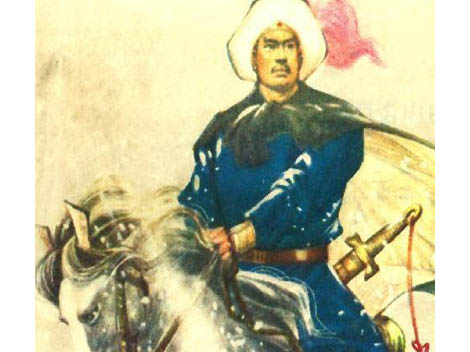
Bogus Hakuin Quote on Life and Death: "Yes, but not a dead one."

The following bogus story can be found at that inexhaustible font of bogosity, wikiquotes:
A samurai once asked Zen Master Hakuin where he would go after he died.
Hakuin answered 'How am I supposed to know?'
'How do you not know? You're a Zen master!' exclaimed the samurai.
'Yes, but not a dead one,' Hakuin answered.

Anyone with the slightest understanding of Zen can see immediately that this attributes to the great Hakuin things that no Zen Master would ever say. Sadly, this totally bogus story appears to be the handiwork of someone who passes himself off as a Zen Master, Albert Low: Teisho by Albert Low: Case number 55 of the Hekiganroku: Alive or dead?

Here is the genuine story as related by Nyogen Senzaki in "Zen Flesh, Zen Bones" (link):

57. The Gates of Paradise
A soldier named Nobushige came to Hakuin, and asked: "Is there really a paradise and a hell?"

"Who are you?" inquired Hakuin.

"I am a samurai," the warrior replied.

"You, a soldier!" exclaimed Hakuin. "What kind of ruler would have you as his guard? Your face looks like that of a beggar."

Nobushige became so angry that he began to draw his sword, but Hakuin continued: "So you have a sword! Your weapon is probably much too dull to cut off my head."

As Nobushige drew his sword Hakuin remarked: "Here open the gates of hell!"

At these words the samurai, perceiving the master's discipline, sheathed his sword and bowed.

"Here open the gates of paradise," said Hakuin.

Tuesday, September 13, 2011

"Challenging the Mandate of Heaven", Or, David Loy don't know much about history.

"When the Chou tribe overthrew the last Shang king, they had to convince the people, especially the nobles, that they had the right to rule. The Chou told people that the Gods in Heaven had told them that they were to rule. This was called 'The Mandate of Heaven', heaven's orders.

"The Chou added that the Gods had warned them that they would only rule as long as they were good rulers. If they became selfish, and thought of themselves first, before the people, that Heaven would appoint another ruling family.

"No one knows if the nobles in ancient China believed this fairy tale, but they most probably thought that the Mandate of Heaven sounded like a good idea."
[Ancient China for Kids: http://china.mrdonn.org/mandateofheaven.html]

At no time in human history, in any culture anywhere on earth, have human beings simply passively accepted whatever the social, economic, and political status quo happens to be. Those who are out of power have always plotted to sieze power, and have often succeeded, while those in power have always been painfully aware of their vulnerability, and have often discovered first hand just how quickly and completely the most well ordered and firmly entrenched regime can be undone. Those who have been oppressed have always been aware of their oppression, and have always sought ways to ameliorate it, or, better yet, to end it altogether. And the oppressors have always been painfully aware of the fact that they are sorely outnumbered, and have often suffered violent deaths at the hands of their not-so-passively-accepting slaves, servants, serfs, and subjects.

In fact, one of the most obvious facts of human history is that human beings are constantly making conscious and very deliberate changes to the societies we live in (although, and as everyone knows, these changes rarely work out the way we hope). Kings and Queens have often pronounced sweeping reforms in order to create a more harmonious and stable, and/or a more enlightened and just, society. Peasants, workers, and common soldiers and sailors have often risen up in revolt with even more radical ideas about justice, and less concern about harmony. Other groups stuck in the middle (aristocrats, urban professionals, bureaucrats, merchants, etc) have often entered into shifting alliances with princes and paupers alike in order to protect what they already have, and also to extend their own rights and increase their share of the wealth.

Here is a typical example, describing events in China during the 3rd century B.C. (from Hardy and Kinney's The Establishment of the Han Empire and Imperial China):
When the king of Qin gained dominion over all of China and established his own dynasty in 221 B.C.E., he dissolved the system of hereditary aristocratic ranks that had prevailed in China for centuries. Aristocrats suddenly found themselves stripped of their titles, and once independent and often warring kingdoms now fell under the administration of centrally appointed, non-hereditary officials. But for centuries already, observers had witnessed the gradually weakening, ever more corrupt, and increasingly dysfunctional nature of the now-rejected system of entitlement instituted by the Zhou dynasty almost a millennia earlier. Under the Qin, men (and to a lesser extent women) distinguished themselves not by birth but largely by their achievements in warfare and agriculture, and they could obtain non-hereditary titles and privileges within a system of ranks. But when the energetic and visionary First Emperor died in 210, his son proved unequal to the task of imperial rule, and the Qin Empire fell three years later. In 202, the fist Han emperor, Liu Bang, reorganized the administrative units of the empire, adopting for central China the Qin-dynasty system of commanderies -- controlled by centrally appointed governors -- and for east and north China, kingdoms.
[p. 69]
Well, fine, you might say. But isn't this just "the elites" playing power games among themselves? What about the peasants, huh? Yeah, well, the thing about that is this: Liao Bang, the first Han Emperor, was born a peasant.

None of this is news to anyone. Except possibly to David Loy, who is peddling an obscurantist view of Asians according to which they are incapable of scrutinizing the societies they live in, which sounds like a bizarre twist on the hackneyed stereotype of "inscrutable" Orientals.

Loy's argument is that Westerners, going back to the Greeks of the classical era, have demonstrated the ability to distinguish between (a) mere social convention, and (b) unchangeable laws of nature. Of course that is only half of it, the other half being that non-Westerners are, according to Loy, incapable of making this same distinction (or, at best, decidedly disinclined to do so). Loy explicitly claims that the ability/inclination to see, for oneself and without any outside coaching or prodding, that human societies are susceptible to change by human (as opposed to divine and/or supernatural) agents is "distinctly Western". (Scroll down for a link to Loy's 2009 article in Tricycle magazine propounding this view.)

Bah.

And again I say: Bah.

Submitted for the Gentle Reader's approval is the following birds-eye view of the social history of China from Elizabeth J. Perry's Challenging the Mandate of Heaven: Social Protest & State Power in China. The difference between David Loy's ahistorical clap-trap and actual history is positively jaw-dropping. But please, don't take my word for it.
No country boasts a more enduring or more colorful history of rebellion and revolution than China. The Chinese tradition of popular upheaval stretches back well beyond this century; indeed, records allow us to trace it as far back as 209 B.C. when the Chen She Rebellion helped to topple the mighty Qin empire and gave rise to famous Han dynasty. Over the ensuing millennia, popular protest has formed a constant and consequential theme in Chinese political history.

China's impressive record of rebellion and revolution is due not simply to the country's extraordinary size and longevity, but also to the fact that central elements in Chinese political culture have directly encouraged such protests. The Confucian (or Mencian, to be precise) concept of a "Mandate of Heaven" (tianming) bestowed instant legitimacy upon successful rebel leaders. This pragmatic precept differed markedly from European notions of a "divine right of kings" or the Japanese belief in an unbroken line of rulers descending from the Sun Goddess, myths that militated against challenges to the powers that be. In imperial China, one who managed to wrest the throne by force thereby gained the Confucian sanction for his rule: as the proverb put it bluntly, "He who succeeds is a king or marquis; he who fails is an outlaw." Of course this did not mean that imperial aspirants were free to ignore normative bounds. Future emperors were expected to demonstrate their claim to the Mandate by means of various divine omens, and needed to come to terms with Confucian elites if they were to harbor any hope of a long-lived reign. Still, the relative openness of the system stood in stark contrast to that of other imperial orders. Political challengers in China -- be they peasants or foreign invaders -- were permitted to make a bid for kingship through popular rebellion.
[page ix]

Further Reading:

Thursday, September 8, 2011

David Loy & the White Buddhist's Burden

In a 2009 Tricycle magazine article (link), David Loy claimed that the Dharma needs the West just as much as the West needs the Dharma. In particular, according to Loy, Asian Buddhism has a deeply ingrained tendency to "passively accept, and sometimes actively support" injustice, inequality, oppression and other bad stuff that, you know, us westerners would never, ever, "passively accept and sometimes actively support"!

meh.

Loy employs pathetic FOX-News-worthy rhetoric such as "But wait a moment … what does Buddhism have to do with political movements? Buddhism, so the response often goes [emphasis added], is a spiritual path for individuals, not a platform for social change. The problem with this way of thinking is ..." Well, in point of fact, the "problem with this way of thinking" is that David Loy is pulling it out of his ass.

Loy himself admits that the historical Buddha was concerned with social and political issues, and that these concerns are clearly reflected in the Buddha's teachings. But then Loy turns around and claims, falsely, that as soon as the Buddha was safely dead, those bad old monks (it's always the monks, isn't it?) coldly abandoned this "social" aspect of the Buddhadharma in favor of the more comfortable lifestyle that comes with "royal-patronage" (never mind the fact that the historical Buddha was himself from the ruling elite and enjoyed patronage from and generally cozy relationships with others of his own class).

The simple fact is that David Loy is full of shit, as anyone familiar with the Rock Edicts of Ashoka knows very well. In those edicts, King Ashoka forcefully advocates for religious tolerance, the humane treatment of prisoners, the protection of animals, and generosity to the poor. He also lists many public works projects for the common good undertaken by his administration, including tree planting, digging wells, and building of rest houses for travelers. Ashoka also supported government subsidized health care for both humans and (non-human) animals! Ashoka also declared his intention to set a good example for others to follow by showing respect to all human beings regardless of their social status, including the poor and servants. And he specifically encouraged people of all religions to put their beliefs into practice by caring for the poor and the elderly.

If one has a mind to, one can find other examples of post-Sakyamuni Buddhists who have been socially "engaged" in ways similar to Ashoka. There is the Tang era Chinese Empress Wu Zetian, who used Buddhist teachings to defend the right of women to be active in public affairs and even to hold high office (including the highest office of all, the one she occupied). She also lowered taxes, reduced the size of the standing army, and reformed civil service hiring to the benefit of lower-class families who had previously been excluded. Several centuries later, during the Sung era, the great Chinese Chan Masters Yuan-Wu, Ta-Hui, and Hung-Chih all argued strongly for the full equality of women in Buddhism, and they put their ideas into practice by promoting women to positions of prominence and authority (over men) within their lineages. Around the same time, the Japanese Zen Master Dogen and his grand-student Keizan similarly advocated for full equality of women within Buddhism, including the recognition of the capacity of women to teach as equals with male teachers.

There is also the somewhat different sort of "engagement" of the Korean Soen Master Sosan Taesa, who led a guerilla army (composed of Buddhist monks) that helped to liberate Korea from Japanese military occupation in the late 16th century. It is worth pointing out that far from being a pampered favorite at the royal Court, Sosan Taesa lived during a time when Buddhism was on the receiving end of religious persecution.

It is even more relevant to point out that the religious persecution of Buddhism during the Korean Joseon Dynasty was child's play if it is measured by western standards of religious violence. The five centuries (roughly 1400-1900) of this "persecution" (of Buddhists by Confucianists) in Korea coincides with the period of western history which saw the Inquisition, the Witch Hunts, the fratricidal Wars of Religion between Catholics and Protestants, the forced conversion of untold millions of Africans and Native Americans, violent (and eventually genocidal) anti-Semitism, and so forth.

But, wait a minute. That 500 year period just alluded to above - isn't that the same historical period when the west became, you know, all socially revolutionized and everything? Hmmm. Isn't it funny how if you carefully select which parts of western history you choose to focus on you can make us look like a bunch of high-minded selfless social reformers, or, alternatively, like the most savage race of bloodthirsty criminals to ever evolve from the primordial ooze, if you can call that evolution?

If David Loy wanted to he could find plenty of Asiatic precedents and exemplars for the virtues that he wishes to extoll as uniquely Western. But he does not want to. It must be said, though, that at several points in his essay he makes it clear that he is uncomfortably, if less than fully, aware of the truly collosal cognitive dissonance involved in the former colonial masters lecturing their former colonial subjects on Justice, Equality and Social Conscientiousness. But the bottom line for Loy is that he cannot accept the simple fact that he needs the Dharma, but the Dharma does not need him.


Further Reading:

"May Allah fight the Jews and the Christians!", Or, Muhammad: Prophet of Intolerance

Some things are simple. The intrinsic intolerance of Islam is one of those things.

Today's text is from Al-Muwatta 45:17-18 (sometimes given as 45:5:17-18). Al-Muwatta is the first written collection of Hadith, or "Tradition", a body of Islamic literature comprising statements and/or opinions attributed directly to Muhammad, but not included in the Quran.

Below are three different online versions of the section of the Hadith in question. Each version is presented here as precisely as possible just as it appears on the cited website, without any modifications, explanations, or commentary of any kind. All three versions coyly leave the Arabic word for "religion", deen, untranslated. But in all three cases Muhammad's meaning is unambiguous: all religions other than Islam are to be eradicated from "the land of the Arabs". Inshallah.

1.

This version is from the "Hadith Library" at ahadith.co.ok
(direct link)

Hadith no: 17
Narrated / Authority Of: Ismail ibn Abi Hakim
Yahya related to me from Malik from Ismail ibn Abi Hakim that he heard Umar ibn Abd al-Aziz say, "One of the last things that the Messenger of Allah, may Allah bless him and grant him peace, said was, 'May Allah fight the jews and the christians. They took the graves of their Prophets as places of prostration . Two deens shall not co-exist in the land of the Arabs.' "


Hadith no: 18
Narrated / Authority Of: Ibn Shihab
Yahya related to me from Malik from Ibn Shihab that the Messenger of Allah, may Allah bless him and grant him peace, said, "Two deens shall not co-exist in the Arabian Peninsula." Malik said that Ibn Shihab said, ''Umar ibn al-Khattab searched for information about that until he was absolutely convinced that the Messenger of Allah, may Allah bless him and grant him peace, had said, 'Two deens shall not co-exist in the Arabian Peninsula,' and he therefore expelled the jews from Khaybar."


2.

This version is from the Qibla Online Library - Hadith, which is part of the Qibla: For the Islamic Sciences website at qibla.com.
(direct link)

The Expulsion of the Jews from Madina

17 Yahya related to me from Malik from Isma'il ibn Abi Hakim that he heard 'Umar ibn 'Abd al-'Aziz say, "One of the last things that the Messenger of Allah, may Allah bless him and grant him peace, said was, 'May Allah fight the Jews and the Christians! They took the graves of their Prophets as places of prostration. Two deens shall not co-exist in the land of the Arabs.'"

[cf Bukhari 1265; also in Muslim]

18 Yahya related to me from Malik from Ibn Shihab that the Messenger of Allah, may Allah bless him and grant him peace, said, "Two deens shall not co-exist in the Arabian Peninsula."

Malik said that Ibn Shihab said, "'Umar ibn al-Khattab searched for information about that until he was absolutely convinced that the Messenger of Allah may Allah bless him and grant him peace, had said, 'Two deens shall not co-exist in the Arabian Peninsula,' and he therefore expelled the Jews from Khaybar."

[Bukhari and Muslim]


3.

This version is from the University of Southern California Center for Muslim-Jewish Engagement
(The Center for Muslim-Jewish Engagement website appears to be offline right now, but here is a direct link to the cached page that contains this section)

Section: The Expulsion of the Jews from Madina


Book 45, Number 45.5.17:

Yahya related to me from Malik from Ismail ibn Abi Hakim that he heard Umar ibn Abd al-Aziz say, "One of the last things that the Messenger of Allah, may Allah bless him and grant him peace, said was, 'May Allah fight the jews and the christians. They took the graves of their Prophets as places of prostration . Two deens shall not co-exist in the land of the Arabs.' "


Book 45, Number 45.5.18:

Yahya related to me from Malik from Ibn Shihab that the Messenger of Allah, may Allah bless him and grant him peace, said, "Two deens shall not co-exist in the Arabian Peninsula."

Malik said that Ibn Shihab said, ''Umar ibn al-Khattab searched for information about that until he was absolutely convinced that the Messenger of Allah, may Allah bless him and grant him peace, had said, 'Two deens shall not co-exist in the Arabian Peninsula,' and he therefore expelled the jews from Khaybar."


Sunday, August 28, 2011

Some deep background on Sudeshna Sarkar's smear campaign against Nepali Buddhism

Three new articles have appeared (relatively) recently about the tragic case of a 21 year old Nepali Buddhist nun who was savagely raped by five men on the night of June 24:
Unfortunately, each of these articles reiterates the false allegation that some Nepali Buddhists have been calling for the nun to be expelled, since, as a rape victim, she is no longer a virgin.

Anyone who tries to get to the bottom of that scurrilous attack on the Buddhadharma will find that all roads lead back to an article that appeared in the July 11 issue the Times of India: Gangraped nun now faces expulsion from nunnery.

That article was written by Kathmandu based journalist Sudeshna Sarkar. It would be impossible to exaggerate the central role Sarkar has played in fomenting outraged condemnations around the world directed against Nepali Buddhism, often coming from well-meaning Buddhists, based solely on an uncritical acceptance of her slanderous accusations.

There is no question about the validity of Sudeshna Sarkar's claims: they are false. Sarkar herself has made it abundantly clear that she fabricated the story about the nun's "expulsion", for even though she has written several follow-up pieces, she steadfastly refuses to present even a shred of evidence to substantiate her allegations.

Various possibilities exist for what is motivating Sarkar's one-woman smear campaign against the Dharma. She could be carrying water for the Maoists, who are now the dominant political force in Nepal, and whose hatred for Buddhism and Hinduism is well known. Or she could be motivated by a Jihadist agenda, a possibility suggested by the fact that articles by Sarkar frequently appear in Islamic news outlets. Then again she could just be a typical scumbag journalist who knows that the more outrageous and salacious a story is, regardless of its veracity, the better it sells, and that the best-selling controversies are always the ones that involve both religion and sex.

But the preponderance of circumstantial evidence is on the side of the possibility that Sudeshna Sarkar has sold her journalistic soul to Jesus. In support of that explanation I now present brief snapshots of some of Sarkar's closest colleagues. Those described below are other reporters who, like Sarkar, work for a rabidly fundamentalist Christian "news" service called Compass Direct. This is a very straightforward propaganda shop specializing in the Orwellian narrative that the world's largest, wealthiest, most powerful, and most intolerant religion is actually the poor oppressed victim of worldwide "persecution". (It is also worth mentioning that in addition to Compass Direct, Sarkar also frequently writes for another Christian "news" service called "Ecumenical News International", which is supported by a coalition of Christian groups including the Lutheran World Federation, the World Communion of Reformed Churches, and the World Student Christian Federation.)

It should also be mentioned that Compass Direct stories often appear without providing the name(s) of whoever it was that actually wrote the story, and also that the Compass Direct website provides vanishingly little information about the reporters who work for them, and no information whatsoever about who actually runs Compass Direct. But a little googling yielded information on the following list of Christian soldier/journalists:

David Miller was described as a "senior correspondent" for Compass Direct in this 2005 "profile" at the Sun Sentinel; his job title is given as "managing editor" according to this 2004 piece from The Free Republic, and the same title is found also in this piece from 2003 in the Sun Sentinel. In the 2003 piece Miller is quoted as follows: "Ministry groups interested in religious freedom need to know what's going on in the world, but we've also found that some officials in the U.S. government are interested." Miller studied at Asbury Theological Seminary in Kentucky. Here is Asbury's Mission Statement: "Asbury Theological Seminary is a community called to prepare theologically educated, sanctified, Spirit-filled men and women to evangelize and to spread scriptural holiness throughout the world through the love of Jesus Christ, in the power of the Holy Spirit and to the glory of God the Father."

Richard Nyberg, was at the time "a correspondent for Compass Direct news service" according to the byline here (2004). For the most part, Nyberg plays his cards fairly close to his chest, as far as speaking publicly about his personal religious views, but in 1999 he wrote a sympathetic, indeed openly enthusiastic, article on "Church Planting" (link). That piece was written clearly from an insider's perspective, and it was produced exclusively for "World Pulse" an organization dedicated to "Providing Evangelism & Mission News, Information and Analysis." Nyberg currently works for USAID in Vietnam. Despite being a US government agency, USAID has extremely close ties with Christian missionary groups, especially World Vision, Catholic Charities, and Samaritan's Purse, as well as with the US military and the CIA.

Barbara G. Baker is a "correspondent for Compass Direct" according to the byline here (2001); and also this 2006 byline (Turkey). Her LinkedIn profile describes her as "Middle East Bureau Chief of Compass Direct." It also lists her alma mater as George Fox University, about which one can read, on their website: "In keeping with our mission of Christian higher education, all employees – faculty, administration and staff – are committed Christians."

Peter Lamprecht is described as a "Compass Direct correspondent" in this piece (2006). He is listed on the "Who We Are" page of the Continental News website, where it is stated that "The mission of Continental News is to spread the Christian News [that is, the Gospel] through contemporary means of communication .... to pursue this mission, Continental News collaborates with many journalists in United States newspapers and with others around the world."

Alex Buchan 1997 byline (Vietnam). An ardent Christian: see his Where Revival Ends (1997), in which Buchan writes unambiguously as a Christian whose cup of missionary zeal clearly overfloweth, especially when the subject is "outpourings of the Holy Spirit".

Sarah Page The Christian Post 2010 byline, here's another, two from 2009 here, and one from July 2011 here, and one from August 2011 here. She is a missionary in Laos working with The Christian Reformed World Relief Committee (CRWRC), along with her husband James Zwier: link. Also, here is a page about James and Sarah and their missionary activities in Laos, hosted at the CRWRC website.


Sunday, August 21, 2011

Barbara O'Brien joins in the smear campaign against Nepali Buddhism

Barbara O'Brien, a Buddhist blogger for About.Com, is now fully on board with the ongoing international internet smear campaign against Nepali Buddhism. This smear campaign consists of simply repeating over and over again the baseless allegation that a Nepali Buddhist nun "faced expulsion" after she was raped. (Here is a link to O'Brien's recent contribution to the smear campaign.)

The most important thing to know is that nothing of the sort ever happened. Sadly it is true that a young Nepali nun was savagely raped by five men on the night of June 24, and that this nun is still struggling to recover emotionally and physically from the assault. But not one Buddhist organization or Buddhist official in Nepal (or anywhere else in the world) has ever said that this rape victim should be expelled from the nunnery in which she has trained for many years. In fact, the exact opposite is the case. Both the nunnery and the Nepal Buddhist Federation have stated unambiguously that she will be returned to the nunnery as soon as she is sufficiently recovered, and that her status as a nun has never been in doubt.

O'Brien claims that she believes these allegations because "a number of different reporters working for different media and independently of each other give pretty much the same version of what happened," and, therefore, according to O'Brien, "that’s probably about what happened."

But when I challenged O'Brien in the comments section of her blog to name three different journalist from three different media organizations who had all independently supported the allegation about the expulsion of the nun, O'Brien suddenly decided to close the comments section!

She could name only one "journalist", it turned out. And who might that be? None other than Sudeshna Sarkar, of course!

If you want to know more about the truth behind this smear campaign, look at these recent posts:

This blog has moved back to blogspot and will most likely remain here. That is all.

The bottom line is that I was somewhat hesitant about moving EGREGORES to wordpress, but I now have no reservations whatsoever about moving it back to blogspot. Issues include (1) they way wordpress fucked up old posts that were migrated, especially images and blockquotes, (2) wordpress' editor is even worse than blogspot's, which I didn't think was possible, (3) lack of flexibility (for instance you can't even look at, let alone edit, the html unless you pay $$$ for the priviledge), (4) more and better widgets are easily available on blogspot, etc.