.


[This is an homage to Captain Beefheart. Very fitting. Achingly beautiful.]

You know, I get stupid emails like: "Well, Nergal, and what if the bone marrow for your transplant is from a Catholic?". My answer: "So what? Am I fighting with people? No, I'm fighting doctrines. In my view, Christian values are an affront to human dignity, an insult to my intelligence. I say this openly, and nothing here has changed . . . .
Despite the difficult circumstances, my life is still full and valuable. When things are going well, do you ask yourself questions like: Why I was born a healthy child? Why have I sold so many records? Why, did I meet a wonderful woman? This is accepted as the norm. All these seemingly bad things are part of the same trend of energy. You can learn a lot thanks to them, but this need not be attributed to the hidden meaning in them ... And if God is punishing me, or putting me to the test, who is punishing the children who lie here next to me in the same ward and die? Let's leave God out of this, and also Mickey Mouse and other products of human imagination, and let's focus on reality, man.Wiesz, dostaję idiotyczne e-maile w stylu: "No dobrze, Nergal, a co, jeśli szpik będzie od katolika?". Odpowiadam: "I co z tego? Czy ja walczę z ludźmi? Nie, ja walczę z doktrynami". Moim zdaniem wartości chrześcijańskie uwłaczają ludzkiej godności, obrażają moją inteligencję. Mówię o tym otwarcie i nic się tu nie zmieniło.
Mimo trudnych okoliczności moje życie wciąż jest pełne i wartościowe. A kiedy jest dobrze, nie zadajemy sobie pytań w stylu: Dlaczego urodziło mi się zdrowe dziecko? Dlaczego sprzedałem tyle płyt? Dlaczego spotkałem wspaniałą kobietę? Przyjmujemy to za normę. Te wszystkie pozornie złe rzeczy są częścią tego samego nurtu energii. Można się dzięki nim wiele nauczyć, ale nie trzeba doszukiwać się w nich ukrytego sensu... A jeżeli Bóg mnie karze albo wystawia na próbę, to za co karze te wszystkie małe dzieci, które leżą tu obok na oddziale i umierają? Zostawmy na moment Boga, Mickey Mouse i inne wytwory ludzkiej wyobraźni w szufladzie i skupmy się na sobie, na człowieku.
 The fierce Saxon opposition to Christianization is inseparably identified with the name of a Westphalian nobleman: Widukind. He is to the Saxons what Geronimo is to the Apache, or Sitting Bull to the Lakota, or Quanah Parker to the Comanche, or Tecumseh to the Shawnee.
It was a ferocious war in a country with little or no civilization, with neither roads nor cities, and entirely covered with forests and marshland. The Saxons sacrificed prisoners of war to their Gods, as Germans had aways done before converting to Christianity, and the Franks did not hesitate to put to death anyone who refused to be baptized. Time and again the Saxon chiefs, worn down by war with no quarter, sued for peace, offered hostages, accepted baptism, and undertook to allow missionaries to go about their work. But every time that vigilance slackened and Charles was engaged on some other front, rebellions broke out, Frankish garrisons were attacked and massacred, and monasteries were pillaged. Even the border regions of the Frankish kingdom were not safe. In 778, when Saxons found out that the king and his army were engaged on the other side of the Pyrenees, and would not be able to return before many weeks of forced marches, they appeared in the Rhine Valley. Local commanders had great difficulty in containing them, and then only after much devastation and plunder.
During the period of these rebellions, the figure of a single leader emerged from among the Saxon ranks. His name was Prince Widukind, and his authority was acknowledged by all the tribes. Just at the time when Charles felt confident that he had pacified the region and gained the loyalty of the Saxon nobles, it was this leader who triggered the most spectacular rebellion by wiping out the Frankish forces hurriedly sent to confront him on the Suntel Mountains in 782. Beside himself with anger at the treachery that had also cost him the lives of two of his closest aides, his chamberlain Adalgisile and his constable Geilo, Charles bround in a new army and forced the rebels to capitulate, with the exception of Widukind, who took refuge with the Danes. The Saxons had to hand over their arms and then, when he had them in his power, he had 4,500 of them decapitated in a single day at the Verden on the Aller, a tributary of the Weser. This episode produced perhaps the greatest stain on his reputation.
Several historians have attempted to lessen Charle's responsibility for the massacre, by stressing that until a few months earlier the king thought he had pacified the country, the Saxon nobles had sworn allegiance, and many of them had been appointed counts. Thus the rebellion constituted an act of treason punishable with death, the same penalty that the extremely harsh Saxon law imposed with great facility, even for the most insignificant crimes. Others have attempted to twist the accounts provided by sources, arguing that the Saxons were killed in battle and not massacred in cold blood, or even that the verb decollare (decapitate) was a copyist's error in place of decolare (relocate), so ther prisoners were simply deported. None of these attempts has proved credible ....
In reality, the most likely inspiration for the mass execution of Verden was the Bible. Exasperated by the continual rebellions, Charlemagne wanted to act like a true king of Israel. The Amelkites had dared to raise their hand to betray God's people, and it was therefore right that every last one of them should be exterminated. Jericho was taken all those inside had to be put to the sword, including men, women, old people, and children, even the oxen, sheep, and donkeys, so that no trace would be left of them. After defeating the Moabites, David, with whom Charles liked to compare himself, had the prisoners stretched out on the and ground, and two out of three were killed. This, too, was part of the Old Testament from which teh king drew constant inspiration, and it is difficult not to discern a practical and cruelly coherent application of that model in the massacre of Verden. Besides, the royal chronicler wrote a few years later, the war against the Saxons had to be conducted in such a manner that 'either they were defeated and subjugated to the Christian religion or completely swept away.'
In the years that followed 782, Charles conducted a war of unparalleled ruthlessness. For the first time, he wintered in enemy territory and systematically laid the country to waste to starve the rebels. At the same time, he had published the most ferocious of all the laws enacted during his life, the Capitulare de partibus Saxonie, which imposed the death penalty on anyone who offended the Christian religion and its clergy, and in reality it constituted a program for the forced conversion of the Saxons. We can only shudder as we read the sections of this law that condemn to death those who fail to observe fasting on Friday, thus reflecting a harsh Christianity far removed from the original message of the New Testament [bollocks]. Yet we should be careful not to put the blame for this barbarity onto the times in general. The Capitulare de partibus Saxonie is one of those provisions by which an infuriated general attempts to break the resistance of an entire people through terror, and Charles must bear the moral responsibility, like the many twentieth-century generals responsible for equally inhuman measures. It is more important to emphasize that the edict provoked criticisms among Charles's entourage precisely because of its ruthlessness. Particularly severe criticisms came from Alcuin, the spiritual adviser he most listened to.
The policy of terror and scorched earth initially appeared to pay off. In 785, after the Franks has ravaged the country as far as the Elbe, Widukind was obliged to capitulate, and he presented himself at the palace of Attigny in France to be baptized. The king acted as godfather. Pope Adrian congratulated the victor and ordered thanks to be given in all the churches of Christendom for the new and magnificent victory for the faith. But the baptism imposed by force did not prove very effective. In 793 the harshness of Frankish government ferocity provoked another mass insurrection in the northern regions of Saxony, which had been more superficially Christianized. 'Once again breaking their faith,' according to the royal chronicler, the Saxons burned churches, massacred clergymen, and prepared yet again to resist in their forests.
Charles intervened with now customary ferocity, indeed with even more drastic and frighteningly modern measures. Rather than limit himself to devastating the rebel country and starving the population, he deported them en masse and planned the resettlement of those areas with Frankish and Slav colonists. However, he was an able politician and soon understood the need to modify his approach to the problem. He intensified his contacts with the Saxon aristocracy and sought out their collaboration. At a large assembly in Aachen in 797, he isssued on their advice a new version of the capitulary that was considerably more conciliatory than the previous one. This twin policy proved immediately effective, because it guaranteed almost definitively the collaboration of the Saxon nobles with the new regime. Eigil, the monk at Fulda monastery who wrote the account of Abbot Sturmi's life, stated during those very years that Charles had imposed Christ's yoke on the Saxons 'through war, persuasion, and also gifts,' demonstrating that he well understood how a new flexibility had made it possible to integrate those obstinate Pagans into the Christian empire.
[pp. 44-48]
Charlemagne proved to be a man of truly "Napoleanic" energy and width of vision. He was constantly on the move and constantly planning. In one year alone (in 785) he covered 2,000 miles, pacing the frontiers of his new dominions. Such energy boded ill for the Old Saxons. The fate of the Pagan Saxons was crucial to Charles' new concept of Christian empire. Not only were Saxons Pagan, they were a surprisingly aggressive warrior confederacy whose raids affected precisely the areas in central Germany werhe Frankish settlement and a Frankish style of life had begun to be established.
As had once been the case along the Roman limes, so now in the eighth century, part of the danger posed by the Saxon challenge came from the fact that Franks and Saxons had drawn closer to each other. Saxon noblemen had already come to adopt a large measure of Frankish customs. Yet, like King Radbod [of Frisia], they clung all the more tenaciously to Paganism so as to differentiate themselves from the Franks. It was all the more essential for the prestige of the Carolingian family that the Saxons, who come to adopt so much of Franksih ways, should be declared to be outside the pale as Pagans, and that, as Pagans, they should be well and truly defeated.
In 772, Charlemagne led the Franks into Saxony. They were said to have desecrated the great intertribal sanctuary of the Irminsul, the giant tree which uphead the world. They rode home again, with much plunder, in time for the hunting season in the Ardennes. Next spring the Franks were in northern Italy. In 774, Charles became king, also, of the Lombards. He even made a short visit to Rome. It was the first time that a Frankish king had set foot in Rome. It was also the first time since the fifth century that a western ruler of such power had been greeted in Rome with the sort of elaborate ceremonies which the Romans know so well how to put on. Charles entered Saint Peter's and, next day, was led through the gigantic basilica churches of the city. In return, Charles proved to be a generous donor. An influx of Frankish silver marked a dramatic recovery in the fortunes of the popes, which was made plain by an unprecedented boom in buildings and repairs.
But it was in Germany, and not in Italy, that Charles showed himself to be a ruler as determined to be obeyed in all matters as any Roman emperor had been. The Saxon war was fought along the same routes into northern Germany as had been taken the legions of Augustus. But this time, unlike Augustus who lost his legions in the Teutoburger Wald, Charlemagne won. It was an unusually vehement war, characterized by the storming, one after another, of well-defended hill-forts. The very flexibility of the kingless society of the Old Saxons prolonged the misery. Total surrender of the Saxons as a whole was impossible. Fifteen treaties were made and broken in 13 years. One Saxon nobelman, Widukind, was able to avoid submission for decades on end. He fled to the Danes and involved even the Pagans of Frisia in his resistance.
For a decade, and entire Frankish order was challenged in the north. Charles found himself forced to take over more territory than he had, perhaps, at first intended to do. He pressed on from the Weser to the Elbe, entering the northern healthlands as far as the Danes. The populations of whole areas were forcibly relocated. In 782, he had 4,500 Saxon prisoners beheaded at Verden, southeast of Bremen....
In 785, Widukind finally submitted and accepted Christian baptism. In the same year, Charles issued his Capitulary on the Region of Saxony. A Capitulary was a set of administrative rulings "from the word of mouth of the king," grouped under capita, short headings. These were very different in their brusque clarity from the long-winded rhetoric of Roman imperial edicts. They registered, in writing, the invisible, purely oral shock wave of the royal will. The royal will was unambiguous. In theory at least, the frontier was now definitively closed. No other rituals but those of the Christian Church could be practiced in a Frankish province."If anyone follows pagan rites and causes the body of a dead man to be consumed by fire ... let him pay with his life.A small body of clergymen (notably Alcuin, a Saxon from Boniface's Britain, who was himself connected with the family of Willibrod) were challenged by the brusqueness to restate, more forcibly than ever before, a view of Christian missions which emphasized preaching and persuasion. But, in fact, when it came to Charlemagne's treatment of the Saxons, most later writers took no notice of Alcuin's reservations. They accepted the fact that, as befitted a strong king, Charlemagne was entitled to preach to the Saxons 'with a tongue of iron' -- as a later Saxon writer put it without a hint of blame. Force was what was needed on a dangerous frontier. Education began, rather, at home. IN the reigns of Charlemagne and his successors, a substantially new Church was allied with a new political system, both of which were committed, to a quite unprecedented degree, to the "correction" and education of their subjects.
"If there is anyone of the Saxon people lurking among them unbaptized, and if he scorns to come to baptism and wishes to absent himself and stay a pagan, let him die."
[pp. 431-433]
Charlemagne's conquest of Saxony was a momentous turning point that overthrew the distinctive political structures and Pagan culture of the Saxons. Before the conquest, Franco-Saxon relations had been a checkered history of wars, alliances, and Saxon payments of tribute. By the 770s Charlemagne resolved to incorporate Saxony into his growing empire, apparently in order to settle once and for all border disputes with the Saxons. The result was a series of wars, raids, treaties, and rebellions between 772 and 804 through which Saxony south of the Elbe was gradually incorporated into the Frankish empire. In the oft-quoted words of Einhard: "No war ever undertaken by the Frankish people was more prolonged, more full of atrocities, or more demanding in effort." This was a war of conquest and conversion. Charlemagne equated Saxon submission to Frankish rule with the acceptance of Christianity; according to one Franksih author, Charlemagne resolved "to persevere until the Saxons had either been overcome and subjected to the Christian religion or totally exterminate."
Charlemagne's conquest of Saxony actually fell into two distinct phases (772-85 and 792-804) separated by a seven-year armistice (785-92). Between 772 and 785 the war followed a similar annual pattern: almost every year a group of Saxons revolted and attacked a Frankish church, army, or fortress; the Frankish army then invaded Saxony and put down the rebellion without much difficulty; Charlemagne next negotiated with Saxon optimates and primores; and finally Charlemagne exacted oaths of fidelity and hostages from the Saxons and supervised mass baptisms. Between 777 and 785 Widukind, a Saxon Westphalian nobleman, and his socii repeatedly provoked these Saxon rebellions and eluded the clutches of the Franks by seeking refuge in Denmark. In the end Charlemagne bribed Widukind into submission: in 785 Widukind accepted baptism, and the king of the Franks received him "from the font and honored him with magnificent gifts." By 780 Charlemagne began to extend the Frankish church hierarchy into Saxony. After a series of mass executions in 782, Charlemagne abolished the Old Saxon pagus administration under chieftains and implemented the Grafschaftsverfassung (system of countships) common to the rest of the Frankish kingdoms. This new administration placed Saxony under the governance of comites selected from the Saxon nobilissimi. By 785, therefore, Charlemagne had incorporated all of Saxony south of the Elbe into the Frankish kingdom. After a seven-year peace between 785 and 792, the Saxons revolted again, but this time primarily in the regions north of the Elbe. After a series of military expeditions, Charlemagne finally ended the northern war by deporting all Saxons north of the Elbe and in Wihimondia (the northern regions between the mouths of the Aller and Elbe) to Francia.
Charlemagne practiced two main strategies that proved crucial for his success in the wars against the Saxons. First, he secured key strategic locations, such as Eresburg, Paderborn, and Lippspringe, He also confiscated extensive lands along the Hellweg, the main east-west Saxon road between the Rhine and Paderborn, to ensure communication and troop movement in and out of Saxony. Second, as alluded to above, Charlemagne followed a policy of enticing the Saxon edhilingui with bribes and gifts to accept Christianity and Frankish overlordship, as in the case of his chief opponent, Widukind. As Egil (822) wrote in his Vita Sturmi, "The kind ... converted the greater part of that people to the faith of Christ partly through wars, partly through persuasion, and also partly through bribes." Clearly the prospect of appointment to newly created Saxon countships must have convinced many nobilissimi to ally with Charlemagne.
[pp. 475-476]
The conversion of the Continental Saxons in the late eighth century stands out as an extraordinarily well defined flashpoint in European early medieval history . . . . The story of the conversion of the Saxons, enforced by the sword in accordance with Charlemagne's imperial political ambitions, is a brutally clear and stark one. While recognition of the vital place political methods and political motives held in the advance of Christianity in medieval Europe is commonplace, the Saxon case is so pure an example of this as to be paradoxically both extreme and typical at the same time (cf. Fletcher 1997:258, in a slightly different context: "Saxony may be the exception which proves the rule"). In the course and aftermath of the capitulation of the Saxons one can observe a thoroughly efficient replacement and reform of previous communal institutions: a cultural revolution, designed to make Saxonia an obedient and profitable part of the Carolingian empire.
[p. 299]
The first Saxon capitulary, probably of the mid-70-'s, ferociously compelling Christian observance and outlawing paganism, offers some remarkable views of alleged pagan ritual practices. Divination and soothsaying (divinos et sortilegos) are condemned (para 23) ... The cremation of the dead is condemned as a pagan practice ... Three known deities are named -- for renunciation -- in a baptismal formula of the ninth century: Wodan, Thunaer and Saxnot. Woden/Odinn and Thunor/Thorr to given them their Old English and Norse names, are highly familiar, and were evidently major deities of the pre-Christian Angl0-Saxson religion (Hines 1997; Turville-Petre 1964). Saxnot, 'companion of the Saxons', is clearly specific to the Saxons, although of sufficient antiquity to be included in Old English form, Saxneat, at the head of the genealogy of the relatively minor East Saxon royal dynasty.
[p. 303]
What then do we know of Widukind and his supporters? The sources offer no direct testimony as to his policies of motivation, setting aside the Revised Annals' presumably fictional and certainly derogatory allusions to the selfish self-interest of a criminal. There is, however, just enough additional information to allow us to make political sense of Widukind. A crucial point appears to be that he could act with a refuge in Scandinavia -- and thus presumably with the connivance and support of the Danish king. Widukind was thus fighting to be part of one politico-religious system -- non-Christian and north Germanic -- rather than another, the Carolingian empire. As represented in both Saxonia and Scandinavia, this preferred system was socially less rigidly hierarchical than the Frankish one, and this would very plausibly be one of its attractions to Widukind. Loyalty to, or a preference for, that which was traditional and familiar would not be ruled out either, as long as there was, or appeared to be, real scope for this choice. What we do not see here is any evidence of the more sophisticated political strategy whereby Christianity may be accepted, but leaders would prefer to accept it from a distant source, not an overbearing neighbor. (cf. Mayr-Hrting 1994:5-9). Sources such as Einhard's Vita Karoli scorn the Danish king Godfred's apparent ambition to emulate Charlemagne, and certainly in terms of any idea of wresting Charlemagne's empire from him it would have been absurd (Einhard, XIV). But a Danish king and the Frankish emperor were more closely comparable than one might think. The strength, capacity and ambitions of the Scandinavians were to be made manifest, in the course of the following century, in a vast Viking 'empire', albeit one that was only haphazardly organized or co-ordinated in political terms.
A cult of warfare and violence, focussed primarily on the Gods Óðinn and Þórr, became central to Viking ideology and motivation. In this context, it is difficult not to believe that Widukind, the leader of pagan resistance, was more than simply a secular nationalist or regional if not personal freedom fighter but a religious leader of some sort -- perhaps taking on some of the familiar characteristics of the traditionalist 'prophet' emerging to lead resistance to imminent Christianity.
[p. 306]


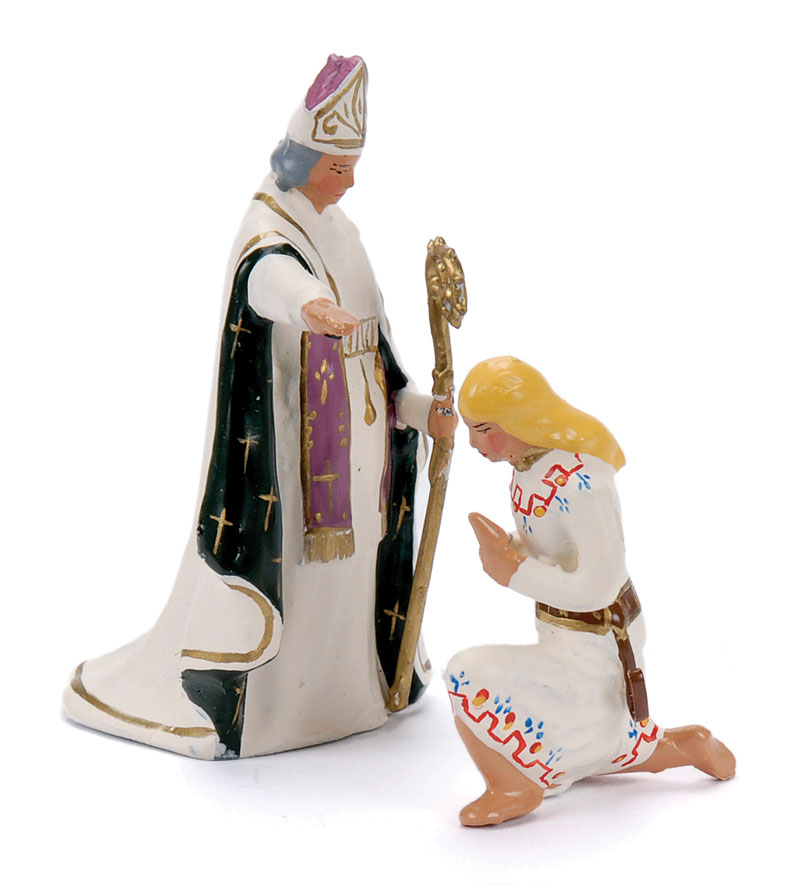 alternative one: Once upon a time there existed a thriving religious tradition. But then this ancient and once proud faith entered into a period of prolonged decline, which continued until this degeneration reached such an advanced state that all of the adherents voluntarily, even enthusiastically, abandoned the beliefs and practices they had had for thousands of years and adopted some other religion that they all now found more to their liking.
 alternative two: Once upon a time there was a vibrant and dynamic religious tradition. But then a new religion came along whose followers sought to convert everyone to their new faith, and to do so they were willing, indeed eager, to resort to any means necessary, including coercion and violence. Faced with social ostracism, mob violence, punitive fines, imprisonment, beatings, torture and execution, many did as the many often do in the face of threats and force, and meekly acquiesced without much of a struggle, or at least did so once the new religion was in possession of sufficient means of persuasion.
 When Hewald the White and Hewald the Black, two Christian Anglo-Saxon missionaries, left their native England on a mission trip to their Continental Saxon cousins sometime around 695, they were blessed with the greatest gift that could have been bestowed upon them: martyrdom.
 There are two important things about the stratification of Old Saxon society, beyond the mere fact that, as in all human societies, such stratification existed. First, the distinction between the non-noble but free frilingi, and the non-free lazzi was not very great, at least according to the grimly quantified system of wergeld, which literally put a value on each human beling's life. The life of an edhilingui was valued at 1,440 solidi, while that of a frilingi was only 1/6 of that, 240 solidi. However, the diference in value between the life of a frilingi and that of a lazzi was compatatively neglible, since a lazzi life was valued at 180 solidi, which is 75% of a frilingi life, which, by comparison, is valued at merely 17% of a edhilingui life!
Finally (for now), here is another excerpt, this one from Alessandro Barbero's Charlemagne: Father of a Continent, focussing on the religious dimension of the conflict between the Saxons and the Franks:There were most likely several reasons for this social division with regard to attitudes toward Christianity. As with the Christianization of most Germanic peoples in late antiquity and the early Middle Ages, missionary work in its early stages was an elite business that catered to the Pagan nobility. Coverting a gens babarorum began with the kings, chieftains, and nobles and only slowly trickled down to the masses. The was the case in seventh and eighth century Saxony. The two Hewalds were martyred on their way to meet with the chieftain of a pagus [local district], and Lebuin had his nobilissimi supporters. Since the vicani of Bede's account feared that their chieftains would force Christianity on them from above, clearly they viewed the new religion as an aggressive encroachment by the nobles on their already limited political power. Also, the frilingi and lazzi probably viewed Christianity as a threat to the Marklo council, the institution through which they had a voice in Saxon politics. The council was not only an annual institution of government but a solemn Pagan religious occassion as well. At the beginning of the council the Saxons "first offered up prayers to their Gods, as is their custom, asking them to protect their country and to guide them in making decrees both useful to themselves and pleasing to the Gods." [Vita Lebuini antiqua 6, p. 793] Such close connections between religious and governmental rituals probably blurred any clear distinction between Paganism and politics at the Marklo council ... [T]he Saxons selected their military leaders by drawing lots, a procedure that also had Pagan religious significance. The frilingi and lazzi therefore probably viewed this nova cultura [Christianity] as a threat both to their ancestors' religion and to the institution of the Marklo council.
Charlemagne's conquest of Saxony was a momentous turning point that overthrew the distinctive political structures and pagan culture of the Saxons. Before the conquest, Franco-Saxon relations had been a checkered history of wars, alliances, and Saxon payments of tribute. By the 770s Charlemagne resolved to incorporate Saxony into his growing empire, apparently in order to settle once and for all border disputes with the Saxons. The result was a series of wars, raids, treaties and rebellions between 772 and 804 through which Saxony south of the Elbe was gradually incorporated into the Frankish empire ... This was a war of conquest and conversion. Charlemagne equated Saxon submission to Frankish rule with the acceptance of Christianity; according to one Frankish author, Charlemagne resolved "to persevere until the Saxons had either been overcome and subjected to the Christian religion or totally exterminated." [Annales regni Francorum s.a. 775, MGH SS 1:153]
[pp. 474-475]
Charles [Charlemagne] had not set himself the declared aim of converting the Saxons to Christianity right from the very beginning. Before him, his father and grandfather had fought against them, and on each occasion, after having defeated them, they were satisfied with the payment of tribute. Einhard [c.775-840, Frankish courtier and biographer of Charlemagne] who was writing when the wounds had had time to heal and could have easily attributed Charles's campaigns beyond the Rhine to reassuring predestinations, actually asserts in very pragmatic terms that 'there were too many reasons for disturbing the peace, for example the border between us and them crossed an open plain, except in a few places where great forests or mountain chains more clearly divided the two countries. Thus murder, raids, and arson were continuously committed by one side or the other.' In the chronicler's opinion, this insecurity of the frontier with the barbarians inevitably meant that 'in the end the exasperated Franks could no longer be contented with returning each blow with another and decided to wage full-scale war against them.'
It is clear that religious motivations were inextricably bound up with political ones, as since the time of Charles Martel I [c. 688-741], Frankish swords had sustained missionary work beyond the Rhine. One of the conditions that Pepin [714-768] imposed on the defeated Saxons was the guarantee that the Frankish and Anglo-Saxon clergy working in the area would be free to continue their apostolic tasks without hindrance. It must have appeared obvious to some of these missionaries that Charles's war had a religious justification. 'If you do not accept belief in God,' Saint Lebuin told the Saxons, 'there is a king in the next country who will enter your land, conquer it, and lay waste.' But the Saxons obstinately refused to believe, so in the end that king had to make his move.
[pp. 44-45]
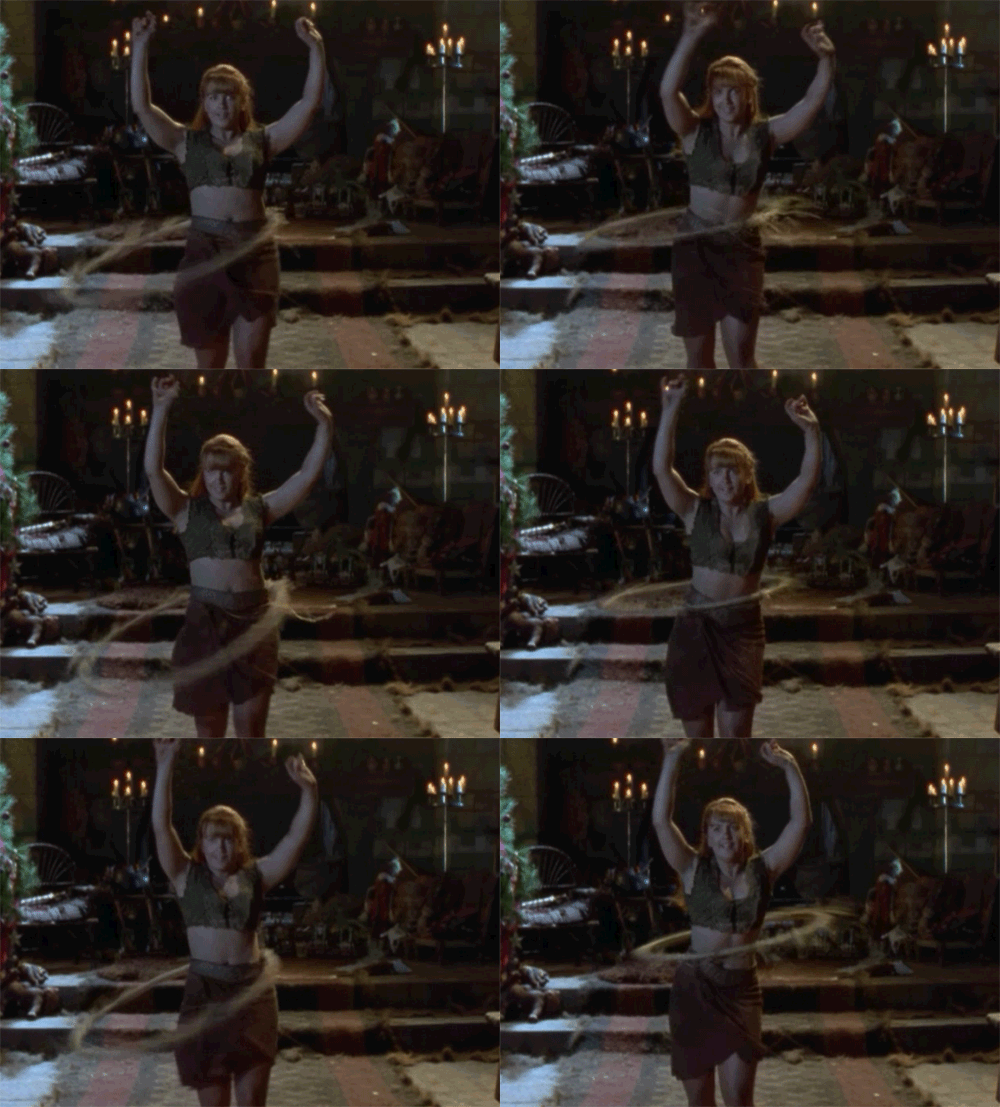 Complaining about historical inaccuracies in Xena: Warrior Princess is like complaining that Sam Kinison yelled too much, or that he was, you know, kind of a sexist pig.

| YEAR - - | Blacks - - | Jews - - | Gays - - | Muslims - - | Total |
| 2009 | 2,725 | 965 | 1,397 | 128 | 6,604 |
| 2008 | 2,876 | 1,013 | 1,237 | 105 | 7,783 |
| 2007 | 2,658 | 969 | 1,221 | 115 | 7,624 |
| 2006 | 2,640 | 967 | 1,148 | 156 | 7,722 |
| 2005 | 2,630 | 848 | 971 | 128 | 7,163 |
| 2004 | 2,731 | 954 | 1,147 | 156 | 7,649 |
| 2003 | 2,548 | 927 | 1,225 | 149 | 7,489 |
| 2002 | 2,486 | 931 | 1,234 | 155 | 7,462 |
| 2001 | 2,899 | 1,043 | 1,375 | 481 | 9,730 |
 This year we have been inundated by hysterical accusations about a wave of Islamophobia sweeping across America. It was specifically claimed that the strong opposition to plans to build a mosque at Ground Zero (or an "Islamic Cultural Center" in "Lower Manhattan", whatever) was proof of a sinister fascistic trend in America that would soon rival the anti-Semitic horrors of the mid 20th century.
 無無明亦無無明尽
 In the biography, JFK: An Unfinished Life, Robert Dallek describes the atmosphere surrounding the famous speech that Kennedy gave to the Greater Houston Ministerial Association on September 12, 1960 as follows:
Religion remained an obstacle. On September 7 [1960], the New York Times carried a front-page article about the ironically named National Conference of Citizens for Religious Freedom, an organization of 150 Protestant ministers led by Dr. Norman Vincent Peale; they said that the Roman Catholic Church, with its dual role as both a church and a temporal state, make Kennedy's faith a legitimate issue in the campaign. Like Kruschev, one member declared, Kennedy was 'a captive of a system.' Although the clergymen were all conservative Republicans eager for Nixon's election (and were guilty of transparent hypocrisy in doing what they said Kennedy's church would do -- interfere in secular politics), their political machinations did not cancel out the effects of their warnings.This was not the first time that Kennedy had tackled the issue. Here is how Dallek describes the way Kennedy responded to reporters who asked about his religion when he first announced his candidacy for the Democratic nomination on January 2, 1960:
Estimates suggested that unless this propaganda was countered and the anti-Catholic bias overcome, Kennedy's religion might cost him as many as 1.5 million votes. The Kennedy campaign quickly organized a Community Relations division to meet the religious problem head-on. James Wine, a staff member at the National Council of Churches, headed the operation. Wine was as busy as any member of Jack's campaign team, answering between six hundred and a thousand letters a week and uring lay and clerical Protestants to combat the explicit and implicit anti-Catholicism in so much of the anti-Kennedy rhetoric.
A highly effective and much publicized appearence made before a group of Protestant ministers in Houston, Texas, on September 12 helped. Bobby, Jack's campaign staff, Johnson, and Rayburn all advised against the appearance. 'They're mostly Republicans and they're out to get you,' Rayburn told Kennedy. But Kennedy believed he had to confront the issue sometime, and he wanted to do it early in the campaign so that he could move on to more constructive matters. 'I'm getting tired of people who think I want to replace the gold at Fort Knox with a supply of holy water.' he told O'Donnell and Powers. In fact, his knowledge of Church doctrine and ties to the Church were so limited that he brought in John Cogley, a Catholic scholar, to coach him in preparation for the appearance.
Although he saw his speech and response to audience questions, which were to follow his remarks, as a crucial moment in the campaign, Kennedy went before the audience of three hundred in Houston's Rice Hotel Crystal ballroom (and the millions of television viewers across the country) with no hesitation or obvious sign of nervousness. The sincerity of what he had to say armed him against his adversaries and conveyed a degree of inner surety that converted a few opponents and persuaded some undecided voters that he had the maturity and balance to become a fine president.
[pp. 282-283]
As for the likely debate to erupt over his religion, he also gave an unqualified response. He acknowledged that it would be a matter of substantial discussion. But he saw only one concern for voters: 'Does a candidate believe in the Constitution, does he believe in the First Amendment, does he believe in the separation of church and state.' Having said that, he dismissed the issue as one that had been settled 160 years ago and concluded that he saw 'no value in discussing a matter which is that ancient, when there are so many issues in 1960 which are going to be important.'In other words, Kennedy's approach to the question of his religion was principled and consistent, and he expressed his views in a clear and forceful way.
[p. 244]
 But in her new book, Sarah Palin complains that John F. Kennedy has received too much praise for his famous Houston speech, because, in her opinion, "His language was more defensive than is portrayed today, in tone and content." [p. 184]


