Saturday, April 14, 2012

Of Smurfs and Crypto-Fascism

In 2011 French sociologist Antoine Buéno published Le Petit livre bleu, essai sur les schtroumpfs, in which he put forward the thesis that the Smurfs are actually an insidious exercise in crypto-fascist propaganda filled with racist, antisemitic and totalitarian secret messages. Srsly.

Personally I think that this helps to put into perspective the paranoid fascist-baiting ravings of Amy Hale and Jason Pitzl-Waters.

And, no, I am not making this shit up.

Friday, April 13, 2012

"We need to start dismantling this notion of 'Tradition.'" (Amy Hale's recent TWH interview)

.
"These are all really complex subjects that you can't just boil down into a soundbite, but lets just start by saying that we really both hate fascism."

"We do, we do hate fascism. And we are against it."


[The following is a transcript of an interview of Amy Hale by Jason Pitzl-Waters. The interview was conducted on April 1, as part of the second installment of a new series of podcasts sponsored by The Wild Hunt. I think the content of this interview is of great interest to a great many people in the Pagan and Esoteric communities. I will have more to say by way of my own analysis - hopefully soon. The time stamps are approximate and refer to the whole podcast, of which this interview is just one segment.]

Jason Pitzl-Waters: [38m52s] Now for this segment on the Wild Hunt Podcast I'm talking to anthropologist and folklorist Dr. Amy Hale, she is the author of a new paper that's in the latest edition of The Pomegranate, it is entitled John Michell, Radical Traditionalism and the Emerging Politics of the Pagan New Right. Welcome Amy, thank you for taking some time out to talk to me today.

Amy Hale: Hi Jason, thank you for having me.

JPW: So, there's a lot of stuff to kind of break down and parse in this article. I guess we have to talk about what is Radical Traditionalism, who is John Michell, why is he important to Radical Traditionalism, and what is the New Right? These are all really complex subjects, you can't just boil down into a soundbite, but lets just start by saying that we really both hate fascism.

AH: We do, we do [39m58s] hate fascism, and we are against it. One thing that I definitely want to clarify, one of the reasons why this topic tends to get very heated, there are a number of reasons why it tends to get very heated, because frankly a lot of people first of all, really hate fascism. The thing is, though, people tend to throw around words like "fascist", and its very common for people to say, "oh, I don't like you, you are doing X thing that I don't like, therefore you are a fascist." And because of that, in the public discourse when we talk about things like the New Right, when we talk about nazism or neonazism or fascism or historical fascism or neofascism, these are all actually very precise terms, but because of their use in popular discourse, a lot of people get very very upset, and I think rightfully so. So I want to make sure that everybody listening to this knows that when we talk about things like fascism [41m4s] in this context, I'm going to be using some fairly precise definitions of what that is and what that is not, because in the case of the New Right in particular and some of these movements, some of the things that are happening, there are a lot of people who say, people on the New Right, who absolutely very much disagree with that label. I think as we go on we'll talk about that a little bit more, so I can help clarify some of that for the audience as we go through the conversation.

JPW: OK. And as you said, fascism in the modern right and left, at least in American politics, is thrown around all the time. You know: "this Republican's a fascist," "Obama's a fascist," basically it's like, anyone who's doing something we don't like is a fascist.
AH: Exactly. The other thing is that even people academically who are writing in political science, there is not a firm agreement on what is and is not to be considered fascist, which is why when you read different political scientists and different historians, people have to do a lot of defining of their own terms for the purpose of their own studies. So there are different schools of thought that have slightly different emphases, and so when I use those terms very specifically, and precisely, I have scholars who's work has influenced me on this, and so I think it's really important that when we're using terms like this that we are precise and that we're careful so that we can actually get into the meat of what we're talking about, rather than having a lot of crazy rhetoric floating around that makes people mad. [42m48s] However, having said that, I do have particular definitions of fascism that will still make people unhappy. So there you go.

JPW. OK. So, why don't we start with John Michell. He was a Traditionalist, he was a New Age, proto-New-Age guru, he was an Earth Mysteries guy, he kind of came up with all kinds of crazy theories about Atlantis and about Britain as a New Jerusalem. So, and for a good portion of his career was basically embraced by hippies if I understand that correctly. So, certainly not, at first anyway, a figure that would be used for, like, right-wing infiltration or nasty extremist politics.
AH: Well, and this is one of the reasons why historically John Michell is such a fascinating character. By way of a little bit of background, in my own interest in this, I've actually worked in the UK for over 20 years now and I've studied the cultural politics of broadly speaking Celtic identities. Most of my work has been in Cornwall, where there are a lot of Earth Mysteries, there's a lot of interest in Earth Mysteries there, a lot of people live there for that reason because there's so much incredible stuff happening with the landscape. There's also a huge tourism industry devoted to Earth Mysteries at Cornwall. So, for me, John Michell ended up, when I first started doing this work, becoming this very interesting figure where this whole range of cultural ideas and politics and subcultural motifs come together. So again to give a little bit of background about him: as you rightly he was a very very important figure in the British counter-culture and in the Earth Mysteries, developing Earth Mysteries scene, and his most famous work related to this, "The View Over Atlantis", was really about the way in which people could interact with the sacred landscape of Britain, although he believed that sacrality and the sacred energies running underneath ley lines in Britain, that this was a universal phenomenon, that you could find this anywhere, and he really just kind of blew some things apart. Obviously there had been this idea of sacred landscape and ley lines in Britain, this is something that people had been into since the 1920s, but what he really popularized was the notion that these were connected to energy currents, telluric currents that ran under the earth. Now, although he popularized this in Britain, this is something that, the idea of telluric currents was that were affiliated with sacred sites, this is something that was already pretty well established for people who were doing Earth Mysteries on the Continent, and in Germany. So this is something that he didn't invent, it was something that he picked up on that was happening in Esoteric cultures elsewhere. So that's part of his importance, was taking the idea of ley lines and really kind of bumping it up a notch with the notion that these were connected to sacred currents, earth currents, that people could contact by visiting these sacred sites and by going along ley lines.
JPW: [46m47s] I think a lot of modern New Age and Pagan authors sort of inadvertently reference [John] Michell and his work, without maybe even knowing that they're doing that. So I guess he was this formative author, and actually as you point out in your article, he actually wasn't himself that much of a big hippie liberal, he was actually pretty conservative in his personal life, and towards the end of his life he [John Michell] started interacting with, if I'm getting this right, interacting with figures from the European New Right. Is that correct?

AH: That is correct, as I understand it that is correct. And one of the other reasons that he is such an interesting figure in this is that one of the characteristics of the New Right is that they see themselves as being, they call themselves the New Right, and this is a reference actually to the old, old right in Europe, which is something that we don't really understand in American politics, because we have our own characteristics of right and left. And John Michell, he really kind of fits with this idea of old European right, which is really neither right nor left. So what ends up happening is you get his ideas, which translate into neotribalism and a lot of really incredibly libertarian ideas. He was very, uh, he was an advocate of legalized marijuana and things like that, and so there were a lot of reasons why the hippies found him, I mean, you know, he was being really radical about some of these things which appear to be very left wing. At the same time he was also quite royalist, from my understanding, and there were many ways in which he was comforted by the notion of traditional society, traditional hierarchy--he really thought that Britain needed to go back to the time period before the Reformation, and that establishing that kind of traditional society with traditional hierarchies would really be more in line with what Britain needed in order to actually reach its own most sacred state would be to go back to that kind of society. So you can kind see in his work and in his personal ideology this interesting mixture of what looks like a really radical social commentary with something that is traditionally based in a way that I think a lot of us kind of have trouble understanding.

JPW: Right I think the classical notion of conservatism, sort of this person who stands athwart history and says, "here, and no further." And Michell, as you point out, was quite a radical in that he actually wanted to turn back the clock [AH: yes] to a golden age, and it's really this sense of a golden age, and of a distrust of modern thought, that sort of made him very appealing to the New Right and from what I understand, to explore what the New Right is, because I think, as you say, these terms are very different in European politics than in American politics, where we understand right and left as the Republican Party and the Democratic Party, or even in Great Britain where we understand it as the Tories and the Labor Party. [AH: exactly] And what we're talking about here as right is actually these New Right groups, are always what they call "third positionist" in they see themselves as above the right left fray, and that they are bringing forward a new paradigm in politics that is taking the best in their minds from classical conservative and liberal values.

AH: Absolutely, that's exactly what they're doing. And it's important to understand that there are a whole bunch of these third positionist, and New Right groups that have very different views on social structure. There are a number of features that they share but some are starch [sic?] monarchists, some are what would be called anarcho-monarchists, some are kind of much more libertarian, have different views on democracy and representation, so there's actually kind of a spectrum of activity over there as well, and sometimes it really is very hard for us to get our heads around what it is that they are promoting when we're thinking of strictly a right-left divide, because it actually is true [52m24s] that they really don't fit that category particularly well. And I think that one thing I don't want to do is to because of what's happening ... [ garbled] ... "Confessions of a Radical Traditionalist is something that was edited toward the end of his life. And from what I've read from his biographer, in his biography, he was trying to kind of shed this hippy image. It's really hard to know exactly what his involvement with New Right politics was or would have been. So I don't want to overstate that he was all of a sudden becoming some sort of crazy activist, because I don't have that specific data. But it is clear that he was knowledgable about it, and from what he wrote and from other aspect of his life, I think we can certainly say he was conscious of it and sympathetic to some of their aims."

JPW: Right. So, here we bring up another term, which is Radical Traditionalist [both laugh], and I think this is where our conversation is going to start getting into the weeds [more laughter] of political jargon, and so our listeners will have to forgive us if we get a little bogged down here. In your article you quote Tamir Bar-On from his article Fascism to the Nouvelle Droite: The Dream of Pan-European Empire [54m1s], and he says, the New Right has a list negations which it shares with historical fascism, which is anti-modernism, anti-capitalism, anti-immigration, anti-materialism, anti-egalitarianism, and anti-Americanism. So I guess if we're going to place the New Right on a spectrum, would you say that there are benign New Right groups that are merely sort of yearning for a golden age and want to rise above partisan politics and then there perhaps is another portion of the New Right spectrum that are, as this other scholar [Bar-On] notes, sympathetic with historical fascism?

AH: Yes. I absolutely think that there is a continuum of beliefs, interests and activities among these groups. I think that there are a number of people who not maybe identify as Radical Traditionalists but who might identify as Traditionalists within certainly the Pagan community who would find any notion of of ethnic separatist politics to be odious and disturbing, and really what they're interested in, they might be perhaps of an anti-modernist bent, may perhaps be of an anti-corporate-capitalist bent, perhaps even into more collective living, into maybe radical environmentalism, and are most interested in the notion of resacralizing the world which is a key idea within Traditionalism and within Radical Traditionalism. And so I think that there are a number of Traditionalists, Prince Charles, for one, actually qualifies as a Traditionalist. A key to Traditionalism is that there is a single Tradition, with a capital "T", that really represents the sacrality of the world and when one is in touch with this, then life, the universe and everything will be in harmony. So yes, I think that there are a number of Traditionalists who, and maybe even some Radical Traditionalists, who are not interested in these politics, and maybe not even aware of them. But what I hope we talk about a little bit later is the frameworks underneath these that actually cause, in my view, potentially a bit of a slippery slope.

JPW: So, Radical Traditionalism would you say is a movement within the broader umbrella of the New Right?

AH: Yes. My view is, and again, I just want anybody to know that if there are other perspectives on this that I am very happy to listen to the data on this. I believe that Radical Traditionalism is really the, it's emerged within a Pagan framework, in an explicitly Pagan framework, and it is, um, it really is, uh, I think a way to help merge some of the politics, political views, with the New Right, specifically those of Julius Evola, Rene Guenon, and to take those, and to put them in a more Pagan and Esoteric framework, to help build a more Pagan culture, around the ideas of the European New Right.

JPW: Obviously I've encountered Radical Traditionalism at several points over the years doing journalist work, and at first it just seemed sort of like, like you said, mostly and largely benign, "we're harkening back to a golden age when men were men and women were women and Tradition was important," you know, and it was sort of this yearning for, I guess, a purer time. And it was very Pagan, explicitly so, and often allied itself with several underground bands, especially in the neofolk subculture in Europe. So it really was trying very hard to be something that would appeal to a very specific subculture. I guess what my issue here is that [59m18s], how much of Radical Traditionalism as a movement, how much of it do you think is co-opted by extremists, racists and people who believe in a sort of virulent ethnic superiority.

AH: Well, I think that, uh, one thing I want to look at within this is certainly the idea of ethnic superiority because, uh, well, to answer the first part of your question I will say that I believe that there is a lot of what is called Radical Traditionalism that has some politics that I personally believe and would define to be what we call little 'f' fascism. Which means not historical fascism which is defined by the Nazism and Italian Fascism during the interwar and WWII period. And so yes I do believe that there are some in my view rather challenging[?] politics that are promoted by these groups. Now the difficulty is that there are some who I have seen who are absolutely promoting white supremacist views. And I know that there are some people who are going to be very upset by that but I'm sorry, there are. There are some who are actually allied with white supremacist organizations. That is also true. I am very sorry if you do not want to hear that. However, there are a number of people involved with Radical Traditionalism who are separatist rather than supremacist, and I think it's important to make that distinction. A lot of them feel that they are actually promoting diversity by promoting separatism and the idea within their framework that what the world needs in order to be more diverse and happy is for everybody to be within their own ethnically homogenous enclave, and people like myself don't find that that is viable, nor is it a particularly good idea, and it also just doesn't reflect the way that culture works. I mean there are no pure cultures. Cultures, like people, thrive off of contact. In some ways, culture works well biologically if we use that kind of biological model where the cultures that are the most vibrant are actually the ones that have had the most contact. That kind of [garbled] doesn't actually promote them. I think it's very difficult that the rhetoric, and I do believe it is rhetoric, that many of them use about diversity, I find that it's more almost co-opting the strategies of leftist discourse in order to, that the real agenda is this type of separatist enclave.

JPW: It does seem to me to be almost a smoke-screen for a more noxious form of politics. That the "separatism" is really a, I'm not saying that there aren't, who don't have any underlying agenda, but it just seems that most of the rhetoric I've read online about these homogenous separatist communities are really sort of a polite supremacism.

AH: Some of it is a polite supremacism, and some of it is a very impolite supremacism, and as I've been following this movement over the past couple of years, it's gone from being implicit to explicit. You know I visited one website that markets to the Esoteric community that was basically issuing blog points about Black History Month, and why there shouldn't be one. In my view, well, thanks for letting me know how you really feel. And they put it out there, so, there you go. But one thing I want to mention though about this is we can look certainly within Paganism and see how certain attempts at actually being culturally sensitive have opened the door to this, and I want to talk about is the notion of cultural preservation and appropriation, because I think that a lot of Pagans are very sensitive to cultural appropriation and think its a bad thing and don't want to do it ...

JPW: Right, and I want you to continue that thought, but I just wanted to point out that obviously within reconstructionism especially there are very strong ideas of preserving cultures and preserving religious cultures and about not appropriating cultures that you don't belong to.

AH: Exactly. And it ends up being a kind of a sticky issue theoretically, because I have been professionally involved with minority cultures and with cultural preservation for most of my career, in both a professional and a personal context, and I feel very strongly about these issues, however, they're not cut and dry. So what ends up happening is you get a lot of good Pagan folk, and folk in general who really want to try to do it right, so, well, we don't want to appropriate anything, and we also want to preserve culture because we think that cultural preservation is a good thing in general. So what do we do? Well, gee, we need to only work within the tradition that belongs to us. Well, how do you define that? Well, you pick and choose. A lot of people do. So a lot of people try to find traditions that they feel are part of their genetic inheritance, which for most of us in the United States, well, for most of us anywhere, that's a choice we make, we choose to [garbled] we call our genetic inheritance, because as I was saying earlier, culture doesn't work like that. So I think that this notion of trying to do things, like a lot of the current thrust of reconstructionism, and trying to do things in a really pure, authentic, and that in really big finger quotes, way, comes out of just wanting to do things right and trying to be a good person. Unfortunately, when you start going down that road, it's not very far to making arguments about cultural purity in the name of preservation. And what we need to remember is that when we are talking about things like cultural appropriation, there are a lot of really good reasons to not do it, and a lot of those are dictated by economic, cultural genocide and exploitation that a lot of us just don't want to be a part of and associated with. But when you look at cultural borrowing, that's something that most of us do on a daily basis whether we are aware of it or not, and what I'd like to see within the Pagan community is for us to be more aware, more sophisticated about how culture works, what's the difference between appropriation and borrowing? When it is OK to do that? When is it not? In what context do we do this? Because if we don't get better at having those conversations, and if we're not more sophisticated then we come up with unsophisticated responses. And in my view, the notion of cultural purity and trying to maintain this crazy notion of cultural-genetic inheritance, that is an unsophisticated response.

JPW: I want to kind of bring this all together now, and what I think what your paper hints at is that John Michell as a figure is indicative of a much larger trend, which is [1h8m57s], which is taking these popular figures and thinkers throughout history, especially our modern history, and then using them as advertisements for I guess what you could call a cryptofascist ideology, and then selling that back to esoteric and Pagan communities in hopes of swelling their own ranks. Would you say that's a fair assessment?

AH: Yes, and I know that a lot of people aren't going to want to hear that. I think that we tend to see this, we might tend to see this impulse more in music, which is another conversation that we could have, a huge and probably even more controversial conversation would be the role of music in all of this, but the interesting about John Michell was when I first started looking at this particular volume [Confessions], I mean a lot of his work, if you look at a whole bunch of his work, you probably wouldn't see it. You might say, [1h10m16s] "oh, that's a bit odd, a bit quirky." You might read some of his essays, if you can even find them, some of his older essays and say, "that's seems a bit strange for somebody whose been so allied with the left." But this particular volume was done in my view in a complicit way. He was working with people who were trying to make a point with his work. So they were cherry picking essays that were sympathetic to and supporting a particular political viewpoint. And at first I was, it took me a while to realize, "oh hey, wait, he was OK with this because he was part of this of this program. He supported the positions of Julius Evola, who is a very complicated writer, a very controversial writer, um, had a lot of very interesting things to say. So he [Michell] was part of a program to give wider attention to his [Evola's] work and to place Evola's thoughts in perhaps a number of different contexts. So, yes, I think that in doing this, it's opening up and showing his work in a new light and in fact might be turning a different group of people onto his body of work which can now be read in a very very different way than I think most people would ever consider reading it.

JPW: OK. Now as far as Michell, and you bring up Evola, which is of course a whole other bag of worms there, but I think what strikes me is that a lot of these thinkers that are used by the New Right and by Radical Traditionalists as tools to do recruiting is that, their murkiness and the difficulty of parsing where they really stand, is something that is purposefully exploited. I see this even with Aleister Crowley, is that they take thinkers who are not easy to categorize politically, and therefore that gives them a lot of ideological cover when they're trying to sell some other agenda with those thinkers.

AH: [1h12m48s]I absolutely agree, and Crowley's a good example. I have encountered a number of thinkers and theorists who really believe that Crowley represented a perspective that is very consonant with the aims and perspectives of the New Right. Sometimes I agree with that, sometimes I vigorously disagree with that. I think that Crowley probably would have had some agreement and and would have really disagreed on other grounds. So, yes, you are correct in that a lot of their rhetoric is very murky, it is designed to be so, absolutely. People affiliated with the New Right completely dismiss the term fascist when applied to their work. They don't see it at all, or they do see it and they just don't want to discuss it. I think that part of what is happening within Paganism is you find a lot of people who are promoting the New Right who will use a variety of writers who maybe have very very different views, and they will tuck them into their publications, or they will schedule a variety of bands together, so that you can't say very specifically, "oh, this is a publication that says this", it just gives you a taste of it here and there and has enough other people involved so that if you try to say that they are promoting one view, they'll say, "but this person's in here, and they don't represent that viewpoint," and because this is something that some New Right theorists, is a tactic of entryism that they have specifically written about ts kind of easy to know ... [audio garbled] ... how it works.
JPW: So, yeah, you actually bring up the term "entryism", and that's actually a term that I've encountered as well. [1h14m54s] Basically, the terms of engagement is you don't give your full ideology, you just give little bits that are acceptable. So I guess I don't want to go too much longer, so lets, I want to wrap up by sort of asking a larger question which is, how dow we, how does the larger Pagan and Esoteric community fight infiltration by crypto-fascist groups? Is the old add that sunlight is the best disinfectant? Is it merely an issue of bringing these people to light? What do you feel is the proper response for Pagan groups that are concerned about infiltration from political groups that may fly in the face of everything that they believe in?

AH: [1h15m54s] Well, unfortunately, I think what this is going to require in my view, isn't even bringing these people to light, because what I think we need is an internal conversation with ourselves as Pagans. And I think we need to look at what we are doing and what values we are holding and what communities we're creating that are opening the door for this kind of thing to continue. And one thing that I want to see and that we need to look at, is what do we, why do we feel the way we do about the idea of "tradition"? And this is really hard because, you know, we like things that are traditional, we like folklore because its cuddly and its cozy and it makes you feel warm and yummy.

Unfortunately, "tradition" is really something that is ideologically loaded, and it's the notion of tradition that a lot of the right, both the old right and the new right, and really any flavor of right centers around, and we need to look at why we as Pagans give the notion of "tradition" and "lineage" as much power as we do. And that's going to be a really hard conversation that we're gonna have to have, because I think a lot of people tend to feel that "tradition" is the center of their practice, and it's "tradition" which gives us legitimacy. I don't agree with that. I think that we are legitimate because of what we choose to do and how we choose to practice, and we need to start dismantling this notion of "tradition", or at least understand why it is that we like it as much as we do, so we can kind of see this stuff coming.

Another thing I want us to look at is, um, or at least be aware of, is the role of radical environmentalism in this, and I think that most of us would be, "Yeah! Environmentalism, that's fantastic!" But we need to know when we are getting "blood and soil" arguments wrapped up in radical environmentalism. And when people are talking about land, and the sacrality of land, and nature and the countryside, and when we are seeing conservative arguments rather than progressive ones. And so I think that it's going to be really a process of unpacking a lot of things that are very important to Pagans today and understanding what the roots of those are, because shining a light on somebody who has views which we might consider less than savory, uh, I don't think that's going to do the trick. [1h19m10s]

Other relevant posts from this blog:


Friday, April 6, 2012

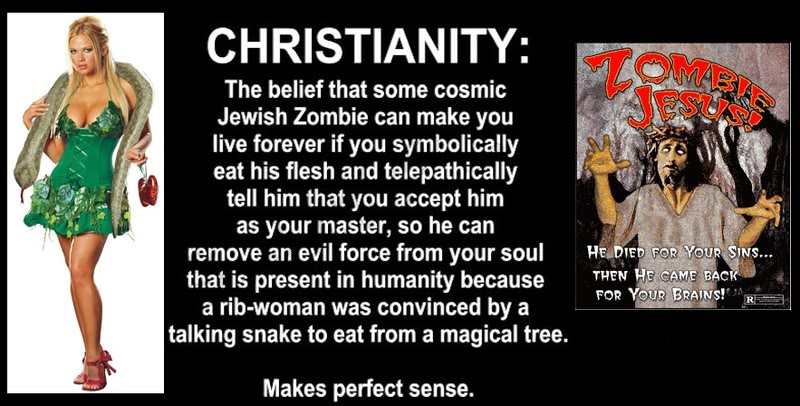
Zombie Jesus, Jesus+Dinosaurs, Robot Chicken Jesus, etc.

.
From the Whip It Good blog:


From Red Shirt's Lament:


From InYourWater:


From Derek Chatwood at PhotoBasement:


This actually explains a lot


Zombie Jesus Is Real


This actually explains a lot, too.


Jesus+Satan 4Ever


Creepy BFF Jesus


Raptor Jesus


Giant Robot Jesus


No description available (or necessary)


Do not enter robot work area


RoboCop Dolphin Jesus


God Jesus Robot


Ghostbusters versus Jesus


Robot Chicken Jesus


Robot Chicken - Jesus from Felipe Canhameiro on Vimeo.

Also be sure to check out:
Happy Zombie Jesus Day

Saturday, March 31, 2012

Wicca and polytheism

It should go without saying that no one speaks for Wicca. But certain authors have nevertheless attempted to pin the label "duotheist" on Wicca with the explicit intention of creating a clear bright line separating modern Wiccans from the historical Paganism of the ancient world, which reveled in extravagant polytheism.

Question: Do Wiccans recognize (revere, worship, adore, call upon, pray to, honor, sacrifice to, sing hymns of praise to, dedicate works of art to, dedicate their lives to ...) one and only one God and one and only one Goddess?

Answer: Uh, no.

As our first and only witness, let us call Gerald Brousseau Gardner. In Chapter XIII of The Meaning of Witchcraft, Gardner states (on page 170 of the 2004 Weiser edition), regarding ancient forms of Paganism and their relevance to Wicca, that "the only kinds of paganism with which we are concerned here are those which may have had some influence on the witch cult." Gardner then names three such sources of influence in particular: (1) "Druidism, the religion of the Celts", (2) "the religion of the Great Mother Goddess or the old Hunting God", and (3) "the Mystery Cults of the ancient world".

Having cited the Mystery Religions as an important part of Wicca's connection with the ancient Pagan past, Gardner then poses the question, "have we any way of ascertaining what the Mysteries taught?" To which he immediately provides the answer:
"Fortunately, we have. In the fourth century A.D., when paganism was engaged in a fierce struggle with the new creed of Christianity, Sallustius, who was a close personal friend of the Emperor Julian (called the Apostate because he tried to restore the old religion), wrote a treatise called Peri Theon kai Kosmou, About the Gods and the World. It is probable that this treatise was a kind of manifesto of the highest type of paganism prevailing at that time, and it is evident that its author was an initiate of the Mysteries."
[p. 171]
At this point, Gardner launches into an extended commentary on the contents of Sallustius' "Pagan Manifesto", with lengthy quotations from several sections of that work. (Gardner uses the English translation of classicist Gilbert Murray, the full text or which is available online in several places, including the blog of yours truly here. The translation was originally published in Murray's Five Stages of Greek Religion.) At the end of this, having given a fairly detailed summation of selected aspects of Sallustian Paganism, Gardner then states:
"Now the thing that will, I think, strike most the consciousness of the reader who is well versed in the teaching of the higher type of spiritualist and occult circles generally is not the antiquity of this teaching of Sallustius, but its startling modernity. It might have been spoken yesterday. Further, it might have been spoken at a witch meeting, at any time, as a general statement of their creed .... [T]he spirit of his teaching, the spirit of the Mysteries of his day, which is also the spirit of the beliefs of the witch cult, is timeless."
[p. 174]
There can be no doubt whatsoever that Sallustius' "Pagan Manifesto" was thoroughly polytheistic. In fact, the opening words of the manifesto declares that it is addressed to "Those who wish to hear about the Gods." Here is a quote from section VI:

"Of the Gods some are of the world, Cosmic, and some above the world, Hypercosmic. By the cosmic I mean those who make [ποιοῦντας] the Cosmos. Of the hypercosmic Gods some create [ποῖουςι] Essence, some Mind, and some Soul. Thus they have three orders; all of which may be found in treatises on the subject.

Of the Cosmic Gods some make the world be, others animate it, others harmonize it, consisting as it does of different elements; the fourth class keep it when harmonized.

These are four actions, each of which has a beginning, middle, and end, consequently there must be twelve Gods governing the world.

Those who make the world are Zeus, Poseidon, and Hephaistos; those who animate it are Demeter, Hera, and Artemis; those who harmonize it are Apollo, Aphrodite, and Hermes; those who watch over it are Hestia, Athena, and Ares.

One can see secret suggestions of this in their images. Apollo tunes a lyre; Athena is armed; Aphrodite is naked (because harmony creates beauty, and beauty in things seen is not covered)."

In addition to the twelve Olympians mentioned above, Sallustius also speaks of Asklepios, Dionysos, the Charities, and Kronos, and he also makes frequent references to the Daemons who occupy a place between humans and the Gods. In addition, Sallustius also insists that the Gods must be worshipped properly in the traditional manner. In other words, the Paganism of Sallustius is a seamless continuation of the traditional polytheism of the Greek and Roman civilizations.

But recall that according to Gardner, as quoted above, all of what Sallustius says "might have been spoken yesterday. Further, it might have been spoken at a witch meeting, at any time, as a general statement of their creed .... [T]he spirit of his teaching, the spirit of the Mysteries of his day, which is also the spirit of the beliefs of the witch cult, is timeless."

QED

Suggestions for further reading:
  1. Thomas Taylor on the Religion of Socrates
  2. Beauty, Nature, Divinity, Secrets
  3. Sallustius, Gardner & Wicca: "A general statement of their creed."
  4. Gerald Gardner, Sallustius, and the Problem of Evil
  5. Gerald Gardner, Sallustius, and Reincarnation
  6. "Divested of their garments"
  7. "On the Nature of the Gods and the Cosmos" (full text)
  8. Plotinus In Defense of Polytheism
  9. More on Plotinus on the Gods
  10. Hinduism, Paganism, & Polytheism


Friday, March 30, 2012

When did the Village Voice stop pimping child sex slaves?

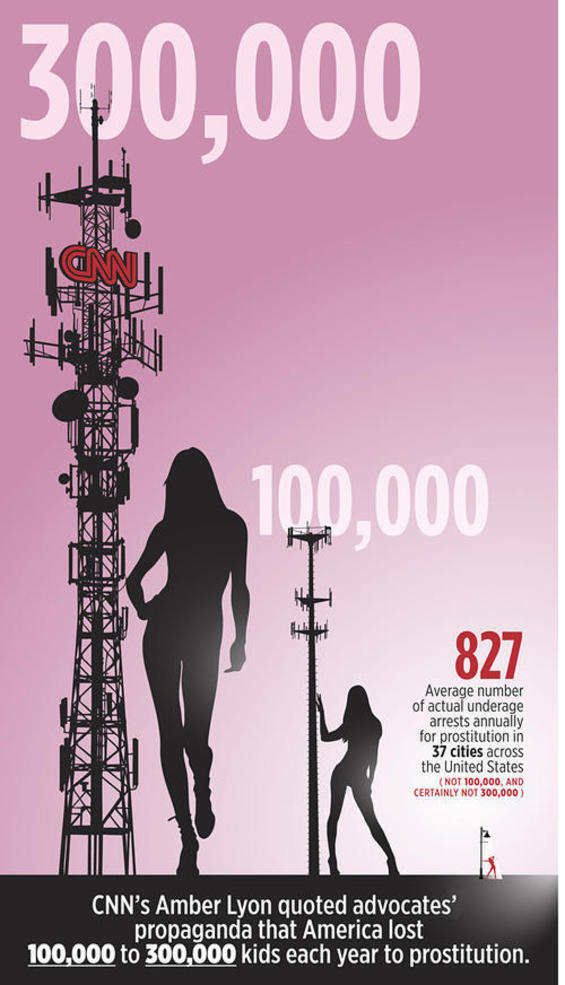
Ace reporter Kirsten Powers (a FOX News "Democrat" pundit and a regular on the O'Reilly Factor) has now jumped onto the bandwagon of a truly McCarthy-esque smear campaign against the Village Voice. Writing for the Daily Beast (where she recently helped to launch the "hey what about Bill Maher, Matt Taibi, Chris Matthews, etc " meme to provide some much needed left-cover for Rush Limbaugh when he was catching hell for calling Sandra Fluke a slut) Powers accuses the Village Voice of being "Sex-Slavery Facilitators".

Why?

Supposedly, Kirsten Powers (and others) are shocked, shocked, to find "adult" ads in the Village Voice. But, to state the painfully obvious, there is nothing new about these ads, or the controversies surrounding them. What is new, though, is that for the past year, the Voice has been running a series of investigative reports exposing the junk science, fuzzy math, and powerful religious organizations behind the overblown moral panic over "sex-trafficking".

I have already recently blogged about this (Counting Sex Slaves: Moral Panics, the Mass Media, and Christian Propaganda). In that post I showed that the investigations of the Village Voice on this issue are based on solid research, and that the Voice's articles closely parallel what has been written by a variety of scholars and activists who have raised very serious doubts about the wildly exaggerated claims of the sex-slavery mongers.

And now here is a selection of some of the highlights of the Village Voice investigative series on sex-trafficking.


If Pirate Jenny worked at Starbucks, etc.

Angela Carole Brown


Frauke Bröcker


hebrew


with a mask


japanese


perfectly understated


pefectly non-understated


if pirate jenny worked at starbucks


"Every normal man must at times be tempted to spit on his hands,
hoist the black flag, and begin to slit throats."

H. L. Mencken

Thursday, March 29, 2012

Silly, Ignorant Goddess Worshippers (More on Tully on Whitmore on Hutton)

In a recent opinion piece published in the Pagan Studies journal The Pomegranate (link), graduate student Caroline Tully contrasts two different views concerning how to interpret the archaeological finds at Çatalhöyük:

Position 1 On the one hand there are the silly, ignorant "Goddess worshippers" who foolishly "identify prehistoric figurines as 'aspects' of the 'Great Goddess'", and who romantically fantasize that these figurines "provide evidence for the existence of a utopian world in which women were not subject to oppression". Tully tells us that the "inspiration" for these imaginings "comes from the mid-twentieth century interpretation of the site by its first excavator, James Mellaart and later popularised by archaeologist Marija Gimbutas."

Position 2 In the other corner we have Tully's heroes, those plucky post-processualist archaeologists who have overthrown Error thereby firmly established the reign of Reason. The theories of Mellaart and Gimbutas have been consigned to the dustbin of history, and all clear thinking people now accept the new post-processualist explanations which are "more nuanced", leaving the silly, ignorant Goddess worshippers "confused".

With respect to Position 1, we are left wondering who these Goddess Worshippers are, and, consequently we must also wonder whether or not they (whoever they are) really espouse anything like the positions that Tully attributes to them? This is not the way serious scholarship is done. This is FOX News style propaganda, where straw-man positions are attributed to a vaguely defined group of people, and then this group is ridiculed and vilified on the basis of positions that are at best distorted versions of the group's actual beliefs, or just outright fabrications.

Let's take a look at two prominent Goddess Worshippers, and see what they actually have to say for themselves in their own words. In the case of both Starhawk and Max Dashu, the evidence is quite clear. Neither of these women takes on anything like the crude positions sloppily attributed to unnamed "Goddess worshippers" by Caroline Tully.
Here is what Starhawk wrote back in 2001

from: Religion From Nature, Not Archaeology:
"Goddess religion is not based on belief, in history, in archaeology, in any Great Goddess past or present. Our spirituality is based on experience, on a direct relationship with the cycles of birth, growth, death and regeneration in nature and in human lives. We see the complex interwoven web of life as sacred, which is to say, real and important, worth protecting, worth taking a stand for. At a time when every major ecosystem on the planet is under assault, calling nature sacred is a radical act because it threatens the overriding value of profit that allows us to despoil the basic life support systems of the earth. And at a time when women still live with the daily threat of violence and the realities of inequality and abuse, it is an equally radical act to envision deity as female and assert the sacred nature of female (and male) sexuality and bodies . . . .

"To us, Goddesses, Gods, and for that matter, archaeological theories are not something to believe in, nor are they merely metaphors. An image of deity, a symbol on a pot, a cave painting, a liturgy are more like portals to particular states of consciousness and constellations of energies. Meditate on them, contemplate them, and they take you someplace, generally into some aspect of those cycles of death and regeneration. The heart of my connection to the Goddess has less to do with what I believe happened five thousand years ago or five hundred years ago, and much more to do with what I notice when I step outside my door: that oak leaves fall to the ground, decay and make fertile soil. Calling that process sacred means that I approach this everyday miracle with a sense of awe and wonder and gratitude, and that in very practical terms, I compost my own garbage.

"The current discussion within the Goddess tradition about our history and scholarship is part of the healthy development of a vibrant tradition that tends not to attract true believers of any sort. We enjoy the debate, but we are sophisticated enough to know that scholars, too, have their biases and fashions."

And here is what Max Dashu has to say for herself in an essay she wrote about Marija Gimbutas back in 2000:


from: The Furor Over Gimbutas:
"All this polarization and oversimplification avoids the real issue, which is not female domination in a reverse of historical female oppression, but the existence of egalitarian human societies: cultures that did not enforce a patriarchal double standard around sexuality, property, public office and space; that did not make females legal minors under the control of fathers, brothers, and husbands, without protection from physical and sexual abuse by same. We know of many societies that did not confine, seclude, veil, or bind female bodies, nor amputate or deform parts of those bodies. We know, as well, that there have been cultures that accorded women public leadership roles and a range of arts and professions, as well as freedom of movement, speech, and rights to make personal decisions. Many have embraced female personifications of the Divine, neither subordinating them to a masculine god, nor debarring masculine deities.

"Evidence for such societies exists, though there's no agreement on what to call them. For many people, 'matriarchy' connotes a system of domination, the reverse and mirror-image of patriarchy. Identified with early anthropological theory and, during the 60s, with slams against African-American women, it has been overwhelmingly rejected by feminist researchers. 'Matrilineal' is inadequate, focusing on the single criterion of descent. 'Matrifocal' is too ambiguous, since it could be argued (and has been) that many patriarchal societies retain a strong emphasis on the mother. A variety of names have been proposed for egalitarian matrilineages, including 'matristic,' [Gimbutas, 1991] 'gynarchic' societies, [Gunn Allen, 1986] 'woman-centered' societies, or 'gylany.' [Eisler, 1987] My preferred term is 'matrix society,' which implies a social network based on the life support system as well as mother-right.

"Old-school academics as well as post-structuralist upstarts like to scold refractory feminists about evidence and certainties. The pretense of disinterested objectivity reminds me of what Gandhi said when asked what he thought about Western Civilization: 'I think it would be a very good idea.' The notion that mainstream academia is somehow value-free, but feminist perspective is necessarily ideological and agenda-driven, is still widely held. Covert agendas pass easily under the banner of objectivity.

The project of reevaluating history with a gender-sensitive eye is in its infancy, and necessarily allied to indigenous and anticolonial perspectives. An international feminist perspective views history as remedial - - because sexism and racism have obscured, distorted and omitted what information is available to us - - and provisional, because new information keeps pouring in. History has changed rapidly since the 60s, in every field: Africana, Celtic studies, West Asian studies, American Indian scholarship. Thousands of new books come out every year that look deeper into women's status and stories in a huge range of societies and periods, at a level of detail not possible before. Fresh interpretations are being advanced from voices not heard before. It's way too soon for sweeping dismissals . . . .

"So polarized has this debate become that, as Wendy Griffin has observed of Marija Gimbutas, 'Her theories tend to be judged as either absolutely true or absolutely false...' [Griffin, 2000] It is impossible to mention the work of Gimbutas in academia without being caught up in a heated dispute. A positive mention is immediately assumed to indicate total agreement with every interpretation she ever wrote, and to warrant heated attack. In this charged atmosphere, the content of her work invariably gets lost, and the documentation she provided is never evaluated. Those who dismiss her work as being about 'matriarchy' and a 'mother goddess,' terms she explicitly rejected, misrepresent her much more complex views. [See Joan Marler’s defense of Gimbutas’ contributions and historical narrative, 1999]

"By any account, Marija Gimbutas had a distinguished career as a 20th-century archaeologist and a primary founder of modern Indo-European studies. She excavated sites of the Vinca, Starcevo, Karanovo and Sesklo cultures. Her ability to read sixteen European languages enabled her to study virtually all the archaeological literature on both sides of the Cold War split, a crucial skill since most key publications in her study area were written in eastern European languages. It was Gimbutas who laid pivotal groundwork for integrating archaelogical data with linguistic studies of Indo-European origins. Her model for Indo-European origins is still the leading theory in the field. Its basic outlines are upheld -- minus the focus on women’s status and goddess interpretations -- by her former student J.P. Mallory, now one of the top authorities in IE Studies."

The take home lesson here is that both Starhawk and Max Dashu show themselves to be articulate, serious minded and well informed. One can agree or disagree with their views, but those views are substantial and reasoned. In brief, neither woman in any way resembles the hackneyed caricature of silly, ignorant Goddess worshippers being peddled by Caroline Tully.

Theoretical Archaeology is a Foreign Country

In her recent Pomegranate article, Researching the Past is a Foreign Country: Cognitive Dissonance as a Response by Practitioner Pagans to Academic Research on the History of Pagan Religions (link), archaeology graduate student Caroline Tully presents a cartoonishly simplistic vision of academia as a noble sodality of high-minded truth-seekers whose selfless devotion to the furtherance of human knowledge is only matched by the refinement of their table manners. Such naïveté is perhaps excusable (and, in fact, probably inevitable) in a graduate student such as Tully, but eventually she is going to have to grow up and discover that the Academy, and her chosen field of archaeology in particular, is very different from this fairy tale. And when that happens, she will be able to learn first hand just what "cognitive dissonance" is really all about.

In the real world, modern archaeology is a faction-riddled theatre of ideological struggle. But the reality of scholars heatedly disagreeing with each other on every point of theory and interpretation (and often even the facts), with competing camps taking turns as the dominant party which must constantly fight off both old rivals and newcomers, rather deflates Tully's fictional narrative in which scholars serenely and univocally instruct the untutored in How Things Really Are.

Below is a very nice overview of the current state of affairs in the field of Archaeology, from Professor John Bintliff of Leiden University. Bintliff's observations concerning "post-processualism" are especially relevant, because one of the major proponents of that theory is Ian Hodder, who makes a brief but very illuminating appearance in Caroline Tully's aforementioned paper. (Fair warning: this is rather heavy on the "inside baseball", but that is unavoidable.)

"To the present day the discourse in archaeological theory has been one of competing dominance. Just as New Archaeologists dismissed the formerly dominant culture history version of the romantic tradition, so in turn the revival of romanticism in the guise of post-processualism proclaimed the misguidedness of the New Archaeology. Thus Matthew Johnson's Archaeological Theory: An Introduction (1999), for all its stimulating content, is primarily a propaganda vehicle for the virtues of post-processualism and the inadequacies of processualism.

"As someone who has experienced all these traditions from the inside--as a university student taught by and encouraged to study the leading exponents of culture history, at the same time as young lecturers were distracting us with the first publications of the New Archaeology, then in later years to observe how these young rebels were consigned to old fogey status by post-processualists--any balance seems sorely lacking. When David Clarke (1973) in a heavily cited paper entitled Archaeology: The Loss of Innocence claimed that processualism was about to achieve an absolute purity of method and theory, free of previous ideology and bias, he was as far from the truth as other intellectual gurus within processualism and post-processualism who offered their borrowed finery from Continental traditions to garner serious recognition from other disciplines. The reality has been a succession of ideologies, driven by a desire of each generation of new scholars in Western society to assume the high status of their predecessors through the simplest method--replace the previous orthodoxies with others and remove the latter from serious consideration (the strategies of bibliographic exclusion and scholasticism) . . . .

The fact that (as in geography) whole sectors of archaeology have settled into divergent philosophies, with Paleolithic specialists by and large remaining positivist and Darwinian, Classical, and Near Eastern archaeologists remaining attached to Cultural Historical aims, while later Prehistory and European post-Roman archaeology are the playgrounds of postmodernism, highlights a practical need to re-create a unified discipline without the demand for [ideological] victory or surrender. Nonetheless, the attraction to each generation of displacing their teachers by moving the intellectual goalposts is a good deal easier than building on the past work to sharpen and improve it, which offers less easy fame and an uneasy dependence on older scholars. One source of motivation is the potential for integrating the works of stimulus and skill by generations older than the recent schools with the knowledge of the important achievements of culture history, processual and post-processual scholarship."
[John Bintliff, "History and Continental Approaches", in Handbook of Archaeological Theories, Alta Mira, 2007, pp. 154-155]

This is just a sampling of Bintliff's wide ranging survey of Theoretical Archaeological. If you read the whole thing you'll find he has much more to say about post-processualism, Wittgenstein, Marx, Nietzsche, the Enlightenment, Romanticism, etc. Also highly recommended is the Introductory chapter, in the same volume, by R. Alexander Bentley and Herbert D. G. Maschner.

Tuesday, March 27, 2012

Caroline Tully and the "Internet Smear Campaign" Against Ronald Hutton. meh.

In a recently published "opinion" piece in the Pagan Studies academic journal, The Pomegranate (link), Caroline Tully makes the following rather alarming claim:

"Pagans who dislike British historian Ronald Hutton’s book The Triumph of the Moon have participated in an internet smear campaign against him, motivated by [Ben] Whitmore’s attempted criticism of Hutton’s work."

The only other critic of Ronald Hutton that Tully mentions in relation to this supposed "smear campaign", besides Ben Whitmore, is Carla O'Harris, who is quoted as saying: "Hutton is a second-rate hack-artist whose cult is completely undeserving." (That is a quote from the comments section of a post over at Chas Clifton's Hardscrabble Creek blog: Arguments without Evidence—or without Ethos?)

Although Tully's paper claims to be based on Pagan responses to "academic research on the history of Pagan religions", she provides no further elucidation on this supposed "smear campaign" against Ronald Hutton, nor does she point us to any other sources where we might learn more about what, precisely, this smear campaign consists of.

Since Tully has failed so miserably in even the most basic scholarly task of data gathering, I have taken the trouble to put together a list of links (thirty three of 'em, so far) to some of the responses (both positive and negative) to Ben Whitmore's book Trials of the Moon (as well as links to responses to the responses). Personally, if there is a smear campaign in there somewhere, I don't see it.

Before getting to that list, though, I just want to point out how unintentionally appropriate it is that an article with the phrase "cognitive dissonance" in its title was written by someone who spews ludicrous accusations about an "internet smear campaign" while, in almost the same hyperventilated breath, claims to be trying to "defuse antagonism"!

Of all the items in the list below, by far the one that strikes me as the most important and substantial is Max Dashu's very thoughtful and detailed review (link #11, below).

  1. Trials of the Moon (book by Ben Whitmore, first published Nov. 10, 2010). Much of Whitmore's book is freely available as a pdf here (download after the jump)
  2. Ronald Hutton - Shibboleths and Moonshine? Frater Barabas, Nov 12, 2010 positive review
  3. Trials of the Moon: a brief critique Peg Aloi, Nov 21, 2010
  4. Book Review: Trials of the Moon by Ben Whitmore Star Foster, Nov 21, 2010
  5. Arguments without Evidence—or without Ethos? Chas Clifton, Dec 10, 2010
  6. From Witch to Archaeology PhD Caroline Tully, Dec. 13, 2010
  7. Some Furor Over Trials of the Moon from Frater Barabas, Dec 17, 2010
  8. The New Witch War by Donald Michael Kraig Dec. 20, 2010. Kraig attempts to defend Hutton while maintaining an even-handed tone. Kraig's historical arguments are potted and unconvincing, but his commitment to civil discussion is admirable if pedantic and superficial (and, in truth, also potted and unconvincing).
  9. Beginning to set the record straight a positive review of "Trials" at amazon by Gaius Cornelius Tacitus Jan 5, 2011
  10. Also, here are all Amazon reviews of Whitmore's book (4 very positive, one very negative)
  11. Reopening the Case for Historical Witchcraft Max Dashu, Jan 21, 2011
  12. Finally a Feminist Historian's Take on Whitmore's Critique of Hutton Feminist/Pagan blogger extraordinaire Hecatedemetersdotir recommends Max Dashu's review, while offering some very cogent thought of her own. Jan. 26, 2011
  13. A review of Ben Whitmore’s "Trials of the Moon: Reopening the Case for Historical Witchcraft" Stasa Morgan-Appel at the aquakerwitch blog Feb. 4, 2011. Very positive but basically just an endorsement of Max Dashu's review.
  14. Interview with Ben Whitmore by Star Foster (Feb 8, 2011)
  15. "Methodological Flaws in Recent Studies of Historical and Modern Witchcraft." A reissued online version of Don Frew's 1998 article with a new Introduction by the author, Feb 8, 2011
  16. Discussion at the Wild Hunt Feb 8, 2011
  17. Barking at the Moon by Fritz Muntean April 7, 2011. Essentially a vicious personal attack on Ben Whitmore
  18. Interview with Professor Ronald Hutton by Caroline Tully, May 20, 2011
  19. Ronald Hutton: Pagan God or "Continuum" Trickster? David Griffin May 22, 2011. Very critical of Hutton.
  20. Wicca, Ronald Hutton and a mystical experience by Peregrin Wildoak at the magicoftheordinary blog May 24, 2011. A breathless encomium by an adoring fan of Ronald Hutton.
  21. Peg Aloi reviews Ben Whitmore's book Trials of the Moon in June, 2010 issue of The Pomegranate
  22. More discussion at the Wild Hunt June 7, 2011
  23. Hutton and the Writing of Witchcraft History Frater Barabas once again. June 9, 2011
  24. Wicca, the Golden Dawn and the Revelation of Love by peregrin at the magicoftheordinary blog, June 11, 2011
  25. The Pomegranate & The Pagan Knight (Reply to Ronald Hutton) Another contribution by David Griffin, this time stating that "it would appear that, eleven long years after Triumph first appeared, Dr. Hutton may finally have learned his lesson." June 14, 2011
  26. Perceptions of Scholarship in Contemporary Paganism by Christine Hoff Kraemer Nov. 22, 2011 Worth reading as an overview of some of the debates around "Triumph of the Moon", but basically just a knee-jerk endorsement of Hutton.
  27. A follow-up interview with Professor Ronald Hutton by Caroline Tully, Feb. 15, 2012
  28. The Wrath of Q & The Return of Ronald Hutton another one by David Griffin, March 1, 2012
  29. Response to “Researching the Past is a Foreign Country" by erska at the nakedoak blog, March 11, 2012
  30. Of Pagans, Scholars, and Cognitive Dissonance from the PaganPerspective blog, March 14, 2012
  31. Cognitive Dissonance: It’s Not Just For Pagans! by Alex Summner, March 23, 2012
  32. Interview with Caroline Tully by Jason of the Wild Hunt March 25, 2012
  33. Aradia and the Revival of Modern Witchcraft another one from the pagan-perspective blog, although this one only mentions Whitmore and his book in passing, March 27, 2012

At the risk of repeating myself, I will now once again list some of my own blog posts which happen to mention Ronald Hutton:


The Old Religion: Getting Beyond the Noise
  1. Part One: Two Myths
  2. Part Two: "A very specific historical claim"
  3. Part Three: The Recantations of Ronald Hutton
  4. Part Four: "A Different World" (Recantations, Part Deux)
  5. Part Five: More on "A Different World" (Recantations, Part Trois)
  6. Part Six: Huttonian Triumphalism (Recantations, Part Quatre)
  7. Part Seven: The Recantation of Ronald Hutton, The Final Episode [parts 5, 6 & 7 are not done yet]
  8. Part Eight: 21st Century Pagans on the Old Religion
  9. Part Nine: Coeval With Time [this part is also still to come]

Ronald Hutton & Reincarnation:
  1. Part One: Dion Fortune, Ronald Hutton, Wicca & Reincarnation
  2. Part Two: Ronald Hutton, Tertullian, John Italos, Anna Comnena & Reincarnation
  3. Part Three: Ronald Hutton, Reincarnation & the Renaissance
  4. Part Four: "Renaissance & Rebirth: Reincarnation in early modern Italian kabbalah"
  5. Part Five: Ronald Hutton,Vergil, Ovid & GradeSaver.Com
  6. Part Six: Ronald Hutton, Voltaire, and Metempsychosis
  7. Part Seven: Erotic Metempsychosis

Ronald Hutton Versus the Witch of Endor:
  1. A question for Ronald Hutton
  2. Ronald Hutton: Witches Are "Inherently Evil"
  3. Ronald Hutton vs The Witch of Endor
  4. Witchcraft: Black and White in Color
  5. "Maleficia Ad Sanandum": Healing By Means of Witchcraft
  6. Christina Larner on the Meaning of "Witchcraft"
  7. Margaret Murray has been completely rejected by everyone ... except for everyone who has not completely rejected Margaret Murray.
  8. Margaret Murray's Thesis "Contained A Kernel Of Truth" (Carlo Ginzburg)
  9. "In the name of the Father, the Son, King Arthur, and Queen Elspeth."
  10. The Strange Case of Emma Wilby and the Wise & Cunning Witches of Britain

"The Good Witch Must Also Die"